






Definition and Meaning
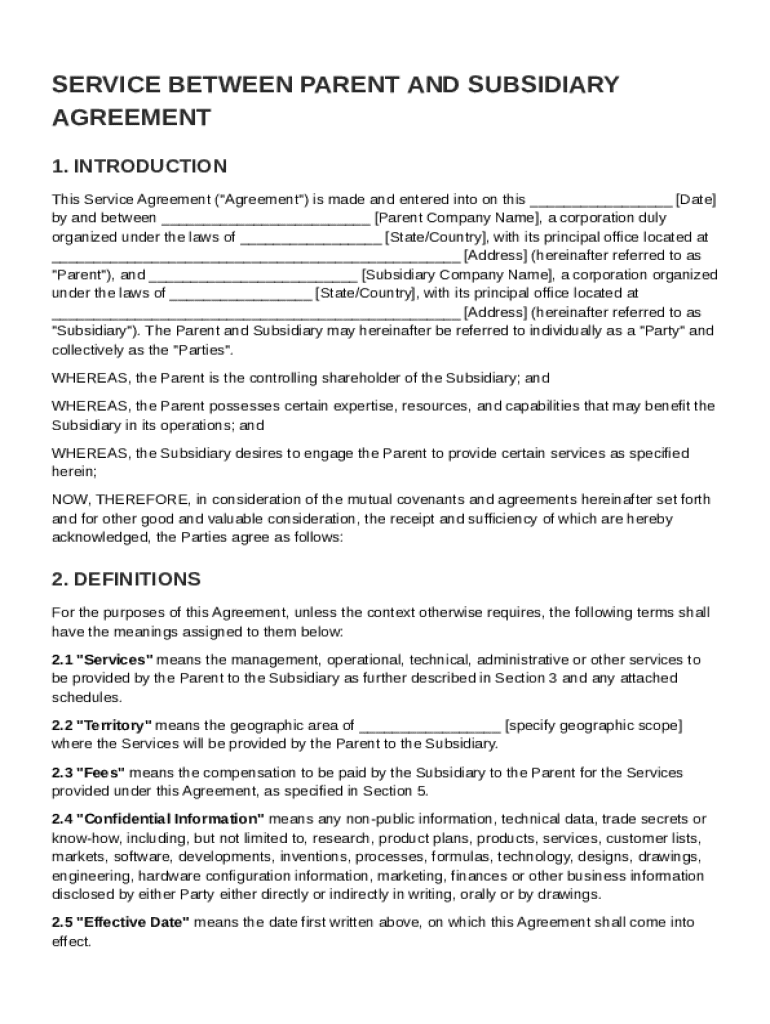
A Service Between Parent and Subsidiary Agreement Template is a formalized document detailing the terms and conditions under which a parent company provides services to its subsidiary entity. This template typically includes aspects like definitions of key terms, scope of services, compensation procedures, obligations of both parties, confidentiality clauses, indemnification provisions, and dispute resolution mechanisms. It establishes a legal and organizational framework ensuring that both the parent and the subsidiary are clear about their responsibilities and the expectations involved in their business collaboration.
Key Components
- Definitions: Clarifies terminology used in the document to prevent misunderstandings.
- Scope of Services: Outlines the specific services the parent company will provide to the subsidiary.
- Compensation Details: Specifies how and when payments for services will be made.
- Obligations: Lists the duties and responsibilities of both the parent company and the subsidiary.
- Confidentiality Provisions: Protects sensitive information exchanged between the parent and subsidiary.
- Indemnification: Determines liability for any losses or damages that may occur.
- Dispute Resolution: Describes the process for resolving disagreements.
Steps to Complete the Service Between Parent and Subsidiary Agreement Template
-
Gather Essential Information: Collect necessary details such as names, addresses, and legal identifiers of both the parent company and the subsidiary.
-
Define Services: Clearly describe the services that the parent company will provide to the subsidiary, ensuring comprehensiveness and clarity.
-
Set Compensation Terms: Agree on compensation terms, including the method of payment and any deadlines.
-
Determine Obligations: Specify the obligations of each party, ensuring both understand their responsibilities.
-
Include Legal Provisions: Add necessary legal clauses, such as confidentiality and indemnity, to safeguard interests.
-
Review and Validate: Both parties should review the document to ensure accuracy before signing.
-
Signature and Authentication: Acquire signatures from authorized representatives of both the parent company and subsidiary, possibly in the presence of a notary to authenticate the agreement.
Detailed Example Steps
- Create a draft agreement including all sections and get initial feedback.
- Revise based on feedback and proceed for legal review to ensure compliance.
- Finalize and distribute copies to relevant stakeholders.
Key Elements of the Service Between Parent and Subsidiary Agreement Template
Essential Clauses
- Definitions and Interpretation: Ensures every term used is understood in the right context.
- Service Scope: Details the specific activities and support the parent will provide.
- Payment and Billing: Includes the rate or fee structure, invoicing, and payment schedules.
- Role and Responsibilities: Defines what each party must accomplish to fulfill the agreement.
- Confidential Information: Safeguards any proprietary or sensitive information exchanged.
- Termination Conditions: Outlines under what circumstances the agreement can be concluded prematurely.
Provisions for Risk Management
- Indemnity: Protection against potential legal actions or claims.
- Force Majeure: Addresses unforeseen events preventing either party from fulfilling obligations.
- Governing Law: Establishes which state's laws will govern the agreement.
Who Typically Uses the Service Between Parent and Subsidiary Agreement Template
-
Large Corporations: Enterprises with multiple subsidiaries needing service agreements to streamline operations.
-
SMEs (Small and Medium-sized Enterprises): Growing businesses transitioning into a parent-subsidiary structure.
-
Legal and Financial Professionals: Specialists providing advisory services to corporate clients on structuring such agreements.


Practical Application
- Corporate Structure Management: Ensures well-defined service delivery across affiliated companies.
- Legal Compliance: Assists in maintaining structured interactions between parent companies and their subsidiaries.
Legal Use of the Service Between Parent and Subsidiary Agreement Template
Using this template involves understanding legal implications and ensuring compliance with relevant federal and state laws. It is essential to consider:
Legal Compliance
-
Regulatory Framework: The agreement must align with laws governing corporate relations, including intellectual property and data protection.
-
Jurisdictional Considerations: Adapting elements of the template depending on the operational jurisdictions of the parent and subsidiary.
Avoiding Legal Pitfalls
- Ensure clarity to prevent misinterpretation.
- Include a legal review to validate compliance and enforceability.
Examples of Using the Service Between Parent and Subsidiary Agreement Template
Scenario 1: Technology Company
A tech company offering IT services initiates an agreement with its subsidiary for on-site support and software maintenance.
Scenario 2: Manufacturing Firm
A parent manufacturing company provides facility management services to its subsidiary, detailing machinery maintenance schedules and staff support levels.
Scenario 3: Retail Chain
A retail conglomerate organizes centralized marketing services for its subsidiaries, outlining campaign strategies and promotional support specifics.
Important Terms Related to Service Between Parent and Subsidiary Agreement Template
- Parent Company: The primary organization controlling one or more subsidiaries.
- Subsidiary: A company controlled by the parent company.
- Service Agreement: Contract detailing the provision of services between entities.
- Indemnification: Compensation for potential losses.
- Confidentiality: Maintaining privacy over shared sensitive information.
Related Terminology
- Affiliate: A company with a minor interest as opposed to subsidiary control.
- Joint Venture: A business arrangement where two parties collaborate for a specific goal.
Business Types That Benefit Most From Service Between Parent and Subsidiary Agreement Template
- Multinational Corporations (MNCs): Ensures coherence across international branches.
- Conglomerates: Facilitates varied service offerings among diversified business units.
- Vertical Integration Models: Allows seamless operational interaction between different stages of production.
Example Sectors
- Finance: For centralizing administrative functions.
- Healthcare: Involving shared medical support services.
- Agriculture: Coordinated resource management across regional farming subsidiaries.