



Definition and Meaning of an Exit Plan Contract Template
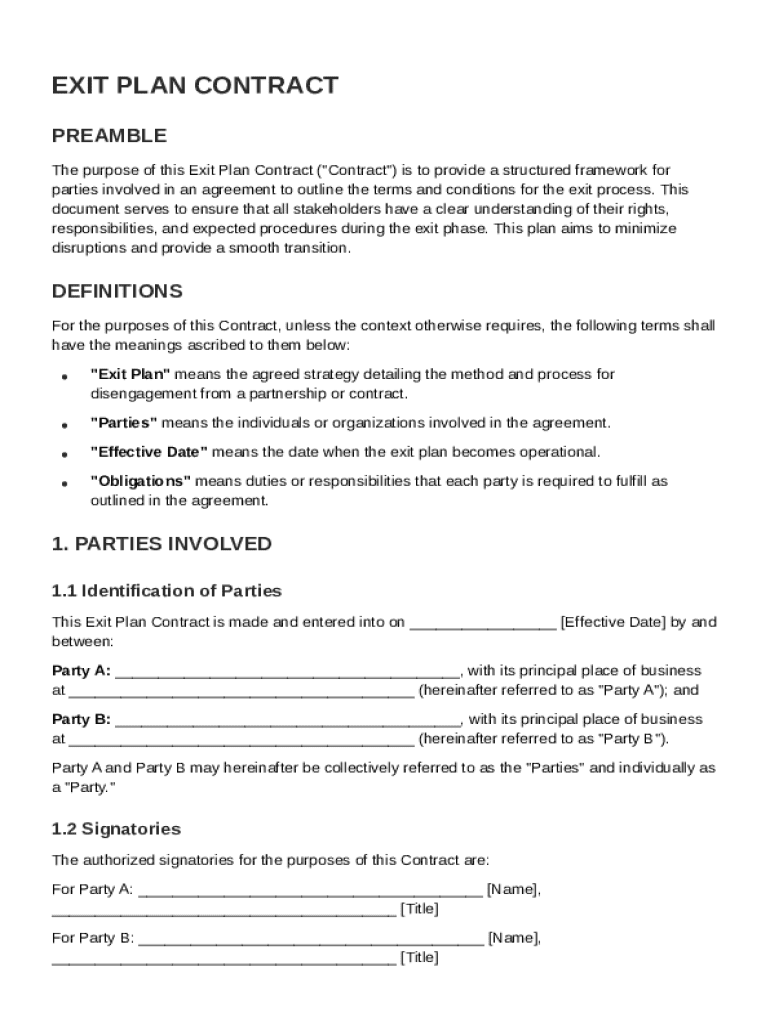
An Exit Plan Contract Template serves as a predefined framework to guide parties involved in an agreement through an organized exit or termination process. Its primary purpose is to provide clarity and structure regarding how to handle the disengagement of a contract, ensuring that all involved parties understand their obligations and rights. This contract template includes essential elements such as notice periods, compensation arrangements, asset distribution, confidentiality obligations, and dispute resolution procedures. Real-world application of this contract often involves business partnerships, employee agreements, or any long-term collaborations where formalized cessation ensures minimal disruption and legal compliance.
How to Use the Exit Plan Contract Template
Utilizing the Exit Plan Contract Template effectively requires familiarity with its structured sections and users' specific needs. To begin, parties should review all terms and conditions within the template to identify sections relevant to their particular agreement. It is crucial to modify these sections to reflect the precise details of the engagement being dissolved. Completing the template involves filling in information such as timelines for notice periods, amounts and conditions for payable compensation, and confidentiality requirements. The template can also serve as a communication tool to express mutual understanding and agreement on the exit terms, requiring each party's consent before finalization.
- Identify relevant sections that apply to your specific contract situation.
- Modify sections to reflect precise details of the termination agreement.
- Ensure all parties agree on compensation, confidentiality, and timelines.
How to Obtain an Exit Plan Contract Template
Exit Plan Contract Templates are accessible through various legal resources and document management platforms, including the DocHub suite. To obtain a template tailored to your needs, you can start by searching for industry-specific templates online or consulting with legal professionals who may provide these documents as part of their service offerings. Online platforms like DocHub offer templates that users can easily download and customize. Users can import these templates directly into the editing interface and begin personalizing the document to fit their specific contract cessation requirements.
- Search online for industry-specific templates.
- Use document platforms like DocHub to download and customize templates.
- Consult with legal professionals for tailored documents.
Steps to Complete the Exit Plan Contract Template
Completing an Exit Plan Contract Template involves several key steps to ensure all necessary information is accurately included. First, gather all relevant data, including the names of involved parties and any specific notice periods or monetary settlements. Next, customize the template sections to reflect the terms agreed upon during preliminary discussions. As each section is completed, review for accuracy and completeness, ensuring it meets legal standards and considers each party's needs. Lastly, both parties should review the contract together, making amendments where necessary before signing to confirm mutual agreement.
- Gather relevant data: parties' details, notice periods, settlements.
- Modify template sections to fit agreed terms.
- Review for accuracy and completeness.
- Conduct joint review for final amendments and signature.
Key Elements of the Exit Plan Contract Template
The Exit Plan Contract Template comprises several key elements that form the foundation of an effective and comprehensive exit agreement. These elements include:
- Notice Periods: Clearly define the required time frames for each party to announce their intention to exit the agreement.
- Compensation Details: Outline any monetary settlements or payments due upon termination of the contract.
- Asset Distribution: Specify how assets or property shared during the contract term will be divided among parties.
- Confidentiality Clauses: Ensure that sensitive information continues to be protected even after the contract concludes.
- Dispute Resolution: Establish procedures for handling disagreements or conflicts arising during or after the exit phase.
These elements are essential to reducing misunderstandings and ensuring a smooth departure from the contractual relationship.
Legal Use of the Exit Plan Contract Template
The legal use of an Exit Plan Contract Template requires adherence to jurisdictional laws and regulations that govern contract terminations. In the United States, this typically involves ensuring that the template complies with relevant state laws, offering protection to parties by clearly documenting each aspect of the exit process. The template serves as a legally binding document, provided that all parties sign and agree to the terms outlined within it. Legal professionals often review these contracts to confirm compliance and provide recourse should any party fail to adhere to the agreed provisions.
- Ensure compliance with state-specific laws related to contract terminations.
- Use as a legally binding document upon mutual agreement and signing.
- Consult legal advisors for review and validation.
Important Terms Related to the Exit Plan Contract Template
Several terms are critical to understanding and effectively using an Exit Plan Contract Template. These include:
- Breach of Contract: Refers to a violation of terms agreed within the contract, outlining potential penalties or remediation processes.
- Termination Clause: A provision within a contract specifying conditions under which the agreement can be terminated.
- Force Majeure: Circumstances beyond control that may impact contract execution or termination without liability.
- Arbitration: A method of dispute resolution agreed upon within the contract to settle disagreements outside court litigation.
Understanding these terms ensures parties can interpret the contract correctly, enhancing compliance and execution effectiveness.
State-Specific Rules for the Exit Plan Contract Template
Exit Plan Contracts may be subject to state-specific rules and interpretations, impacting their execution and enforceability. Different states within the United States have varying requirements for contract terminations, including specific notice periods or dispute resolution methods. Users must adapt the template to incorporate these local legalities, ensuring the contract remains valid within the appropriate jurisdiction. Consulting with legal professionals acquainted with state laws can help tailor the contract to meet specific legislative requirements, thus avoiding unintended legal complications.
- Adapt contracts to align with state-specific legal requirements.
- Consult legal professionals for state law expertise.
- Incorporate local nuances in notice periods and dispute methods.
By addressing these various components and ensuring all necessary elements are included and state-specific rules are adhered to, users can effectively navigate the creation and finalization of an Exit Plan Contract Template.