TAX ORGANIZER - CSI Group 2026

Get Form
TAX ORGANIZER - CSI Group Preview on Page 1

Here's how it works

01. Edit your form online
Type text, add images, blackout confidential details, add comments, highlights and more.

02. Sign it in a few clicks
Draw your signature, type it, upload its image, or use your mobile device as a signature pad.

03. Share your form with others
Send it via email, link, or fax. You can also download it, export it or print it out.

Definition and Meaning of the TAX ORGANIZER - CSI Group

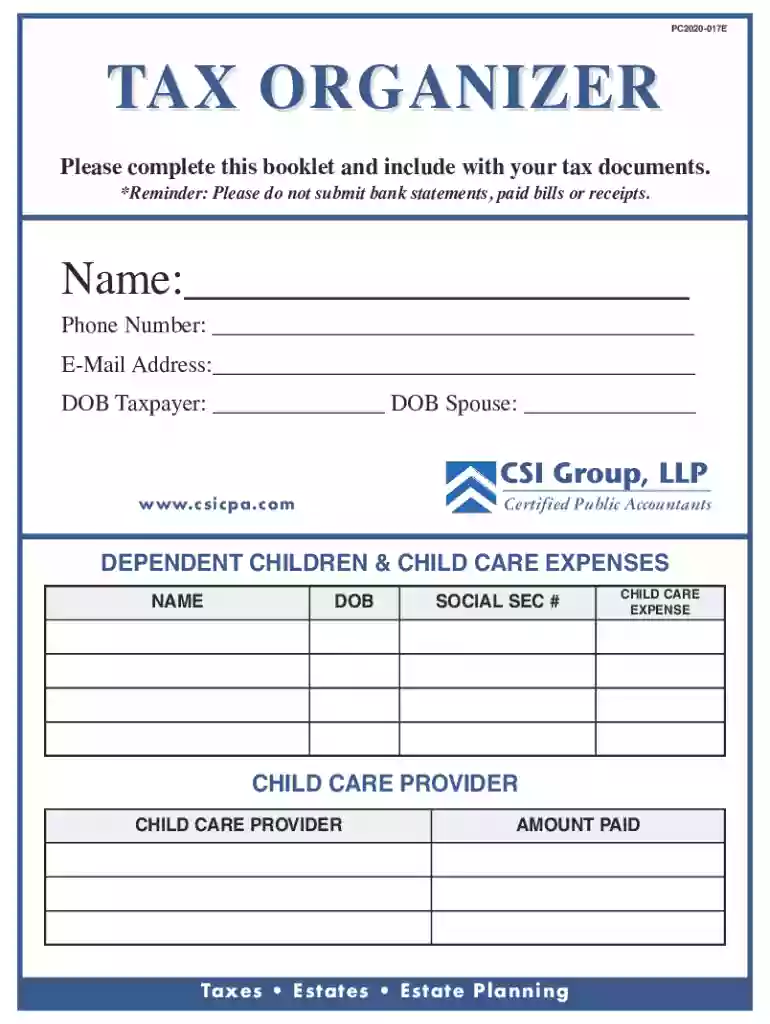
The TAX ORGANIZER by CSI Group, LLP, is a comprehensive document designed to streamline the tax preparation process for U.S.-based individuals. This organizer assists users in compiling necessary data for tax filing, reducing the risk of errors and omissions. It includes structured sections for personal information, dependent children, child care expenses, required income forms, deductions, and provides specific instructions tailored to self-employed individuals.

Key Steps to Use the TAX ORGANIZER - CSI Group

  1. Gather Personal Information: Ensure you have accurate personal details, including your Social Security number, full name, and contact information.
  2. Compile Income Documents: Collect W-2s, 1099s, and any other relevant income statements.
  3. List Dependents and Expenses: Document any dependent children and associated child care costs.
  4. Enter Deductions and Credits: Carefully record eligible deductions and credits, such as those for mortgage interest or educational expenses.
  5. Review and Self-Employed Instructions: Follow specific guidance if you are self-employed, ensuring deductions and income are accurately detailed.
  6. Final Review: Before submission, thoroughly check all entries for accuracy and completeness.

How to Obtain the TAX ORGANIZER - CSI Group

The TAX ORGANIZER can be obtained directly from CSI Group, LLP. Typically, it is distributed to clients as part of their tax preparation services. Individuals can request a copy via the CSI Group website or by contacting their office.

Required Documents for the TAX ORGANIZER - CSI Group

  • Personal Identification: Social Security numbers and identification for all filers.
  • Income Records: W-2s, 1099s, and income statements.
  • Deduction Documentation: Receipts for deductible expenses, including charitable contributions or medical expenses.
  • Child Care Records: Documentation of child care expenses for applicable credits.
  • Self-Employment Records: Business expenses and income records if applicable.

Importance of the TAX ORGANIZER - CSI Group

The TAX ORGANIZER is crucial for ensuring a comprehensive and organized approach to tax filing. It helps prevent common errors, such as missed deductions and incorrect forms, thus maximizing potential refunds or reducing liabilities. Its structured format provides clear guidance, ensuring that no essential information is overlooked.

Who Typically Uses the TAX ORGANIZER - CSI Group

This tax organizer is primarily used by individuals, especially those with complex tax situations involving multiple income streams, deductible expenses, or self-employment income. It's particularly beneficial for taxpayers with dependent children or those claiming specific credits and deductions.


decoration image ratings of Dochub

Legal Use of the TAX ORGANIZER - CSI Group

The TAX ORGANIZER is a legal document intended solely for the use of compiling data needed for U.S. tax filings. It should be used in accordance with federal and state tax laws, and all information provided must be truthful and accurate to comply with legal obligations and avoid potential penalties.

Filing Deadlines and Important Dates Related to TAX ORGANIZER - CSI Group

  • April 15: Standard deadline for filing federal taxes for individuals.
  • October 15: Extension deadline if a federal tax extension was filed by April 15.
  • January 31: Deadline for employers to send out W-2 forms to employees. These dates are crucial for ensuring timely submission and avoiding late fees or penalties.

Penalties for Non-Compliance

Failure to file accurate tax returns using the TAX ORGANIZER can result in significant penalties from the IRS. These may include fines, additional interest on outstanding tax amounts, and more severe consequences if fraud is detected. It is essential to ensure all information in the TAX ORGANIZER is complete and truthful.

be ready to get more

Complete this form in 5 minutes or less

Get form

Got questions?

We have answers to the most popular questions from our customers. If you can't find an answer to your question, please contact us.
Contact us
Resolution: You can Download the CSI file by following below mentioned steps: Step:1 Login to e-Filing portal using TAN as User ID. Step:2 Go to e-File e-Pay Tax Service. Step:3 On e-Pay Tax page click on Payment History tab.
Corporate social investments and tax.
A tax organizer is a client-facing document to help with the collection and submission of client information necessary to prepare a tax return. The individual income tax return organizer should be used with the preparation of Form 1040, U.S. Individual Income Tax Return.
Challan Status Inquiry (CSI) | Income Tax Department.
Challan Status Inquiry (CSI) FAQs.

Security and compliance

At DocHub, your data security is our priority. We follow HIPAA, SOC2, GDPR, and other standards, so you can work on your documents with confidence.
Learn more
ccpa2
pci-dss
gdpr-compliance
hipaa
soc-compliance

People also ask

An area of ongoing interest is the protection of confidential supervisory information (CSI), a term used by the banking agencies to refer to information that is prepared by, on behalf of, or for the use of financial regulatory agencies, including state or federal banking supervisors.
What are the main differences between a tax advisor and a CPA? Tax advisors specialize in tax law, planning, and compliance, focusing on strategies to minimize tax liabilities. CPAs offer a broader range of financial services, including auditing, financial planning, business consulting, and tax services.
Avoid These Common Tax Mistakes Not Claiming All of Your Credits and Deductions. Not Being Aware of Tax Considerations for the Military. Not Keeping Up with Your Paperwork. Not Double Checking Your Forms for Errors. Not Adhering to Filing Deadlines or Not Filing at All. Not Fixing Past Mistakes. Not Planning for Next Year.

Related links