
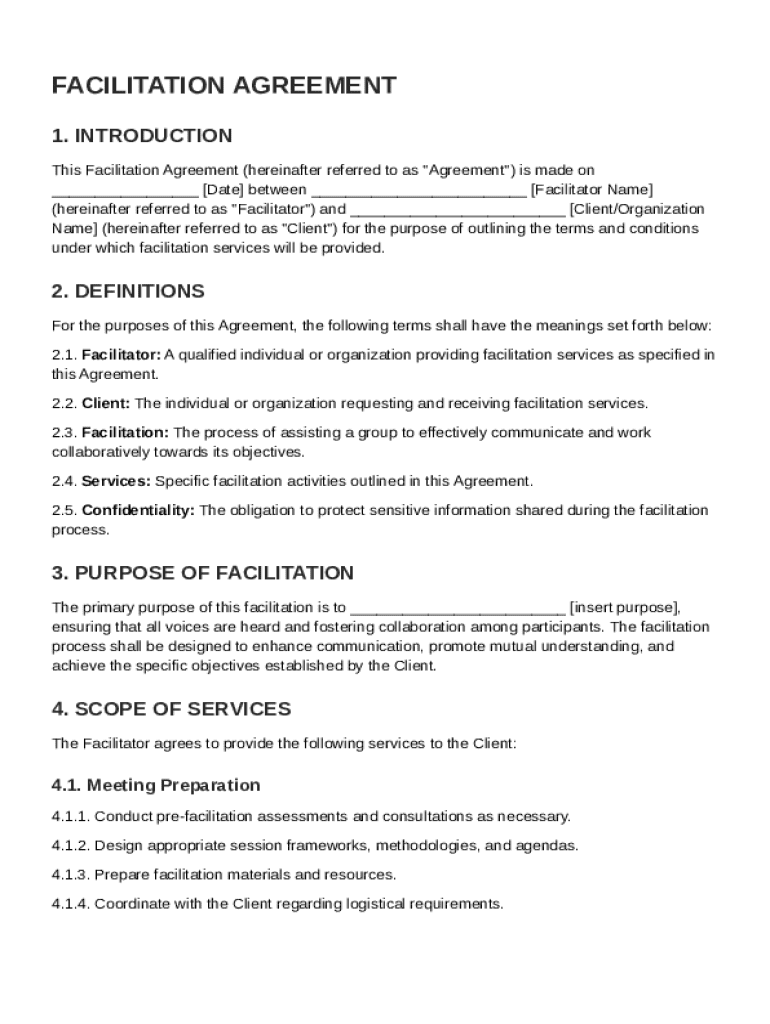







Definition and Meaning
A Facilitation Agreement Template serves as a comprehensive tool designed to outline and formalize the relationship between a facilitator and a client. This document specifies the roles and responsibilities of each party, ensuring a clear understanding and agreement on the services provided. It includes critical sections such as confidentiality provisions, compensation details, cancellation policies, duration, dispute resolution methods, and potential amendments. By clearly defining these elements, the template assists in establishing a framework for effective communication and collaboration during facilitated sessions.
Key Elements of the Facilitation Agreement Template
The Facilitation Agreement Template comprises several essential components that protect and clarify the interests of both the facilitator and the client:
- Purpose and Scope of Services: This section outlines what facilitation services will be provided, the context in which they are applied, and any limitations or specific conditions.
- Responsibilities of Parties: Both the facilitator and the client have distinct roles that need to be defined. Responsibilities such as preparation, delivery of materials, and participant engagement are typically included.
- Confidentiality Agreements: To protect sensitive information shared during facilitation, confidentiality provisions are included, covering the type of information considered confidential and any exceptions.
- Compensation and Payment Terms: Details about the facilitator's fees, payment schedule, and any additional costs or expenses are specified to ensure financial transparency.
- Amendments and Modifications: A clause that allows for adjustments to the agreement, contingent upon mutual consent, is crucial for maintaining its relevance and accuracy over time.
How to Use the Facilitation Agreement Template
Utilizing the Facilitation Agreement Template involves several straightforward steps to ensure its proper application:
- Review the Template: Begin by reading through the entire template to become acquainted with its structure and sections.
- Customizing Sections: Adapt sections such as scope of work, payment terms, and responsibilities to align with the specific needs of your facilitation service.
- Consult Legal Experts: For legal validation and to ensure compliance with local laws, consider consultation with legal professionals.
- Finalize and Sign: Once all parties agree on the terms, finalize the document with signatures from both the facilitator and client.
Important Terms Related to Facilitation Agreement Template
Understanding the terminology within the Facilitation Agreement Template is crucial:
- Facilitator: The individual or entity providing the facilitation services.
- Client: The entity or person receiving and utilizing the facilitation services.
- Confidential Information: Data or knowledge that is proprietary or sensitive in nature.
- Dispute Resolution: The methods agreed upon by the parties to resolve any disagreements.
Steps to Complete the Facilitation Agreement Template
Completing the Facilitation Agreement Template is a methodical process:
- Initial Information Gathering: Collect all necessary details, such as names, contact information, and project specifics.
- Drafting and Customizing: Using the template as a baseline, tailor each section to meet the parties' exact requirements.
- Review and Revise: Go through each section thoroughly to ensure that all terms align with the parties' expectations and any legal standards.
- Agreement and Signatures: Obtain the agreement and signature of both parties to validate the document.
Legal Use of the Facilitation Agreement Template
The Facilitation Agreement Template must be used in compliance with legal standards to ensure its enforceability:
- Adherence to U.S. Laws: Ensure that the agreement meets federal and state legal requirements specific to the jurisdiction in the United States.
- Legally Binding Nature: When properly executed, the agreement becomes legally binding, protecting both the facilitator’s and the client’s rights.
- Dispute Resolution Compliance: Incorporate established legal frameworks for resolving disputes to avoid costly litigation.
Examples of Using the Facilitation Agreement Template
The Facilitation Agreement Template is applied in various scenarios, each illustrating its adaptability:
- Corporate Training Workshops: Facilitators use the agreement to formalize services for conducting workshops within a business setting.
- Community Mediation Sessions: Community groups employ the template to clarify the facilitator’s role in managing disputes or discussions.
- Educational Seminars: In education settings, the agreement outlines the facilitator's responsibilities for leading seminars or focus groups.
State-Specific Rules for the Facilitation Agreement Template
While the Facilitation Agreement Template is broadly applicable, state variations can exist:
- State Restrictions on Confidentiality: Some states have specific requirements regarding the handling of confidential information, which should be reflected in the agreement.
- Jurisdiction of Dispute Resolution: The choice of law governing the agreement and the venue for dispute resolution can vary by state, and it’s important to tailor the template accordingly.
Business Types That Benefit Most from Facilitation Agreement Template
Different business entities profit from employing the Facilitation Agreement Template due to its adaptability:
- Corporate Enterprises: Large businesses frequently use these agreements to streamline processes for internal and external workshops.
- Non-Profit Organizations: These groups often need structured facilitation for strategic planning retreats.
- Small Businesses: For small business owners, the template helps in defining terms for consulting engagements efficiently.
By thoroughly covering these aspects, the Facilitation Agreement Template aids facilitators and clients in creating structured, clear, and legally compliant agreements tailored to their specific needs.




