
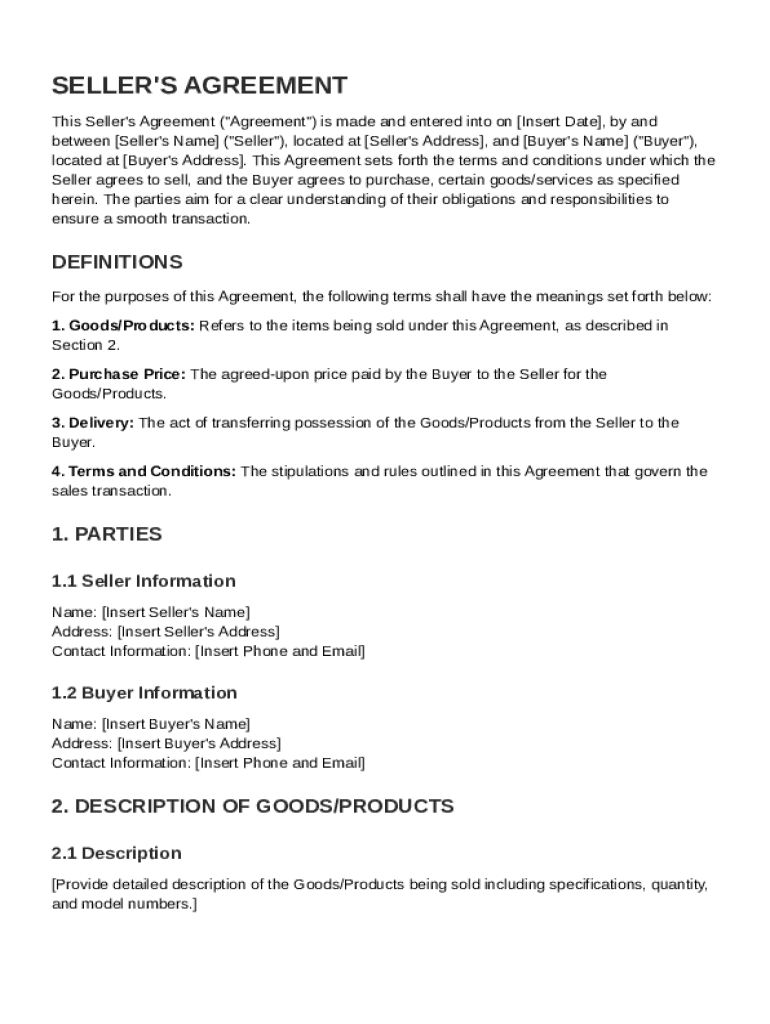







Definition and Meaning of Sellers Contract Template
A Seller's Contract Template, often referred to as a Seller's Agreement, is a formal document that outlines the terms and conditions agreed upon by a seller and a buyer in a sales transaction. It specifies details such as the products or goods being sold, the purchase price, payment terms, delivery methods, warranties, termination conditions, and applicable governing laws. The primary objective of this document is to ensure clarity and mutual understanding between the parties, thereby facilitating a smooth and conflict-free transaction. By delineating each party's rights and responsibilities, the Seller's Contract Template minimizes the potential for disputes and ensures both parties have clear expectations.
Key Elements of the Sellers Contract Template
The Seller's Contract Template includes several critical components that must be addressed to ensure a comprehensive agreement:
-
Description of Goods: A detailed description of the goods or products being sold is essential. This includes specifics like quantity, quality, and any special features or conditions.
-
Purchase Price and Payment Terms: Clearly state the agreed purchase price, currency, and payment terms. Payment terms might include upfront payments, deposits, installments, and deadlines for each payment phase.
-
Delivery Details: Specify the delivery method, shipping costs, timeline, and address. Include any responsibilities concerning the transfer of ownership or title.
-
Warranties: Outline any warranties provided with the goods. This section should cover the duration of the warranty and conditions under which it can be claimed.
-
Termination Conditions: Explain the conditions under which the agreement can be terminated by either party, including necessary notice periods and any related costs or penalties.
-
Governing Law: Indicate the jurisdiction whose laws will govern the contract. This is particularly important for interstate or international transactions.
Steps to Complete the Sellers Contract Template
Completing a Seller's Contract Template involves several steps to ensure that all necessary details are captured:
-
Gather Initial Information: Collect all relevant details about the transaction, including descriptions of the goods, the agreed-upon price, and delivery methods.
-
Fill Out Contract Sections: Using the template, fill in each section with the appropriate information. Be meticulous to prevent leaving out crucial details.
-
Review Terms and Conditions: Carefully review the terms and conditions to ensure they reflect mutually agreed-upon elements and protect your interests.
-
Seek Legal Review: It may be beneficial to have a legal professional review the contract to ensure its validity and enforceability, particularly for large or complex transactions.
-
Finalize and Sign: Once both parties are satisfied with the contract, each party should sign the document. Electronic signatures may be used if agreed by both sides.
Important Terms Related to Sellers Contract Template
Several terms are key to understanding and utilizing the Seller's Contract Template:
-
Offer and Acceptance: This principle forms the basis of contract formation, where one party proposes terms and the other accepts them.
-
Consideration: Refers to the value that each party agrees to exchange in the contract, typically involving the goods being sold and the payment received.
-
Liability: Describes the responsibilities and potential legal obligations of each party, especially in case of breach or issues arising from the transaction.
-
Confidentiality: May include clauses to protect proprietary information related to the transaction.
-
Force Majeure: A clause that excuses a party from fulfilling contractual obligations due to unforeseen events beyond their control, like natural disasters.
Legal Use of the Sellers Contract Template
The legality of using a Seller's Contract Template is contingent on proper formulation and adherence to applicable laws:
-
Compliance with Laws: The template should comply with relevant federal, state, and local laws, including commercial transaction regulations.
-
Enforceability: For a contract to be legally binding, it must include essential elements such as mutual consent, lawful purpose, and consideration.
-
Dispute Resolution: The contract may include provisions for dispute resolution, such as mediation or arbitration, which can be an efficient way to handle disagreements.
-
Electronic Signatures: Under the ESIGN Act, electronic signatures are legally recognized in the United States, offering a convenient option for contract execution.
Digital vs. Paper Version of the Sellers Contract Template
Choosing between a digital and a paper version of the Seller's Contract Template depends on various factors:
-
Accessibility: Digital contracts can be accessed, edited, and shared easily across different platforms and devices.
-
Storage and Retrieval: Electronic storage reduces the physical space requirement and allows for quick retrieval compared to paper documents.
-
Environmental Impact: Electronic documents contribute to reduced paper use, aligning with sustainability goals.
-
Security Measures: Digital contracts can use encryption and password protection to enhance security, though they also require vigilance against cyber threats.
Who Typically Uses the Sellers Contract Template
A variety of individuals and businesses may find the Seller's Contract Template beneficial:
-
Retailers and Wholesalers: Commonly use the template to document sales agreements for goods between suppliers and customers.
-
Manufacturers: May use it for transactions involving components or raw materials with distributors.
-
Service Providers: Although primarily for goods, the template can be adapted for service contracts with modifications pertinent to the nature of services provided.
-
End Consumers: Buyers and sellers in private transactions, such as sales of second-hand items, also use these contracts to formalize their agreements.


State-Specific Rules for the Sellers Contract Template
Understanding state-specific regulations is vital when drafting and utilizing the Seller's Contract Template in the U.S.:
-
Sales Tax Requirements: Different states have varying regulations regarding the collection and remittance of sales tax, which should be reflected in the contract.
-
Consumer Protection Laws: States may offer different protections for consumers, impacting return policies and warranties stipulated in the contract.
-
Contractual Formality Levels: States differ in terms of the formalities required for contracts. Some may require notarization or specific disclosures for validity.
Each state may impose additional requirements, so consulting with a legal expert familiar with local laws can ensure full compliance and enforceability of the agreement.




