




Definition and Meaning
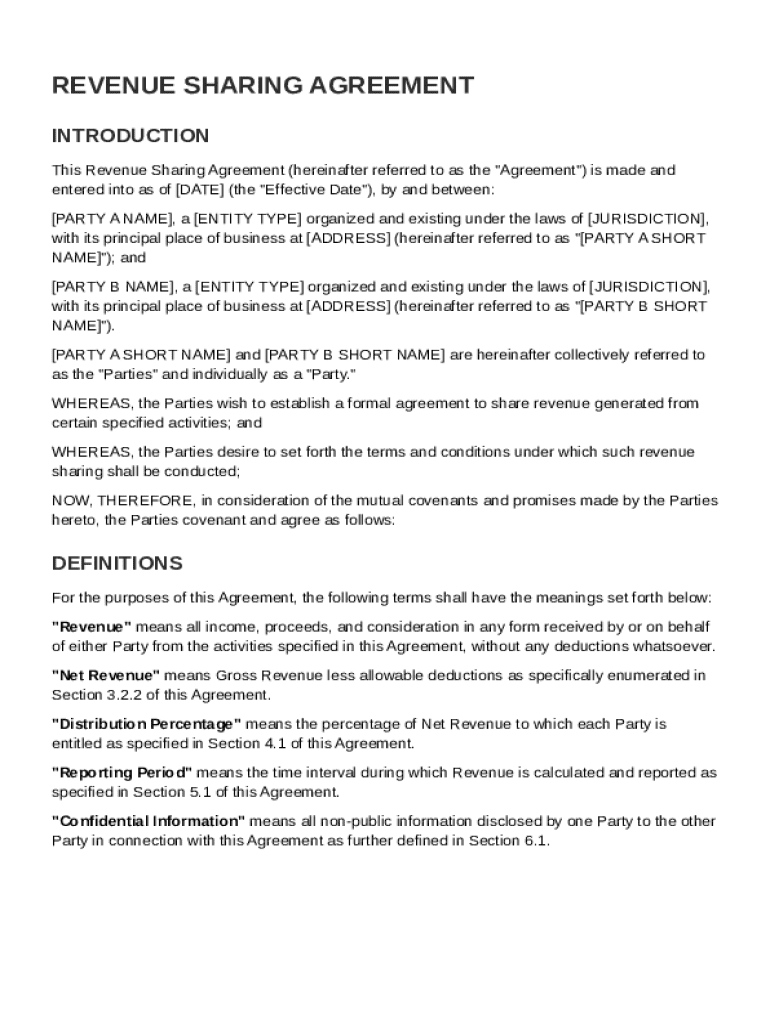
A Revenue Sharing Agreement Template is a legally binding document that outlines how parties involved will distribute revenue generated from specific activities or ventures. Typically, it involves two or more parties, each identified as Party A, Party B, etc., and defines concepts like 'Revenue', 'Net Revenue', and 'Distribution Percentage'. This framework clarifies how financial gains will be shared, ensuring all parties understand their financial responsibilities and benefits.
Key Concepts Explained
- Revenue: This is the total income generated by the activity before any costs or expenses are deducted.
- Net Revenue: It refers to the remaining revenue after costs, taxes, and other expenses have been subtracted.
- Distribution Percentage: This percentage outlines how the net revenue is split among the parties.
Setting precise definitions for these terms prevents misunderstandings and disputes between parties.
Key Elements of the Revenue Sharing Agreement Template
The template incorporates several essential components necessary for a comprehensive agreement. Every section is critical for ensuring clarity and fairness among all parties involved.
Roles and Responsibilities
- Party Obligations: Each party's duties, including financial contributions and operational roles, are clearly defined.
- Decision-Making Authority: How decisions affecting the revenue distribution are to be made, including voting rights or consensus requirements.
Financial Provisions
The financial aspects of the agreement include:
- Calculation Methods: Detailed explanation of how revenue and net revenue will be calculated.
- Payment Schedules: Specifies when and how payments will be disbursed among parties.
Reporting and Transparency
- Reporting Requirements: Specifies the frequency and format of financial reports that need to be shared among parties, promoting transparency.
- Audit Rights: Describes any rights to audit financial records to verify revenue distribution accuracy.
Steps to Complete the Revenue Sharing Agreement Template
Filling out the Revenue Sharing Agreement Template involves several sequential steps to ensure all necessary details are covered and agreed upon by all parties.
- Identify Parties Involved: Clearly list all parties, their contact information, and the role each will play.
- Define Revenue Terms: Specify key revenue terms, including how gross and net revenue are calculated.
- Detail Distribution Percentages: Agree on and document each party’s share of the revenue.
- Outline Responsibilities: Clearly outline each party's roles and responsibilities, as well as mutual obligations.
- Set Reporting Rules: Establish how and when financial reports will be distributed.
- Finalize and Sign: Once all parties agree on the terms, sign the document to make it legally binding.
Examples of Using the Revenue Sharing Agreement Template
Revenue Sharing Agreements are versatile and can be applied in various business scenarios.
Common Use Cases:
- Entertainment Industry: Actors and producers share box office or streaming revenues.
- Technology Partnerships: Tech companies collaborate to develop products, sharing the income from sales.
- Academic Research: Universities and companies partner on research projects, sharing profits from patents or innovations.
These examples reflect the flexibility of the template in accommodating diverse industry needs.
Legal Use of the Revenue Sharing Agreement Template
Revenue Sharing Agreements must comply with legal standards to ensure enforceability and avoid legal disputes.
Compliance Factors:
- Confidentiality Provisions: Protects sensitive business information from unauthorized disclosure.
- Dispute Resolution: Lists methods for resolving disagreements, possibly through arbitration or mediation.
- Termination Conditions: Outlines how the agreement can be terminated, including any penalties or notice periods required.
By fully understanding these legal components, parties can better safeguard their interests.
Important Terms Related to Revenue Sharing Agreement Template
Understanding specific terminologies within a Revenue Sharing Agreement is crucial for avoiding misinterpretations.
Essential Terms:
- Confidentiality: Refers to measures ensuring that sensitive financial information remains confidential.
- Force Majeure: This clause relieves parties from liability due to unforeseen events beyond their control.
- Indemnification: Specifies conditions under which one party will compensate the other for certain losses.
These terms ensure that the agreement covers all potential legal and operational issues.
Business Entity Types Benefiting from the Revenue Sharing Agreement Template
Different business structures can greatly benefit from implementing a Revenue Sharing Agreement.
Suitable Entities:
- Partnerships: Ideal for partners looking to clearly define profit-sharing arrangements.
- Joint Ventures: Useful for businesses collaborating on a single project or long-term endeavor.
- Limited Liability Companies (LLCs): Often use this framework to specify internal revenue distribution.
Using this agreement helps these entities clearly outline and protect financial rights and obligations.
State-Specific Rules for the Revenue Sharing Agreement Template
While the template is versatile, certain states may have specific requirements that should be considered.
Considerations:
- Regulatory Compliance: Stay updated with local regulations that might affect revenue sharing agreements.
- Additional Provisions: Some states may require additional context or clauses related to taxation or industry-specific laws.
Parties must consult legal professionals to ensure their agreement complies with state-specific norms and standards.