




01. Edit your form online
Type text, add images, blackout confidential details, add comments, highlights and more.

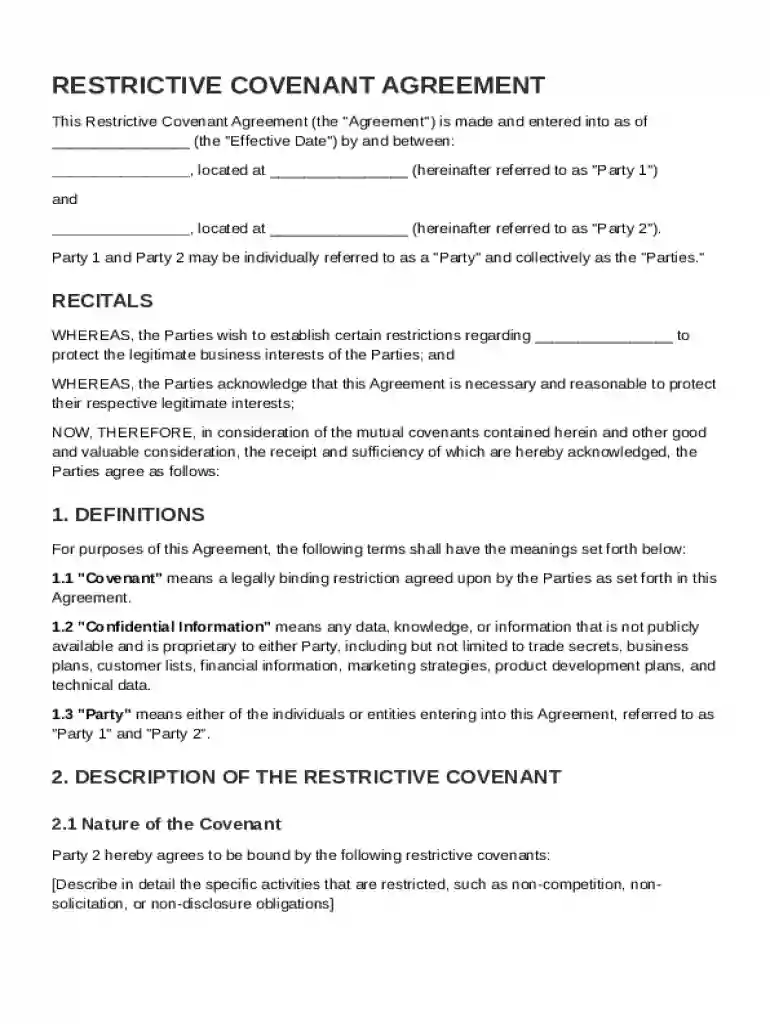
Type text, add images, blackout confidential details, add comments, highlights and more.

Draw your signature, type it, upload its image, or use your mobile device as a signature pad.

Send it via email, link, or fax. You can also download it, export it or print it out.
Restrictive Covenant Agreements are legal contracts that limit the actions of a party, typically an employee or business associate, to protect the business interests of another party. These agreements may include clauses that restrict competition, solicitation, and the disclosure of confidential information. They ensure that the contracted party does not engage in activities that could harm the legitimate business interests of the enforcing party. Common examples include non-compete agreements and non-disclosure agreements (NDAs). The structure and enforceability of these agreements depend on state laws and the specific terms outlined within the contract.
Using a Restrictive Covenant Agreement Template effectively involves several steps to ensure the document is comprehensive and legally binding:
Customization: Tailor the template to reflect the specific business relationship and the interests you intend to protect. This involves adding the correct details for each party involved and specifying the type of restrictions being enforced.
Legal Review: Consult with a legal professional to ensure the template complies with state laws and effectively protects your business interests without being overly restrictive to the point of unenforceability.
Execution and Storage: Once the agreement is signed by all involved parties, store the document securely, either digitally with encryption measures or in a physical format, and ensure all parties have access to a copy.
A comprehensive Restrictive Covenant Agreement Template should include several crucial elements to ensure its enforceability and clarity:
Definitions: Clearly define key terms used within the agreement to avoid ambiguity, ensuring both parties have a mutual understanding.
Obligations of Each Party: Outline what each party is required to do or abstain from doing. This includes any non-competition or non-solicitation clauses.
Restricted Period: Specify the duration for which the restrictions apply, which can vary depending on industry norms and specific business needs.
Governing Law Provisions: Indicate which state laws will govern the agreement, a crucial aspect that affects the interpretation and enforceability of the contract.
The legal use of Restrictive Covenant Agreement Templates involves ensuring that the restrictions imposed are reasonable and legitimate. Courts typically assess whether these terms protect a legitimate business interest, are reasonable in duration and geographic scope, and do not impose unnecessary hardship on the restricted party. For instance, a non-compete clause that lasts two years and covers a specific region may be enforceable, whereas an indefinite restriction covering a broad area might not be. Additionally, maintaining clear documentation of how the agreement was explained and agreed upon can prevent legal disputes.
Understanding the terminology used in these agreements is vital. Key terms include:
Non-Compete: A clause preventing a party from competing with their employer or business associate within a specific geographic area and time frame.
Non-Solicitation: Prohibits a party from soliciting clients, employees, or other business associates away from the enforcing party.
Confidentiality: Mandates a party to keep proprietary information private and not disclose it to third parties.
Restrictive Covenant Agreement Templates are commonly utilized by businesses across various industries to protect proprietary information and business interests. They are particularly prevalent in industries with high employee turnover or where sensitive information, such as customer lists and trade secrets, is a core aspect of the business. Employers may use these agreements to prevent employees from joining competitors or starting a rival business immediately after leaving. Similarly, corporations may use them when dealing with contractors or business partners to safeguard sensitive data and collaboration details.


The enforceability of Restrictive Covenant Agreements varies significantly across states due to differing legal standards. For instance, California largely prohibits non-compete clauses, rendering many agreements unenforceable, whereas states like Georgia have specific statutes that delineate the acceptable scope and enforcement measures for such agreements. It's crucial for businesses to understand the specific legal framework in their state when drafting these agreements to ensure they are enforceable and remain compliant with state laws.
Consider a technology company that frequently provides training to its staff. To ensure that this training doesn't end up benefiting competitors, they might employ restrictive covenants to mitigate this risk. For instance, employees may sign a non-compete agreement preventing them from joining a competitor for a particular time period after leaving the company. Another example involves a sales agency using non-solicitation clauses to prevent former employees from contacting their clientele, which ensures customer retention and protects business interests.
Completing a Restrictive Covenant Agreement Template involves several detailed steps:
Identify Parties: Clearly state the names and details of the parties involved in the agreement.
Outline Restrictions: Specify the actions that are restricted, such as engaging with competitors or disclosing confidential information.
Set the Term: Define the duration and geographical boundaries (if applicable) of the restrictive clauses.
Clarify Definitions: Provide clear definitions for all necessary legal terms and clauses to ensure mutual understanding.
Include Governing Law: Designate the jurisdiction's laws that will apply to the agreement.
Seek Legal Counsel: Review the agreement with a legal expert to ensure compliance and adequacy.
Sign and Secure: Gather signatures from all parties involved and ensure the document is stored securely for future reference.
At DocHub, your data security is our priority. We follow HIPAA, SOC2, GDPR, and other standards, so you can work on your documents with confidence.


May 1, 2020 (4) A short form easement or restrictive covenant runs with the land and is binding on the owners, from time to time, of lots in the strata
The covenants and restrictions set forth in this Declaration are intended to constitute a conservation agreement as defined by G.S. 121-35(1) in that the


