Definition and Meaning of an Account Service Contract Template
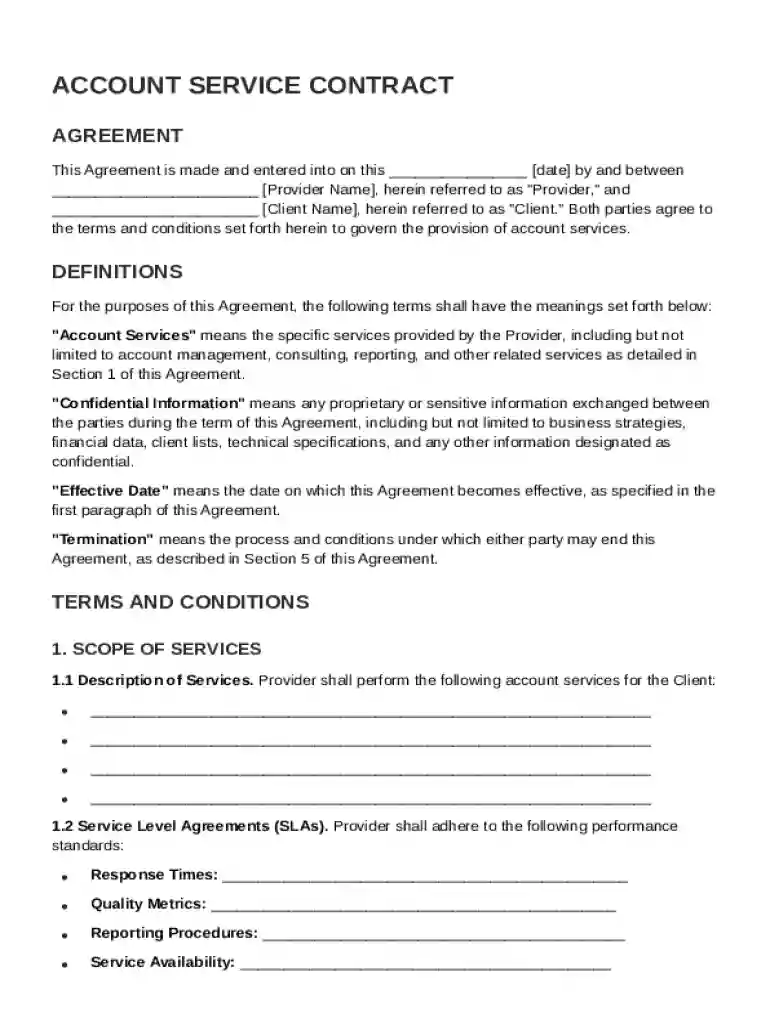
An Account Service Contract Template is a pre-structured agreement used by businesses and individual service providers to outline the terms and conditions related to the provision of account services. This template serves as a foundation for establishing a clear understanding between the Provider, who offers the service, and the Client, who receives the service. It details mutual responsibilities, fee structures, confidentiality obligations, and other essential elements of the business relationship. By using a standardized template, both parties can ensure that their contract covers all necessary legal and functional aspects, which helps to prevent misunderstandings and potential disputes.
Key Elements of the Account Service Contract Template
The Account Service Contract Template comprises several critical components that define the working relationship between the Provider and the Client.
- Definitions: Clearly defines key terms used within the contract, ensuring both parties understand their meanings and implications.
- Responsibilities of Parties: Outlines the specific duties and obligations of both the Provider and the Client, including service deliverables and timelines.
- Fee Structures: Details the compensation model, including payment schedules, invoicing procedures, and potential penalties for late payment.
- Confidentiality Obligations: Describes the measures both parties must take to protect sensitive information exchanged during the contract period.
- Termination Conditions: Specifies the conditions under which either party can terminate the contract, including notice periods and reasons for termination.
- Indemnification Clauses: Addresses how each party will handle liabilities and potential damages that could arise during the service period.
- Dispute Resolution Processes: Outlines the steps to be taken to resolve any disputes that may arise, including mediation or arbitration methods.
Steps to Complete the Account Service Contract Template
Crafting a well-defined Account Service Contract involves several detailed steps:
- Review the Template: Begin by thoroughly reviewing the template to familiarize yourself with its sections and content.
- Input Party Details: Fill in the names and contact information of the Provider and the Client.
- Define Services Offered: Clearly describe the account services that will be provided, including any specific methodologies or processes.
- Outline Deliverables: Specify the outputs or results expected from the service provision, and the criteria for assessing these deliverables.
- Set Payment Terms: Detail the agreed-upon fees, payment due dates, and acceptable payment methods.
- Establish Confidentiality Measures: Define the information regarded as confidential and the methods for safeguarding this data.
- Specify Termination Rights: Indicate the scenarios in which either party may lawfully terminate the agreement.
- Finalize and Sign: Once all sections are complete, both parties should review the contract for accuracy, make necessary amendments, and sign the document to make it legally binding.
Important Terms Related to the Account Service Contract Template
Understanding specific terminology is crucial for interpreting and using the Account Service Contract Template effectively.
- Provider: The entity or individual offering account services.
- Client: The recipient of the services specified in the contract.
- Deliverables: The tangible or intangible outcomes that result from the service provision.
- Confidential Information: Any sensitive data or proprietary knowledge that is exchanged during the service period.
- Liability: Legal responsibility for any loss or damage arising from the services rendered.
Legal Use of the Account Service Contract Template
The template ensures compliance with legal standards by including necessary clauses that safeguard the interests of both parties involved. It adheres to:
- Contract Law: Encompasses the legality of contracts, ensuring they fulfill requirements for offer, acceptance, consideration, and mutual consent.
- Data Protection Regulations: Focuses on maintaining confidentiality and managing sensitive personal data in compliance with laws such as GDPR or CCPA.
State-Specific Rules for the Account Service Contract Template
While the template provides a general basis for account service agreements, users must adapt it to comply with state-specific legal requirements and business practices.
- Local Regulations: Each state may have distinct regulations regarding service contracts, which must be adhered to.
- Tax Implications: State laws may influence the tax treatment of payments and service provisions.
- Dispute Resolution Variations: States may have different laws on arbitration or legal proceedings regarding contract disputes.
By adjusting the template to include these regional considerations, parties can ensure their contract is both compliant and enforceable.
Examples of Using the Account Service Contract Template
To illustrate how this template might be applied, consider these scenarios:
- Small Business Contracts: A small retail business hires an accounting firm to manage its financial records and uses the contract to outline payment terms and service deliverables.
- Consultancy Firms: A large consultancy firm employs an independent accountant to handle its clients’ financial audits, making use of the template to establish confidentiality obligations.
- Startup Financial Agreements: A startup company partners with a financial consultant to develop a business plan and uses the template to set performance metrics and reporting schedules.
These examples showcase the versatility and necessity of using a structured contract template in professional arrangements.