
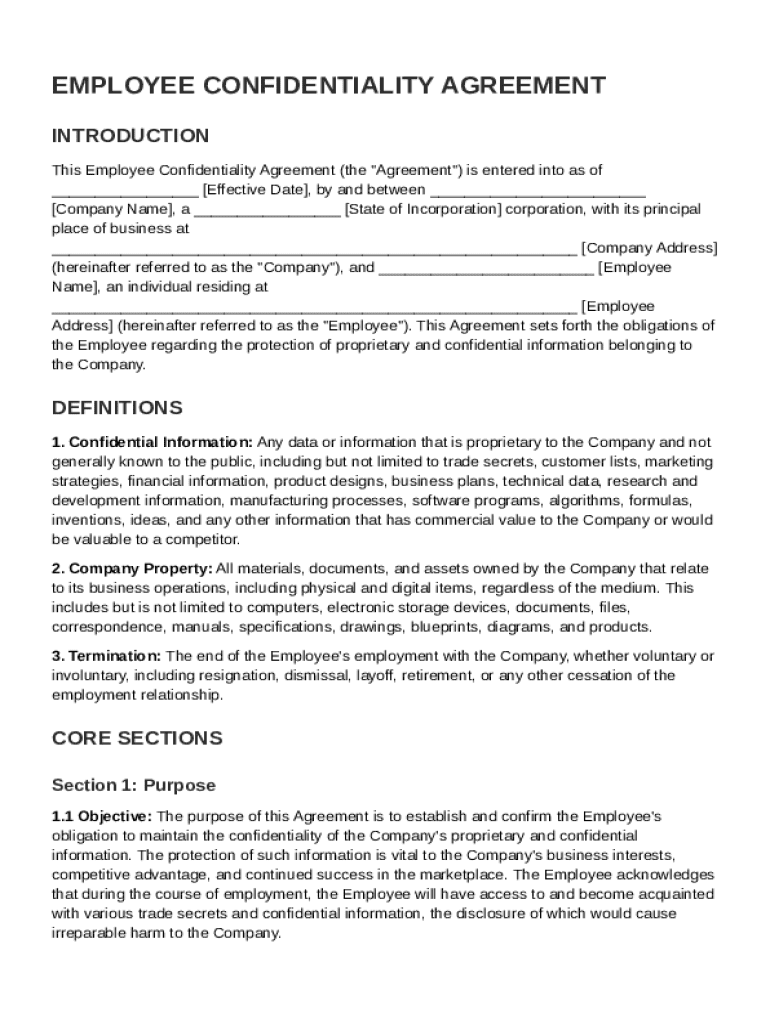







Definition and Purpose of an Employee Confidentiality Agreement
The Employee Confidentiality Agreement is a pivotal legal document that defines the responsibilities an employee has in safeguarding a company’s sensitive information. Known also as a non-disclosure agreement (NDA), this document delineates what constitutes 'confidential information,' such as trade secrets, client data, or proprietary systems. It is essential for ensuring that sensitive company data is not disclosed or utilized without permission. Employees are bound to protect the information both during and after their employment, ensuring ongoing compliance with confidentiality obligations.
Key Elements of the Employee Confidentiality Agreement Template
Identification of Confidential Information
- Clearly specifies what qualifies as confidential, including data about clients, financial records, and strategic plans.
- Ensures that employees understand the scope of what they are required to protect.
Duration of Obligations
- Outlines the time frame during which employees must adhere to confidentiality terms, often extending beyond the term of employment.
- Protects the company’s interests long-term by preventing post-employment leaks.
Employee Responsibilities
- Details the ways in which employees must handle confidential information, ensuring it is not disclosed or misused.
- Includes procedures for the physical and digital protection of sensitive data.
Exceptions to Confidentiality
- Lists situations where disclosure is legally permissible, such as in compliance with a court order or applicable laws.
- Provides a legal framework for employees to follow when encountering such exceptions.
How to Use the Employee Confidentiality Agreement Template
Customization
- Use the template as a starting point, modifying it to reflect the specific needs and industry of the company.
- Ensure that all definitions and obligations are clear to avoid misunderstandings and legal challenges.
Integration into Employment Onboarding
- Incorporate the signing of the agreement into the new employee onboarding process to emphasize its importance from the outset.
- Provide training to clarify the expectations and importance of confidentiality within the company culture.
Legal Use and Compliance
Governing Law
- The template should specify the jurisdiction under which the agreement is governed to resolve any legal disputes.
- Aligns with the applicable local, state, and federal laws to ensure enforceability.
Remedies for Breach
- Describes potential consequences for violating the terms of the agreement, including legal action or employment termination.
- Provides a clear consequence framework to deter breaches and protect company interests.
Examples of Using the Employee Confidentiality Agreement
- Tech Industry: A software company uses an NDA to protect its proprietary code and algorithms from being shared with competitors.
- Health Sector: A medical practice ensures that its patient's private data remains secure and undisclosed by mandating confidentiality agreements.
- Startups: A startup involved in developing new technology requires employees to sign an NDA to secure upcoming product details and strategic market plans.
Steps to Complete the Employee Confidentiality Agreement Template
- Review the Template: Familiarize yourself with the entire document to understand all provisions.
- Identify Specific Needs: Determine any unique requirements your company might have and adjust the template accordingly.
- Fill in Company-Specific Information: Include details such as company name, employee names, and scope of confidential information.
- Consult with Legal Counsel: Engage with legal professionals to ensure all aspects are compliant with local and federal laws.
- Distribute to Employees: Provide the document to employees for signature during onboarding.
- Collect and Store Signed Documents: Keep signed agreements in a secure file for future reference and auditing purposes.
State-Specific Rules for Employee Confidentiality
- In California, stronger restrictions are imposed on non-compete clauses within confidentiality agreements.
- Massachusetts has specific statutory criteria that define what constitutes trade secrets, which influences confidentiality terms.
- Each state may have distinct nuances; thus, it is crucial to adapt the template to align with state-specific regulations for full legal compliance.
Business Types That Benefit Most from Employee Confidentiality Agreements
Technology Companies
- Firms developing innovative solutions need NDAs to protect their intellectual property and ensure competitive advantage.
Healthcare Organizations
- Due to stringent privacy laws such as HIPAA, confidentiality agreements are crucial in safeguarding patient health information.
Financial Services
- Companies in the finance sector must protect sensitive client data and strategic investment information, making confidentiality agreements a necessity.




