






Definition & Meaning
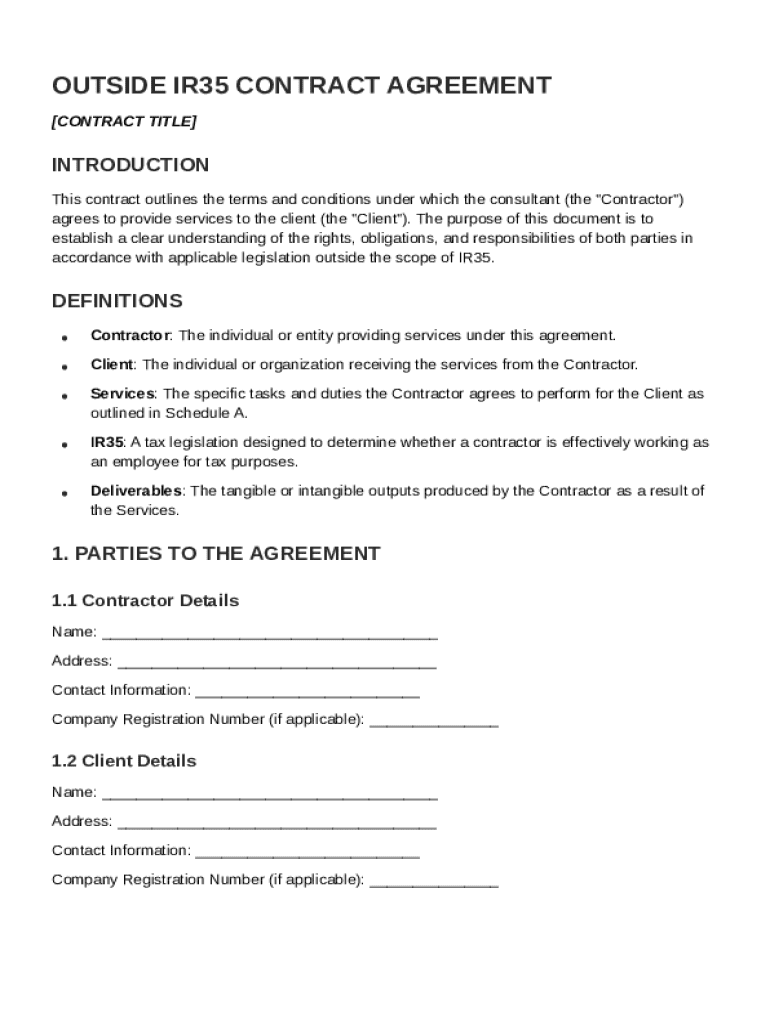
An Outside IR35 Contract Template is a document designed to outline the terms and conditions between a consultant or contractor providing services and a client. The key feature of this template is its compliance with the IR35 tax legislation in the United Kingdom, which determines the employment status and tax obligations of the contractor. By emphasizing the contractor's independence, such as control over working hours, the right of substitution, and the assumption of financial risk, the template establishes that the contractor's role is outside the scope of IR35. This means the contractor is considered to be self-employed for tax purposes, positioning them to maintain favorable tax treatment and avoid being taxed as an employee. Understanding the nuances of this template is essential for both parties to ensure compliance and protect their interests.
Key Elements of the Outside IR35 Contract Template
The Outside IR35 Contract Template includes several critical components that define the contractual relationship and underscore the contractor's independence:
-
Roles and Responsibilities: Clearly delineates the specific tasks and functions the contractor will perform, emphasizing control over their work.
-
Payment Terms: Outlines the method and schedule of payments, reinforcing the contractor's financial risk by avoiding fixed salary models.
-
Confidentiality and Intellectual Property: Addresses the ownership and use of confidential information and IP created during the contract tenure.
-
Right of Substitution: Establishes that the consultant can delegate tasks to a substitute, a significant factor in proving non-employee status.
-
Termination Clauses: Provides terms for contract cessation by either party, emphasizing flexibility indicative of an independent contractor relationship.
Legal Use of the Outside IR35 Contract Template
For the template to effectively demonstrate an outside IR35 status, it must be legally sound and align with current regulations. The contract must reflect the reality of the working relationship, where the contractor genuinely operates independently. Legal adherence often involves:
-
Accurate Representation: Ensuring all contract terms reflect the actual work practices and relationship dynamics.
-
Incorporation of Relevant Clauses: Including specific wording and clauses that explicitly state the contractor's autonomy and the lack of supervision or control.
-
Review by Legal Professionals: Having the contract evaluated by a legal expert familiar with IR35 to ensure it meets all regulatory and compliance requirements.
How to Use the Outside IR35 Contract Template
Utilizing the template effectively requires understanding each section's purpose and ensuring all information appropriately reflects the working arrangement. Steps include:
-
Customization: Tailor the template to specify the project's scope, deliverables, and the contractor's role in a manner consistent with an independent contractor status.
-
Validation: Engage with lawyers or tax professionals to verify the contract's compliance with IR35 and other applicable laws.
-
Finalization: Once reviewed and approved, both parties should thoroughly read and sign the agreement, retaining a copy for their records.
Steps to Complete the Outside IR35 Contract Template
Completing the template involves several critical steps focused on accuracy and clarity:
-
Fill in Contractor and Client Details: Ensure that both parties' names, addresses, and contact information are correctly recorded.
-
Define Scope of Work: Clearly articulate the tasks and services the contractor will provide, emphasizing their independence.
-
Specify Payment Terms: Describe how payments will be processed, citing amounts, dates, and any conditions tied to deliverables.
-
Outline the Right of Substitution: Explicitly mention the contractor's right to appoint a substitute if necessary, underlining their status as self-employed.
-
Review All Clauses: Go through each clause to ensure language consistency and legality.
-
Seek Legal Confirmation: Before signing, have the document assessed by a legal expert to confirm its adherence to outside IR35 criteria.
Who Typically Uses the Outside IR35 Contract Template
The template is commonly used by:
-
Independent Contractors and Consultants: Professionals aiming to maintain self-employed tax status while delivering services to various clients.
-
Companies and Businesses: Organizations seeking to hire contractors without the risks associated with reclassification under IR35.
-
Legal and Tax Advisory Firms: Entities that offer templates and guidance to clients on maintaining compliance with IR35.


Important Terms Related to Outside IR35 Contract Template
Several terms are critical to understanding the template's context:
-
IR35 Legislation: Tax rules aimed at preventing labor disguised as self-employment to avoid taxes.
-
Right of Substitution: A term allowing contractors to send a substitute, enhancing their independence claim.
-
Mutuality of Obligation: The obligation of employers to offer work and employees to accept work, which does not generally apply to contractors.
-
Financial Risk: Contractors assume business risk, such as expenses, reinforcing the self-employed status.
Examples of Using the Outside IR35 Contract Template
To illustrate real-world usage:
-
IT Consultants: An IT specialist helps a company implement a new system and dictates project milestones, working autonomously, only invoicing for time and materials rather than earning a fixed salary.
-
Marketing Professionals: A freelance marketer creates a campaign strategy for a client, maintaining the freedom to determine how and when work is performed, emphasizing autonomy through the template.
Business Types that Benefit Most from Outside IR35 Contract Template
Different businesses benefit from utilizing the template:
-
Startups and SMEs: These organizations favor flexible workforce arrangements that don't necessitate long-term employment commitments.
-
Professional Services Firms: Companies offering consulting, legal, or accounting services, often employing specialists on a contractual basis.
-
Creative Agencies: Agencies with variable project demands engage freelance designers, writers, and strategists using such contracts to safeguard both parties.