
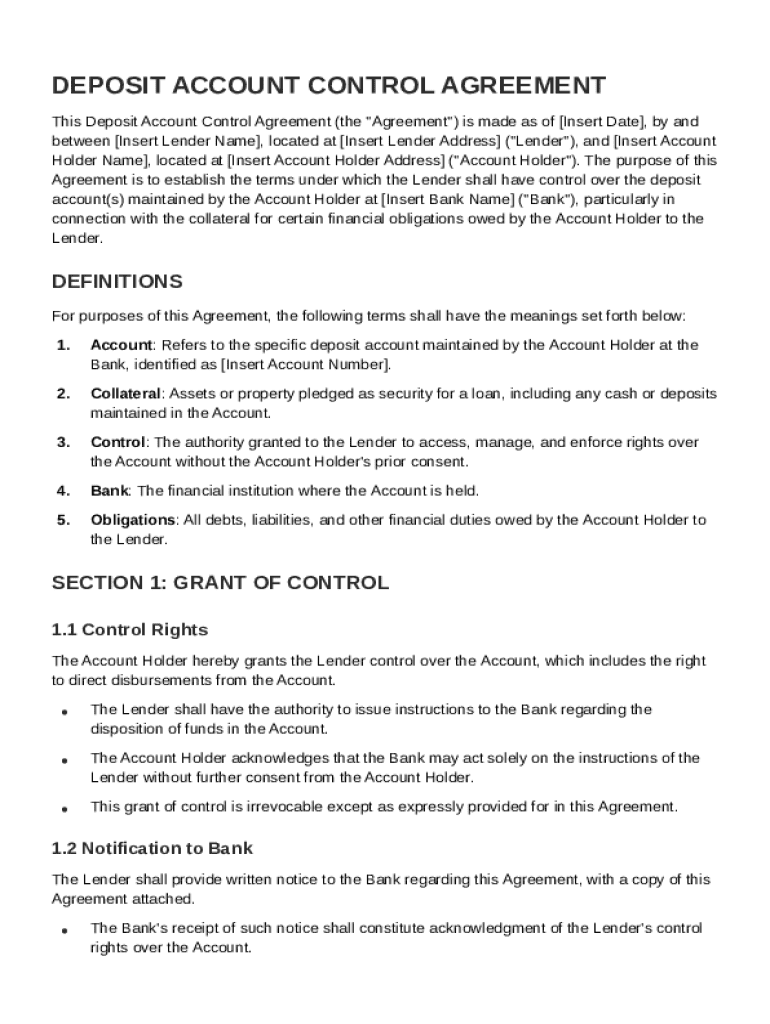







Definition & Meaning
A Deposit Account Control Agreement (DACA) is a legal document that establishes the terms and conditions under which a lender obtains control over a borrower's deposit account at a financial institution. The agreement primarily serves as collateral, protecting the lender's interests by allowing them to exercise control over the account in specific circumstances, typically related to default or failure to meet financial obligations. The DACA outlines the roles and responsibilities of the involved parties, including the lender, borrower, and bank, ensuring the lender can manage the account as needed without requiring the borrower's consent. This agreement is an essential tool in securing loans, particularly in commercial lending scenarios.
How to Use the Deposit Account Control Agreement Template
To effectively use the Deposit Account Control Agreement template, follow these steps:
-
Review the Template: Begin by thoroughly reviewing the template to understand its structure and components. Make note of sections that require customization.
-
Customize the Agreement: Enter specific details related to the lender, borrower, and bank involved. Ensure all financial and legal terms align with the agreed-upon terms between parties.
-
Define Control Provisions: Clearly define the conditions under which the lender can assume control of the account. This may include events of default or other predefined scenarios.
-
Obligations and Rights: Detail the obligations of each party, including the lender’s rights to access funds and the borrower's responsibilities regarding account activities.
-
Review and Revise: Collaborate with legal counsel to review the customized agreement. Ensure legal accuracy and compliance with relevant regulations.
-
Finalize and Execute: Once all parties agree to the terms, execute the document with signatures from authorized representatives.
Key Elements of the Deposit Account Control Agreement Template
The Deposit Account Control Agreement template includes several critical components:
-
Parties Involved: Identification of the lender, borrower, and depository bank, along with their respective roles.
-
Definitions and Terms: Clarification of key terms used within the agreement to avoid ambiguity.
-
Control Provisions: Detailed conditions under which control of the deposit account is transferred to the lender.
-
Rights and Responsibilities: Outline of each party's rights, duties, and responsibilities under various circumstances.
-
Default Events and Remedies: Specification of events that constitute a default and the remedies available to the lender.
-
Disbursement Instructions: Procedures for the release and allocation of funds from the account.
Legal Use of the Deposit Account Control Agreement Template
The Deposit Account Control Agreement must adhere to legal standards and be enforceable under applicable laws. Consider these factors:
-
Adherence to UCC Regulations: Ensure compliance with the Uniform Commercial Code (UCC), which governs secured transactions across the United States.
-
Joint Review by Legal Counsel: Have legal representatives from all parties review the agreement to assure legal integrity and mutual understanding.
-
Jurisdictional Considerations: Consider state-specific laws that may impact the structure and enforceability of the agreement, especially variations in contract laws.
Steps to Complete the Deposit Account Control Agreement Template
Completing a DACA involves several key steps:
-
Gather Necessary Information: Collect details regarding all parties involved, including account numbers, contact information, and key financial terms.
-
Customize the Template: Modify template sections to reflect the unique arrangements of the transaction between parties.
-
Draft Specific Conditions: Clearly outline control conditions, specifying exact circumstances that trigger the lender’s rights.
-
Review Drafts with Counsel: Conduct a legal review to ensure the document meets all requirements and is free of ambiguities.
-
Finalize the Document: Confirm all parties agree to the terms and clauses. Make any last-minute revisions if necessary.
-
Official Execution: Obtain signatures from authorized representatives of all involved parties and secure notarization if required.
Important Terms Related to Deposit Account Control Agreement Template
Several key terms are crucial to understanding the DACA:
-
Control: The lender's authority to revoke the borrower's rights over the deposit account, typically upon default.
-
Default: Events defined in the agreement, such as failure to meet repayment obligations, that allow the lender to take control of the account.
-
Secured Party: The lender who holds the interest and rights over the borrower's deposit account as collateral.
-
Debtor: The account holder who offers their deposit account as security.
Who Typically Uses the Deposit Account Control Agreement Template
The use of a DACA is prevalent among:
-
Lenders: Financial institutions that require security over a borrower's deposit account to manage lending risk.
-
Borrowers: Businesses or individuals offering their deposit account as collateral for securing a loan.
-
Corporate Entities: Companies involved in corporate lending, where significant sums are involved, and additional securities are required.


Examples of Using the Deposit Account Control Agreement Template
Consider these scenarios as examples of DACA usage:
-
Commercial Real Estate Loans: A lender requires a DACA to secure a loan extended to a real estate development firm, offering the firm’s deposit account as collateral.
-
Inventory Financing: A manufacturing company might use a DACA when securing financing for inventory purchase, allowing the lender to control funds if financial conditions are not met.
-
Merger and Acquisition Financing: In cases where a company is undergoing an acquisition, a DACA ensures that due financial commitments are secured by the deposit account in question.




