
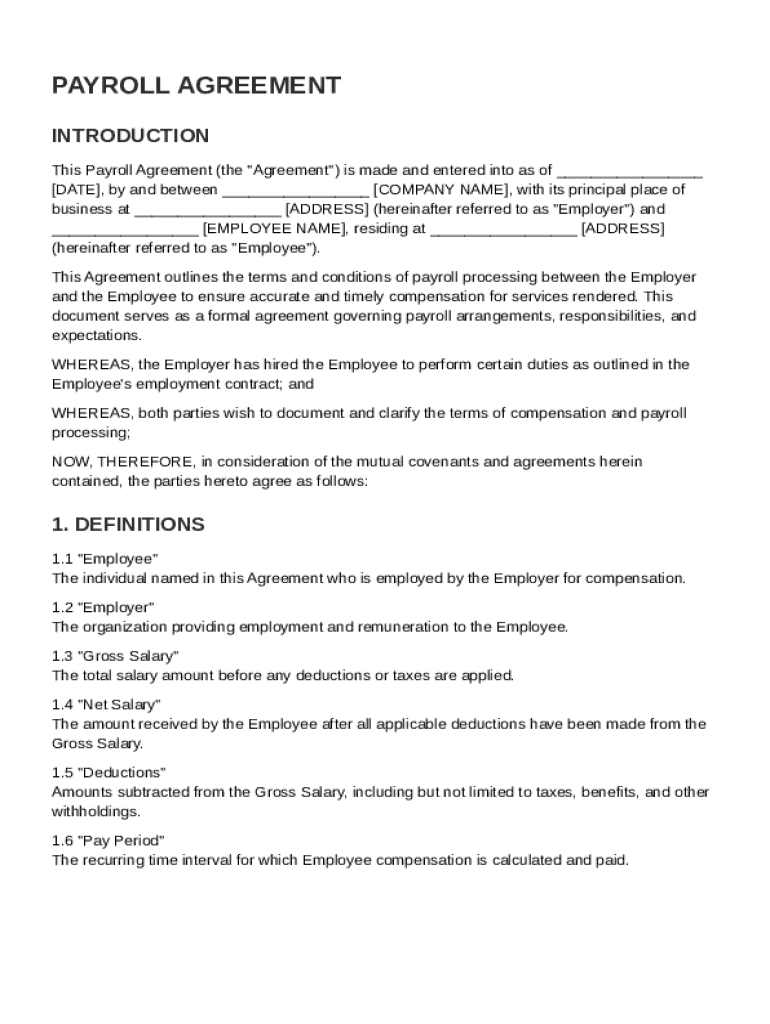







Definition and Meaning of a Payroll Agreement Template
A Payroll Agreement Template is a structured document used to outline the terms and conditions of payroll processing between an employer and an employee. This document serves to ensure that both parties clearly understand their roles and responsibilities related to compensation. The template generally includes sections detailing compensation types, frequency, deductions, responsibilities, amendments, termination procedures, and dispute resolution processes. It provides a clear framework for managing payroll operations in compliance with governing laws, offering assurance that the payroll process will be conducted accurately and efficiently.
How to Use the Payroll Agreement Template
Using a Payroll Agreement Template entails several steps to tailor it to an organization's specific needs. Initially, users should review the template to ensure that all sections are relevant to the employment agreement. This might involve customizing sections related to compensation, benefits, and deductions. Employers can fill in specific details such as employee names, employment terms, salary amounts, and any additional benefits. The standardized structure facilitates easier modifications and updates as employment terms change. Users should ensure that all relevant legal guidelines are integrated and the completed document is reviewed by legal counsel for compliance with applicable employment laws.
Customizing Sections
- Compensation breakdown: Define salary, bonuses, and hourly wages.
- Benefits and deductions: Specify healthcare contributions, 401(k) plans, and voluntary deductions.
- Employment terms: Detail start and end dates, probationary periods, and work schedules.
Key Elements of the Payroll Agreement Template
The Payroll Agreement Template contains several critical components that are necessary to maintain clarity and compliance:
- Compensation Details: Clearly outlines salary information, including frequency and method of payment.
- Deductions: Specifies mandatory and voluntary deductions such as taxes, insurance, and retirement contributions.
- Responsibilities: Details the responsibilities of both the employer and employee in the payroll process, ensuring both parties understand their obligations.
- Amendments and Terminations: Provides guidance on how changes can be made to the agreement and the procedures for terminating the agreement.
- Dispute Resolution: Establishes mechanisms for resolving disagreements or disputes related to payroll.
Legal Use of the Payroll Agreement Template
This template ensures legal compliance by including provisions that adhere to applicable employment and labor laws. It helps to mitigate legal risks related to payroll discrepancies by providing a legally binding record of agreed terms. Ensuring that the agreement incorporates relevant labor laws, such as those pertaining to overtime, minimum wage, and required notices, is crucial. Legal compliance also involves updating the template to reflect changes in laws or regulations and maintaining thorough documentation of agreement amendments.
Legal Compliance Considerations
- Adhere to state-specific labor laws and wage regulations.
- Incorporate clauses aligned with the Fair Labor Standards Act (FLSA).
- Ensure proper worker classification (e.g., exempt vs. non-exempt employees).
Steps to Complete the Payroll Agreement Template
Completing a Payroll Agreement Template involves a detailed process to ensure all necessary information is accurately captured:
- Review Template Structure: Familiarize yourself with the sections and ensure each is applicable.
- Fill in Employee Information: Input specific employee details, including name, position, and employment start date.
- Detail Compensation Terms: Clearly outline salary information, including bonuses, travel allowances, and overtime pay, if applicable.
- Specify Deductions and Benefits: List both mandatory and voluntary deductions, as well as employee benefits.
- Define Responsibilities: Ensure clarity in roles for both the employer and employee regarding payroll administration.
- Include Dispute Resolution Methods: Detail the process for handling payroll-related conflicts.
- Review and Sign: Ensure the document is reviewed for legal compliance and signed by all relevant parties.
Important Terms Related to the Payroll Agreement Template
Understanding specific terminology associated with payroll agreements is vital in ensuring comprehension and compliance:
- Gross Pay: The total salary before deductions.
- Net Pay: The take-home amount after all deductions.
- Exempt Employee: Employees who are not entitled to overtime pay under the FLSA.
- Non-exempt Employee: Employees eligible for overtime pay.
- Withholding Allowance: Reduces the amount of income tax to be withheld from an employee’s paycheck.
Business Types That Benefit Most from Payroll Agreement Template
Various types of businesses can maximize efficiency and accuracy with a Payroll Agreement Template. Small to medium-sized enterprises (SMEs), startups, and growing companies find these templates integral in establishing clear payroll practices. They are particularly beneficial for businesses with a structured payroll process where roles and salaries are well-defined. Companies operating across multiple states benefit from tailored templates that incorporate state-specific laws, ensuring compliance across different jurisdictions.
Specific Business Advantages
- SMEs: Streamlined payroll management for limited HR resources.
- Startups: Clearly defined compensation terms attractive to new hires.
- Multi-State Operations: Templates adjusted per state regulations ensure comprehensive compliance.
State-Specific Rules for the Payroll Agreement Template
Payroll agreements can vary significantly depending on state-specific employment and labor laws. These differences can pertain to minimum wage requirements, overtime calculations, and specific employee protections. Employers must adjust their agreement templates to comply with the various laws applicable in each state of operation. This requires detailed research into state labor codes and periodic reviews to remain up to date with legal changes.
Examples of State Variations
- California: Requires detailed record-keeping and specific overtime regulations.
- New York: Mandates regular wage notifications and distinct requirements for different worker classifications.
- Texas: Emphasis on at-will employment clauses and fewer state-specific payroll regulations.




