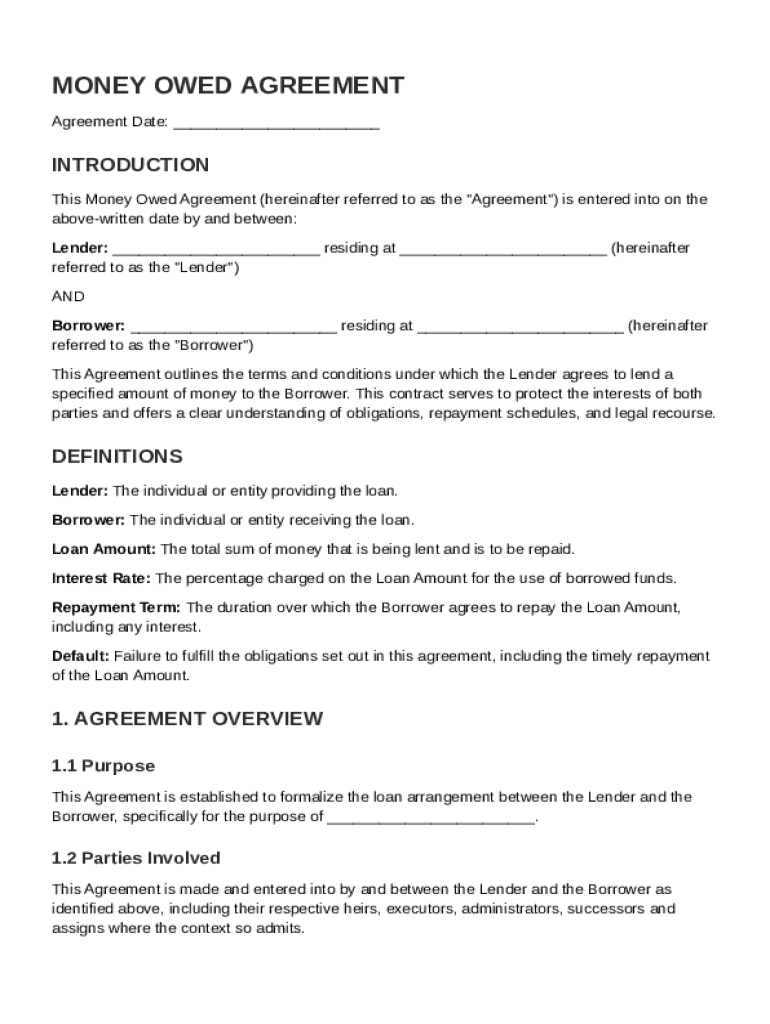







Definition and Meaning of the Money Owed Contract Template
The Money Owed Contract Template is a formal legal document used to specify the terms of a loan agreement between a lender and a borrower. This template is critical in documenting the essential components of the agreement, such as the loan amount, interest rate, and repayment schedule. By clearly outlining the rights and responsibilities of both parties involved, the template serves to prevent misunderstandings and disputes. It also sets parameters for default conditions and the consequences of non-payment. This contract captures the legal obligations under the jurisdiction's applicable laws, facilitating a mutual understanding between the borrower and lender.
Key Elements of the Money Owed Contract Template
The contract encompasses several pivotal sections to establish a comprehensive agreement:
-
Loan Amount and Interest Rate: Clearly states the principal amount loaned and the agreed-upon interest rate, ensuring both parties have a mutual understanding of the financial terms.
-
Repayment Schedule: Defines the timeline and mechanism for repayment, including the specific dates and amounts, aligning with the borrower's capacity and the lender's expectations.
-
Default Conditions and Remedies: Outlines what constitutes a default scenario and the resulting legal or financial consequences, allowing parties to preemptively address potential breaches.
-
Governing Law and Dispute Resolution: Specifies the legal jurisdiction governing the contract and outlines methods for resolving disputes, such as arbitration or mediation, to provide a framework for handling disagreements.
How to Use the Money Owed Contract Template
Utilizing this template involves a series of structured steps to ensure all relevant information is accurately captured and documented:
-
Gather Required Information: Collect essential data such as personal and financial details of both parties, the agreed-upon loan amount, and terms of repayment.
-
Fill in Template Details: Enter the gathered information into the template, ensuring clarity and accuracy across all sections. Include all necessary legal language to protect both parties' interests.
-
Review and Adjust Terms: Evaluate the terms outlined to make sure they reflect the agreement accurately. Adjust any clauses that may not align with the original intent.
-
Obtain Signatures: The contract becomes legally binding once both parties have signed it. Consider using DocHub's electronic signature feature for convenience and legality.
-
Distribute Completed Contract: Ensure that both parties receive copies of the signed contract, stored securely for future reference.
Who Typically Uses the Money Owed Contract Template
This template is vital for a broad spectrum of users:
-
Individuals: People who lend or borrow money informally from friends or family.
-
Businesses: Companies issuing loans to employees or other businesses to support financial transactions.
-
Financial Institutions: Banks and credit unions often require such formal agreements for small private loans.
-
Legal Professionals: Attorneys drafting or reviewing loan agreements on behalf of clients.
The Money Owed Contract Template serves a diverse audience by providing a structured format that accommodates varying lending and borrowing needs.


Important Terms Related to the Money Owed Contract Template
Understanding specific terminology is crucial for both parties engaging with this template:
-
Promissory Note: A legal instrument in which one party promises in writing to pay a determinate sum of money to the other.
-
Secured vs. Unsecured Loan: Security status of the loan, indicating whether it is backed by collateral.
-
Amortization: The process of gradually paying off a debt over time through regular payments.
-
Acceleration Clause: A provision that allows the lender to demand early repayment in certain circumstances.
Legal Use of the Money Owed Contract Template
The document's legal robustness ensures enforceability in a court of law, covering:
-
Compliance with State Laws: The contract requires adherence to the laws of the state governing the loan, maximizing legal enforceability.
-
Legally Binding Signatures: The inclusion of signatures from both parties transforms the contract into a legal obligation.
-
Clear Definition of Rights and Obligations: It clearly distinguishes what each party is entitled to and responsible for, reducing legal risks.
How to Obtain the Money Owed Contract Template
Accessing this contract template can be straightforward through various avenues:
-
Online Platforms: Legal document websites like DocHub provide instant access to customizable templates.
-
Legal Advisors: Attorneys can supply and tailor a template to align with specific needs.
-
Software Tools: Document management systems often include built-in templates for diverse legal needs.
Examples of Using the Money Owed Contract Template
Practical scenarios where this template proves invaluable include:
-
Family Loans: Documenting informal loans between family members to maintain transparency and accountability.
-
Startup Business Financing: Ensuring that funding agreements between investors and fledgling companies are clearly stated and legally documented.
-
Debt Consolidation: Recasting multiple debts with differing terms into a single loan agreement, simplifying repayment and formalizing the process.
These examples illustrate how the template can adapt to various contexts and needs, providing a reliable framework for financial agreements.