





Definition and Meaning of Intercompany Between Parent and Subsidiary Agreement Template
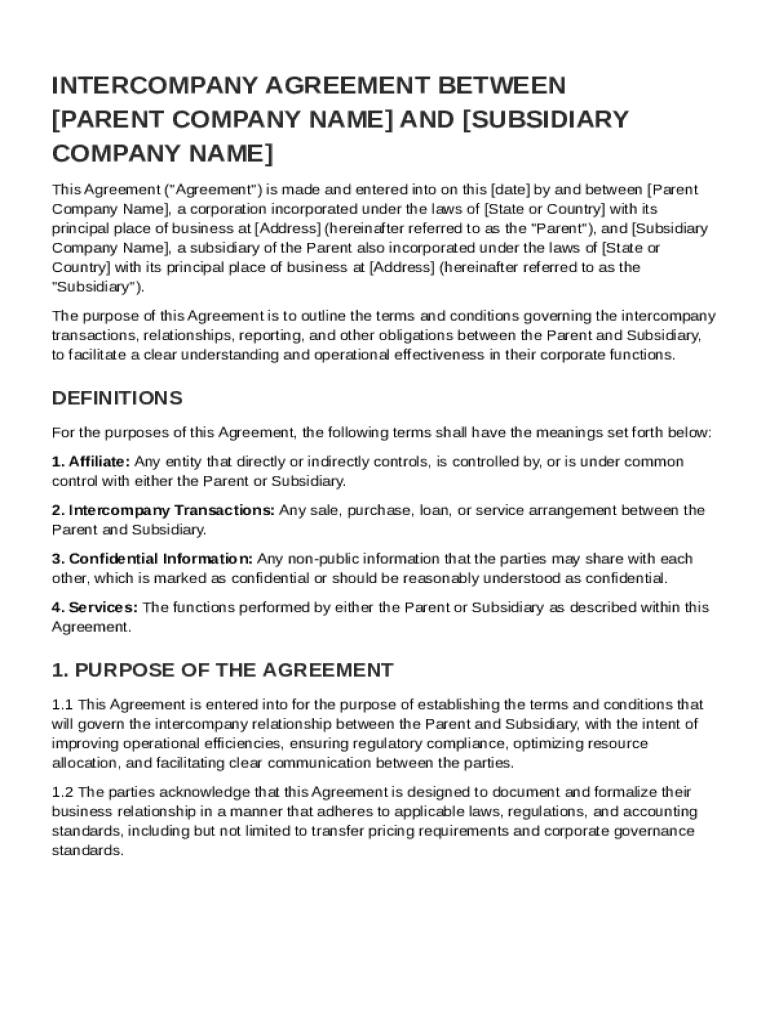
An Intercompany Between Parent and Subsidiary Agreement Template is a structured document used to outline the specific terms and conditions governing transactions, relationships, and obligations between a parent company and its subsidiary. This template serves to enhance operational efficiency and ensure compliance with legal and fiscal regulations, particularly focusing on tax laws such as those dictated by the Internal Revenue Service (IRS) in the United States. By clearly defining key aspects such as transaction principles, pricing models, confidentiality, and indemnification, it facilitates clear communication and mitigates potential risks in intercompany dealings.
Key Components
- Definitions of Terms: Critical terms used throughout the agreement should be explicitly defined to ensure clarity and mutual understanding.
- Scope of Services: Detailed descriptions of the services or products exchanged between the parent and subsidiary, their nature, and expected outcomes.
- Transaction Principles: The framework for pricing transactions based on arm's length standards, ensuring fair market value in dealings.
- Reporting Requirements: Specifies documentation and reporting obligations needed to satisfy regulatory compliance.
Steps to Complete the Intercompany Between Parent and Subsidiary Agreement Template
Completing an Intercompany Between Parent and Subsidiary Agreement Template requires careful attention to ensure all necessary legal and business considerations are addressed.
- Gather Necessary Information: Begin by collecting essential details about the parent company, subsidiary entities, and the scope of their interactions.
- Define Terms and Conditions: Clearly establish the terms, conditions, duties, and responsibilities of each party involved.
- Legal Review: Have a legal expert review the draft to ensure compliance with applicable laws and regulations, minimizing potential legal risks.
- Stakeholder Input: Gather insights from key stakeholders and management teams of both entities to identify any additional considerations.
- Finalization and Agreement: Once all parties agree on the terms, the document should be signed and dated by authorized representatives of both companies.
Common Pitfalls
- Vague Definitions: Ensure all critical terms are precisely defined to avoid ambiguities.
- Inadequate Compliance Measures: Regularly update the document to reflect current legal standards and IRS guidelines.
Key Elements of the Intercompany Between Parent and Subsidiary Agreement Template
Transaction Pricing and Principles
A core feature of the agreement involves transaction principles adhering to arm's length pricing, which protects against transfer pricing issues. This involves:
- Comparable Uncontrolled Price (CUP) Method: Establishes pricing by comparing it with similar transactions between unrelated parties.
- Cost Plus Method: Determines prices based on costs incurred, plus a reasonable profit margin.
Confidentiality and Indemnity Clauses
These provisions are critical in protecting proprietary information and assigning liabilities:
- Confidentiality Agreements: Protect sensitive data and intellectual property shared during intercompany transactions.
- Indemnification Clauses: Specify the responsibilities of each party in case of legal claims or financial losses.
Legal Use and Compliance for the Template
Adhering to the legal framework is paramount when using this template. The primary considerations include:
- Regulatory Compliance: Ensure agreement terms align with federal and state regulations.
- Tax Implications: Evaluate the tax liabilities and obligations associated with intercompany transactions.
State-Specific Considerations
Some states may have specific rules regarding intercompany agreements, such as:
- State Tax Regulations: Different states may have distinct methods of calculating state taxes for intercompany transactions.
- Registration and Reporting: Compliance with state-specific business registration and reporting requirements.
Practical Examples of Using the Agreement Template
Scenario: Cost Allocation between Entities
A technology company might use the agreement to specify how software development costs are allocated across regions, ensuring each subsidiary carries its fair share.
- Background: A parent tech firm and its software development subsidiary decide on cost-sharing for R&D.
- Implementation: The agreement would specify cost allocation methods and outline reimbursement processes.
Scenario: Shared Services Agreement
In instances where administrative services like HR, legal, or IT support are centralized:
- Process: The template would determine service costs and describe qualitative service delivery measures.
Variations and Edge Cases
- Multi-Jurisdictional Companies: Address currency exchange rates and international tax issues.
- Intercompany Loans: Include interest rate agreements and repayment schedules tailored to corporate tax advantages.
Who Typically Uses the Intercompany Between Parent and Subsidiary Agreement Template

Common Users
- Multinational Corporations: Often engage in numerous intercompany transactions across borders.
- Holding Companies: Use these agreements to manage subsidiaries systematically.

Business Entity Relevance
- Corporations vs. LLCs: Tailoring the template to address either C-Corp stringent guidelines or the flexibility associated with LLCs.
Required Documents for Completing the Template
When preparing the Intercompany Between Parent and Subsidiary Agreement Template, collect:
- Financial Statements: To support transaction pricing models.
- Business Licenses: Validate the operational legitimacy of both entities.
- Corporate Bylaws: Provide foundational governance context.
Additional Documentation
- Transfer Pricing Documentation: Ensures compliance with IRS standards.
- Board Resolutions: Approve significant intercompany strategies or changes within the agreement.
Digital vs. Paper Versions of the Agreement Template
Opting between digital or paper formats depends on various factors:
Advantages of Digital Versions
- Efficiency: Electronic sign-offs are quicker, enabling real-time collaboration.
- Reduced Errors: Automated data entry and correction features minimize errors.
Benefits of Paper Formats
- Historical Record: Provides tangible documentation for audits.
- Preference by Some Entities: Certain legal stipulations may necessitate hard copies for enforceability.
Software Compatibility
Ensure your document is compatible with software like DocHub for efficiency:
- Support Wide Range of Formats: From PDF to DOCX for flexibility in preparation and review processes.
- Integration with Document Management Systems: Ensures seamless storage and retrieval within corporate systems.