






Definition and Meaning of a Business-to-Business Agreement
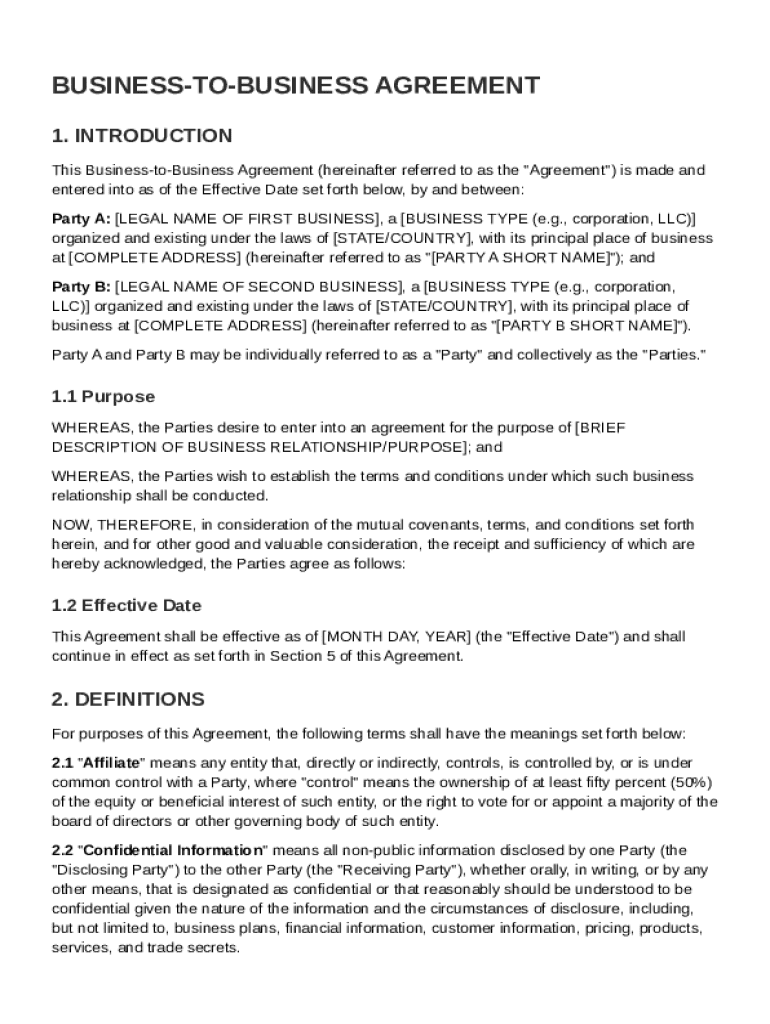
A Business-to-Business Agreement, often referred to as a B2B agreement, is a legally binding contract between two companies. These agreements are essential for outlining the terms and conditions of a business relationship, providing clarity and setting expectations for both parties involved. They encompass a variety of business operations, including product sales, licensing, distribution, joint ventures, and service provisions.
Key Characteristics of B2B Agreements
- Purpose: Clearly defines the business relationship and objectives.
- Scope: Details the products or services to be exchanged.
- Term Duration: States how long the agreement will remain in effect.
- Termination Conditions: Describes how and when either party can terminate the agreement.
Understanding these characteristics is crucial for businesses to effectively manage partnerships and mitigate risks.
How to Use the Business-to-Business Agreement Template
Utilizing a B2B agreement template involves several steps to ensure the contract is tailored to the specific business relationship. The template serves as a foundational document that can be customized to reflect unique needs and intentions.
Steps to Customize the B2B Agreement Template
- Download and Open: Access and open the template in a compatible document editor.
- Fill in Basic Information: Enter details such as company names, addresses, and contact information.
- Define the Scope of Work: Clearly describe the goods or services to be provided or exchanged.
- Outline Payment Terms: Specify billing cycles, amounts, and payment methods.
- Specify Confidentiality Obligations: Include clauses to protect sensitive information.
- Review and Revise: Ensure all sections are filled out accurately and modify as required.
- Obtain Legal Review: Consult with legal professionals for compliance with relevant laws.
- Finalize and Sign: Both parties should review the final document, sign, and retain copies for their records.
By following these steps, businesses can leverage the template effectively, ensuring comprehensive coverage of all necessary legal and operational terms.
Key Elements of the Business-to-Business Agreement Template
The B2B agreement template typically includes various sections essential for defining the business relationship. Each element plays a critical role in outlining responsibilities and obligations.
Core Sections to Include
- Definitions and Interpretations: Establish clear definitions for key terms to avoid ambiguity.
- Scope of Work: Details the deliverables, services, and responsibilities of each party.
- Payment and Billing: Outlines the financial aspect, including invoicing and payment schedules.
- Confidentiality Agreements: Protects proprietary information and business secrets.
- Intellectual Property Rights: Defines ownership rights related to business products and services.
- Liability and Indemnification: Specifies responsibilities for damages or losses.
- Dispute Resolution: Provides methods for resolving disputes, such as mediation or arbitration.
- Governing Law: Identifies which state laws will apply to the agreement.
Incorporating these elements ensures a well-rounded and enforceable agreement that protects the interests of all parties involved.
State-Specific Rules for Business-to-Business Agreement Template
B2B agreements may be subject to varying regulations depending on the state in which the businesses operate. Recognizing and adhering to these state-specific rules is vital for the validity of the contract.
Examples of State-Specific Requirements
- Sales Tax Regulations: Different states have unique sales tax obligations that must be included in agreements involving the sale of goods.
- Licensing Requirements: Certain services may require specific licenses based on state law.
- Legal Compliance: State jurisdictions may have different statutes governing contract terms such as non-compete or indemnity clauses.
Being aware of these differences is crucial for ensuring compliance and avoiding legal pitfalls in business transactions.
Important Terms Related to Business-to-Business Agreement Template
Understanding the terminology used in B2B agreements is key to crafting precise and effective contracts. Each term carries specific legal and operational implications that can impact the agreement.
Common Terms and Their Meanings
- Parties: Refers to the companies entering into the agreement.
- Consideration: The payment or compensation exchanged for goods or services.
- Force Majeure: A clause that frees parties from liability due to unforeseen events.
- Confidential Information: Any non-public information considered proprietary by the parties.
These terms must be clearly defined and consistently applied throughout the agreement to prevent future disputes.
Practical Examples of Using the Business-to-Business Agreement Template
Real-life scenarios highlight the importance and utility of B2B agreements in various business situations. Understanding these examples can provide insight into the effective application of the template.
Practical Situations
- Service Agreements: A marketing agency and a client company define the scope of digital marketing services.
- Supply Contracts: A manufacturer and a retailer outline terms for the distribution of products.
- Consultancy Arrangements: A consulting firm and a corporation detail advisory services and deliverables.
Through these examples, businesses can see the practical relevance of B2B agreements across different industries and transactions.
Legally Binding Electronic Signatures in B2B Agreements
Electronic signatures are legally recognized and offer a convenient method for executing B2B agreements. Integrating e-signatures simplifies the signing process while ensuring legal compliance.
Benefits of Electronic Signatures
- Efficiency: Speeds up the agreement process by eliminating the need for physical signatures.
- Accessibility: Allows parties to sign from any location using electronic devices.
- Security: Utilized encryption methods safeguard the signing process.
Adopting electronic signatures in B2B agreements promotes operational efficiency and aligns with modern business practices.