
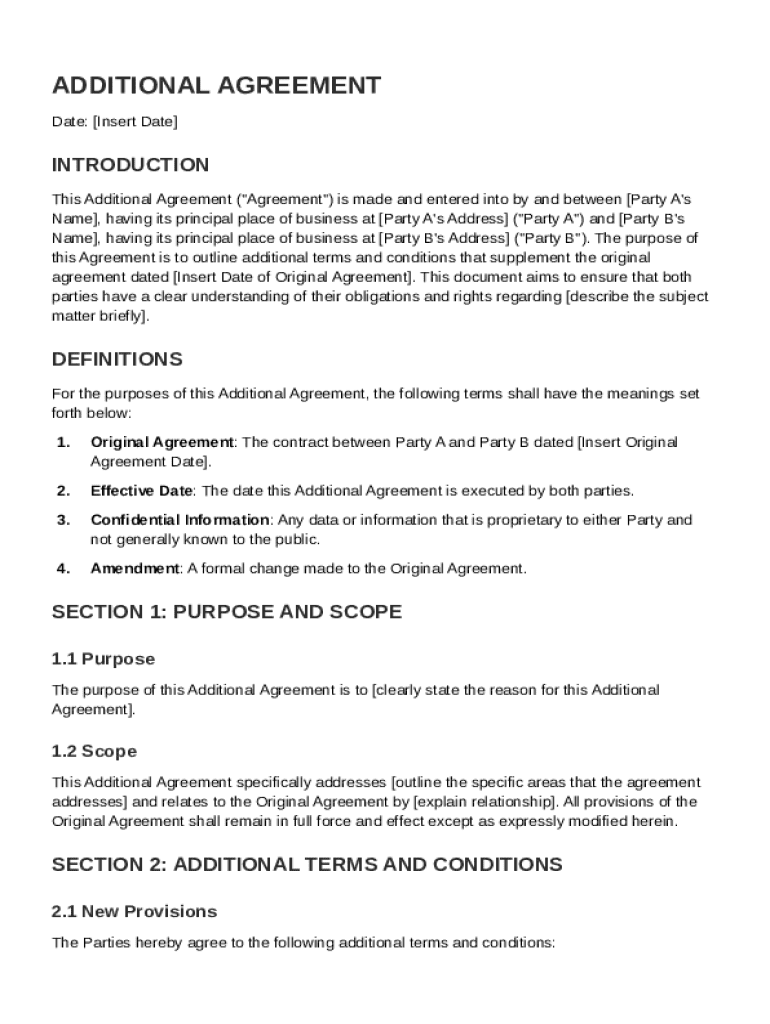







Definition and Meaning of the Additional Agreement Template
The Additional Agreement Template is a formal document used to outline supplementary terms and conditions between two parties, often following the establishment of a primary agreement. This template is pivotal in scenarios where modifications, clarifications, or additional responsibilities need to be added to the original contract without nullifying it. It generally includes sections that define new obligations, confidentiality agreements, and amendments to existing terms. By providing clear documentation of these changes, the template ensures both parties have a mutual understanding, reducing the potential for future disputes.
How to Use the Additional Agreement Template
To effectively use the Additional Agreement Template, begin by clearly identifying both parties involved in the existing agreement. This ensures that the additional terms are specifically tailored to their needs. Next, outline the purpose of the additional agreement, including any new obligations or changes to the original terms. Specific sections can be added to address new confidentiality requirements, adjust the contract duration, or specify termination conditions. Every included amendment should be reviewed and agreed upon by all parties to maintain the legal integrity of the agreement.
Steps to Complete the Template
- Identify Parties: Clearly document the names and roles of the parties involved.
- Purpose Statement: Detail the specific reason for the additional agreement.
- List New Terms: Clearly outline any new terms and conditions.
- Review Existing Terms: Amend any existing clauses that need changes.
- Confidentiality and Security: Address any new privacy concerns.
- Finalize and Sign: Ensure all parties agree and provide necessary signatures.
Key Elements of the Additional Agreement Template
The template is structured to cover several critical aspects that ensure completeness and clarity:
- Supplementary Terms: Additional terms that are added to the existing agreement.
- Modifications: Changes to existing conditions, roles, or responsibilities.
- Confidentiality Clauses: Terms that underscore the importance of privacy.
- Duration and Termination: Updated clauses that define the term's length and conditions under which the agreement can be ended.
- Dispute Resolution: Methods for resolving potential conflicts between parties.
Legal Use of the Additional Agreement Template
Legally, the Additional Agreement Template is used to supplement and clarify existing agreements without invalidating them. It acts as a legally binding document when properly executed by all parties involved. The content and structure of the template should adhere to the governing law stipulated in the original contract. This ensures that any additions or modifications are enforceable under the jurisdiction's legal framework.
Important Terms Related to the Additional Agreement Template
Several terms are critical when discussing additional agreements, including:
- Supplementary Terms: Conditions that extend original agreement terms.
- Amendment: A change or addition to the existing agreement.
- Governing Law: The legal jurisdiction applicable to the agreement.
- Clause: A distinct section of a legal document that addresses specific terms.
Detailed Examples of Using the Additional Agreement Template
Consider a service agreement between a software provider (Party A) and a client (Party B). If Party B requires additional support not covered in the original contract, an Additional Agreement can specify these new services, associated costs, and any other pertinent details. Another example may involve a non-disclosure agreement where new parties need to be included; the Additional Agreement Template would facilitate this inclusion while maintaining the contract's integrity.
State-Specific Rules for the Additional Agreement Template
While the template serves a universal function, certain states may have specific requirements or limitations concerning additional agreements. For instance, some states require that any amendments or supplementary agreements be notarized to be legally enforceable. Others may have distinct rules regarding electronic signatures or the storage of digital agreements. Users should ensure compliance with state regulations to validate the document's legality.
Versions or Alternatives to the Additional Agreement Template
There are numerous versions or alternatives to the Additional Agreement Template depending on industry practices or specific needs. For instance, a Memorandum of Understanding (MoU) might be used for less formal arrangements, while specific sectors like finance or healthcare might have their tailored templates to address industry-specific requirements. Choosing the right version ensures that the agreement is both appropriate and legally robust for the intended purpose.




