






Definition and Meaning
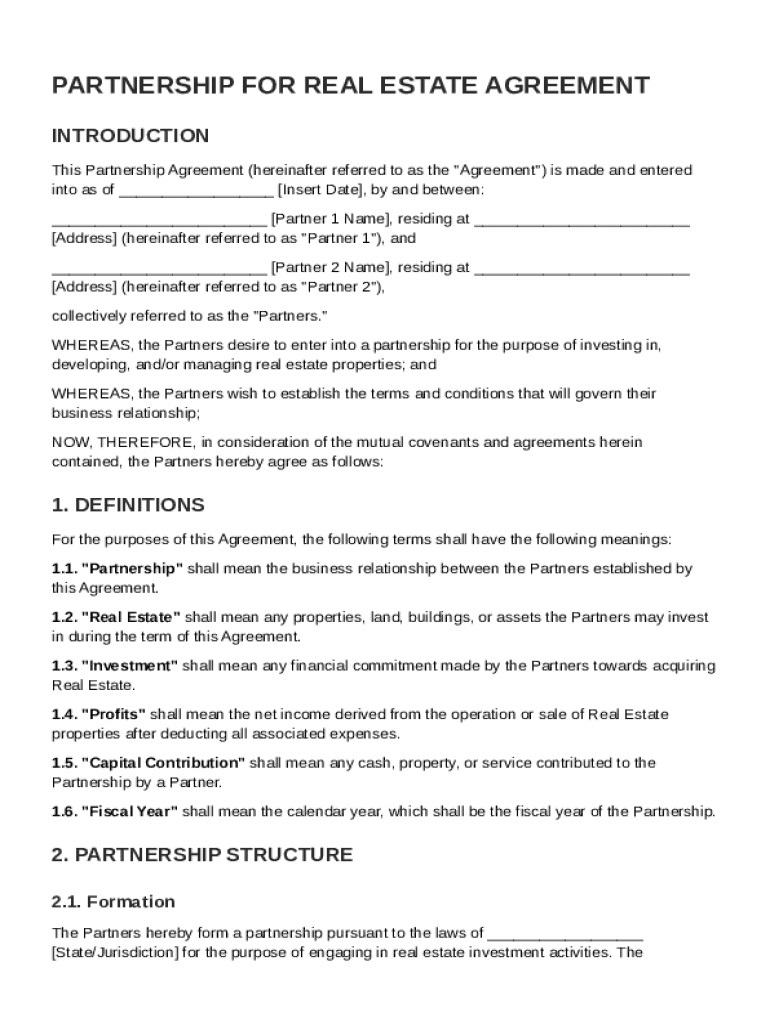
The "Partnership for Real Estate Agreement Template" serves as a legal framework for partners engaging in real estate investments. This template outlines the necessary details for establishing a partnership, including the roles, responsibilities, and contributions of each party. It is designed to ensure that all parties have a clear understanding of their obligations and rights within the partnership, thus facilitating smoother operations and reducing potential disputes. The template is critical for defining the parameters of financial contributions, profit distribution, and authority levels within the partnership.
Key Elements of the Partnership Agreement
A comprehensive real estate partnership agreement includes critical elements such as:
- Partnership Structure: Defines the type of partnership (e.g., general, limited) and each partner's role.
- Capital Contributions: Specifies initial and future financial contributions each partner is to make.
- Profit and Loss Distribution: Details how profits and losses will be allocated among partners.
- Management and Decision-Making: Outlines who will manage daily operations and the process for making major decisions.
- Dispute Resolution: Provides methods for resolving disagreements between partners.
- Termination Conditions: Sets conditions under which the partnership may be dissolved.
Each section is crafted to offer clarity and legally binding agreements for all involved parties.
How to Use the Template
To effectively use the Partnership for Real Estate Agreement Template, follow these steps:
- Review the Template Thoroughly: Examine each section to understand the implications and ensure all parties agree on the terms.
- Customize According to Needs: Modify the template to fit specific partnership arrangements and state requirements.
- Consult Legal Advisors: Engage with legal experts to verify that the document complies with local real estate laws.
- Finalize Agreements: Ensure all partners review and sign the document, signifying their understanding and consent.
- Set Up a Monitoring System: Establish a schedule for regular reviews and updates to the agreement as needed.
Following these steps ensures that the partnership agreement is tailored, compliant, and ready for implementation.
Important Terms Related to the Template
The agreement includes specific terminology crucial for clarity:
- General Partner: A partner with management authority and personal liability.
- Limited Partner: A partner with liability limited to their investment amount.
- Fiduciary Duty: Legal obligation of one party to act in the best interest of another.
- Equity Stake: The ownership interest held by partners in the partnership.
- Net Operating Income (NOI): Represents total revenue minus operating expenses.
Understanding these terms is essential for accurately interpreting the agreement.
Legal Use of the Template
In the United States, the legal use of the Partnership for Real Estate Agreement Template is governed by state partnership laws. The template should be adapted to reflect the legal nuances of the state in which the partnership operates. This involves incorporating state-specific provisions such as liability limits, partnership registration, and dispute resolution procedures. It's crucial to review these legal aspects with a qualified attorney to ensure compliance with both state and federal regulations.
State-Specific Rules
Distinct regulations govern real estate partnerships in different states:
- California: Requires additional disclosures about environmental risks associated with properties.
- New York: Demands specific provisions about equity sharing and partnership dissolution.
- Florida: Legal stipulations focus on personal liability protections for limited partners.
Acknowledging these variances is vital for tailoring the agreement to meet state-specific legal standards.
Who Typically Uses the Template
The Partnership for Real Estate Agreement Template is typically used by:
- Real Estate Investors: Individuals seeking to pool resources for larger investments.
- Real Estate Development Firms: Companies partnering with individual investors for project financing.
- Legal Professionals: Advising clients on structuring and formalizing investment partnerships.
- Financial Advisors: Providing counsel on the financial implications and returns of joint investments.
These users benefit from the template by obtaining a structured, legally compliant framework for their real estate initiatives.


Steps to Complete the Template
To complete the template effectively, adhere to these steps:
- Gather Necessary Information: Collect details about each partner, including capital contributions and roles.
- Complete Personal and Business Information: Fill in sections on partner identities and business structure.
- Outline Financial Arrangements: Clearly specify all financial contributions and profit-sharing arrangements.
- Define Management Roles and Decision Protocols: Assign duties and decision-making processes to appropriate partners.
- Set Dispute Resolution Processes: Establish mechanisms for resolving potential disagreements.
- Review and Sign: Ensure all partners review, consult their legal advisors, and sign the document.
- Record and Store: Keep secure, accessible records of the signed agreement for future reference.
These steps ensure the precise and effective completion of the agreement.
Examples of Using the Template
The Partnership for Real Estate Agreement Template can be applied in several scenarios:
- Investment Partnerships: Two investors with complementary skills and resources may use this template to formalize their joint venture.
- Development Projects: A real estate development company teams up with financial backers to fund a large-scale project.
- Property Management Firms: Partners pool resources to acquire and manage residential or commercial properties.
- Real Estate Syndications: Multiple investors come together under one partnership agreement to share profits and risks.
In each case, the template helps streamline the partnership process, ensuring clarity and legal compliance.