
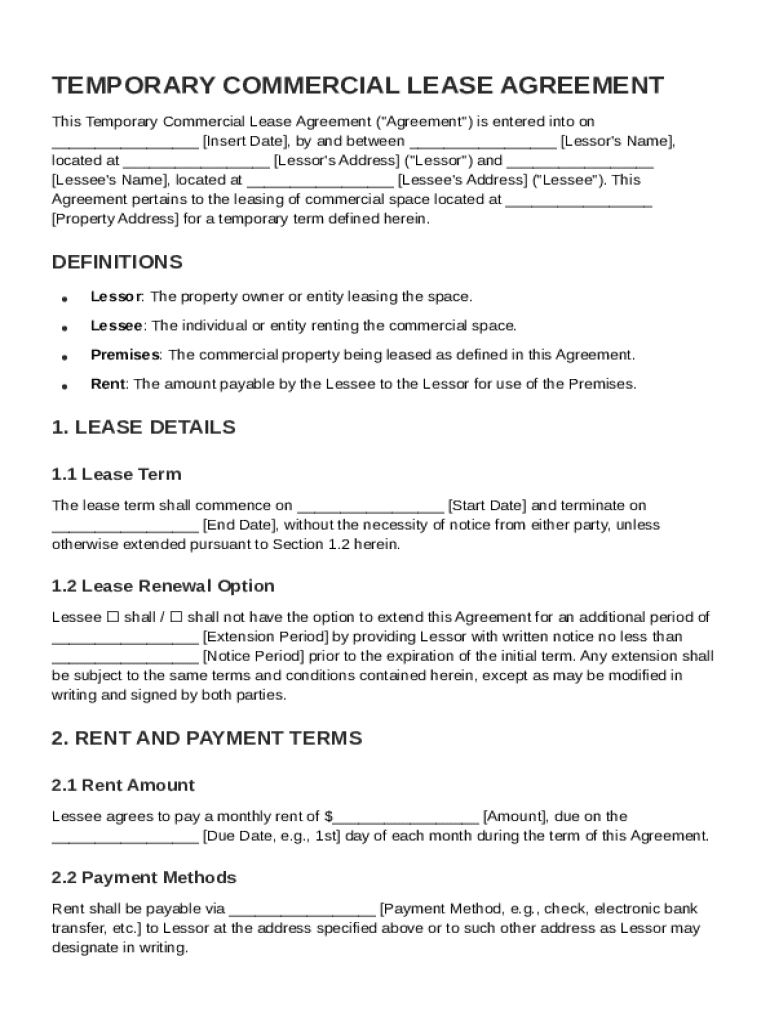







Definition & Meaning
A Temporary Commercial Lease Agreement Template is a documented arrangement between a lessor and a lessee for renting commercial space for a finite duration. This template delineates the contractual obligations and rights of both parties, aiming to make the lease process easier and more streamlined. Essential components often include the rental term, payment specifics, and usage guidelines, offering a structured framework for users to base their agreements on. Such agreements are pivotal in situations where flexibility is required, like pop-up shops or short-term business endeavors.
How to Use the Temporary Commercial Lease Agreement Template
Utilizing a Temporary Commercial Lease Agreement Template involves several steps to ensure it meets the needs of both parties. Start by customizing the template with specific details, including names, addresses, and contact information of all parties involved. Next, fill in the terms of the lease, specifying the duration, rent amount, and due dates. It’s crucial to detail maintenance responsibilities and the intended use of the premises. After inputting all the necessary information, both parties should review the document thoroughly to confirm accuracy, then sign to validate the agreement.
- Customize with specific tenant and landlord details
- Define the lease term and payment terms clearly
- Specify maintenance duties and permitted use of premises
- Ensure both parties review and agree to the terms before signing
Key Elements of the Temporary Commercial Lease Agreement Template
A Temporary Commercial Lease Agreement Template contains several vital elements to be completed by both the lessor and lessee. These include:
- Lease Duration: Specifies the start and end dates of the lease.
- Rent Payment Terms: Outlines total rent due, payment frequency, and methods.
- Security Deposit: Details the amount required and conditions for its return.
- Premises Use: Defines allowable activities and restrictions.
- Maintenance Responsibilities: Allocates obligations for repairs and upkeep.
- Termination Conditions: Describes scenarios and procedures for early ending of the lease.
- Indemnification Clauses: Protects both parties from liability issues arising during the lease term.
- Governing Law: Indicates which state's laws govern the agreement.
Each section ensures both the tenant's and landlord's needs and obligations are clearly understood and legally protected.
Steps to Complete the Temporary Commercial Lease Agreement Template
Completing a Temporary Commercial Lease Agreement Template is a straightforward process if approached methodically:
- Gather Necessary Information: Collect all relevant details about the parties and the premises.
- Fill in Detailed Sections: Input data into each section, focusing on accuracy and completeness.
- Review and Revise: Carefully review the entire document for any discrepancies or errors.
- Agree and Sign: Once both parties are satisfied, sign the document to formalize the agreement.
These steps are necessary to ensure the lease is legally binding and meets the expectations of both the lessor and lessee.
Who Typically Uses the Temporary Commercial Lease Agreement Template
This type of lease is particularly popular among small business owners, entrepreneurs, and companies testing new locations. It's ideal for:
- Pop-Up Shops: Businesses looking to capitalize on short-term opportunities or seasonal demands.
- Temporary Office Spaces: Companies needing a short-term workspace without long-term commitments.
- Event Spaces: Organizers requiring a temporary venue for an event or exhibition.
Both landlords seeking flexible leasing options and tenants requiring temporary space use this template to cater to their specific needs.


Important Terms Related to the Temporary Commercial Lease Agreement Template
Understanding the terminology within a Temporary Commercial Lease Agreement Template enhances clarity and compliance. Key terms include:
- Lessor and Lessee: Refers to the landlord and tenant, respectively.
- Common Area Maintenance (CAM): Involves costs for shared spaces, which might be a tenant responsibility.
- Base Rent vs. Gross Rent: Distinctions between fixed rent and rent inclusive of additional expenses.
- Force Majeure: Outlines protections for unforeseen events affecting contract fulfillment.
Fully grasping these terms is crucial for both parties to avoid future disputes.
Legal Use of the Temporary Commercial Lease Agreement Template
The Temporary Commercial Lease Agreement Template must adhere to legal standards to be enforceable. It is governed by contract laws within the applicable jurisdiction. Legal considerations include:
- Compliance with State Laws: Ensures alignment with specific state property and commercial leasing laws.
- Signature Validity: Requires understanding of how electronic signatures, like those facilitated by platforms such as DocHub, are used legally.
- Modification Provisions: Details how amendments to the agreement can be processed.
Given these legal aspects, it is often advisable to consult with a legal professional to ensure that the template aligns with local law and protects both parties adequately.
State-Specific Rules for the Temporary Commercial Lease Agreement Template
Each state in the U.S. may have particular rules and requirements for commercial leases, including:
- Disclosure Requirements: Some states mandate certain disclosures from landlords, such as known property defects.
- Security Deposit Regulations: Varying laws dictate maximum amounts and conditions for deposit returns.
- Eviction Procedures: Defined processes and timelines for eviction need to be adhered to, differing by jurisdiction.
To minimize legal risks and ensure compliance, parties should tailor the template to incorporate these state-specific regulations.




