
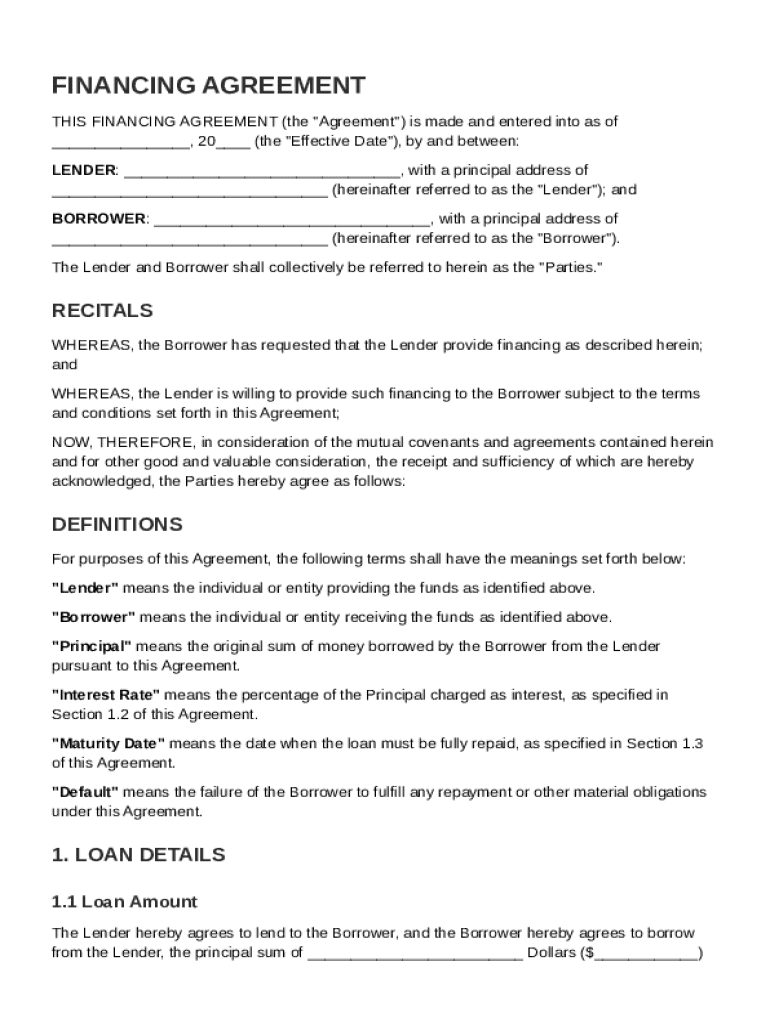







Definition & Meaning
A financing agreement template is a structured document designed to outline the terms and conditions under which a lender provides financial resources to a borrower. This agreement includes critical components such as the loan amount, interest rate, repayment terms, and the specific purpose of the loan. It serves as a legally binding contract that establishes the rights and obligations of both parties, ensuring that the financial transaction is both clear and enforceable. By defining these elements, the template provides a comprehensive overview of the expectations and commitments involved in the lending process.
Key Elements of the Financing Agreement Template
The financing agreement template contains several essential elements that are crucial for establishing a clear understanding between the lender and borrower:
- Loan Amount and Purpose: Specifies the total amount of money to be lent and the intended use of the funds.
- Interest Rate and Repayment Terms: Outlines the interest rate applicable to the loan and the schedule of repayments, including any grace periods or penalties for late payment.
- Representations and Warranties: Details the assurances provided by both the lender and borrower regarding their legal capacity and authority to enter into the agreement.
- Covenants: Includes any promises made by the borrower regarding specific actions they will or will not take during the term of the loan.
- Events of Default and Remedies: Specifies conditions that would constitute a default and the recourse available to the lender in such situations.
- Governing Law: Indicates the legal jurisdiction that will govern the agreement, which is important for resolving any disputes.
Steps to Complete the Financing Agreement Template
- Gather Necessary Information: Collect details about the parties involved, including legal names, addresses, and contact information.
- Define Loan Terms: Determine the loan amount, interest rate, and repayment schedule.
- Draft Representations and Warranties: Clearly articulate the assurances both parties are required to provide.
- Establish Covenants and Obligations: Outline any specific requirements or restrictions imposed on the borrower.
- Specify Defaults and Remedies: Detail what constitutes a default and the steps that can be taken if a default occurs.
- Select Governing Law: Agree on the state or jurisdiction under which the agreement will be enforced.
- Review and Finalize: Have both parties review the template to ensure accuracy and completeness before signing.
Who Typically Uses the Financing Agreement Template
The financing agreement template is commonly used by a variety of organizations and individuals, each having distinct reasons for implementing this structured document:
- Banks and Financial Institutions: Use the template to formalize lending arrangements with individuals or businesses.
- Private Lenders: Employ the template to clearly outline lending terms with private borrowers.
- Businesses Seeking Funding: Utilize the agreement when securing loans to support operations or expansion.
- Individuals Seeking Loans: Adopt the template when entering into personal loan agreements to formalize terms efficiently.


Legal Use of the Financing Agreement Template
The financing agreement template serves as a legally binding document that solidifies the agreement between the lender and borrower. It is crucial that both parties fully understand and consent to the terms specified within the template, as it will be used to enforce their respective rights and obligations. Legal professionals often recommend using standardized templates to minimize ambiguity and ensure compliance with relevant laws. The agreement’s enforceability is supported by adherence to the governing law specified within the document, making it crucial to ensure all sections are completed accurately.
State-Specific Rules for the Financing Agreement Template
Financing agreements are subject to specific state laws that may affect aspects such as interest rates, repayment terms, and enforcement protocols. Understanding these state-specific rules is vital for both parties, as failure to comply can render the document unenforceable:
- Interest Rate Limits: Many states impose caps on the interest rate that can be charged on loans, varying by loan type and amount.
- Usury Laws: These laws exist to prevent exorbitant interest rates, setting maximum limits that can be legally charged.
- Enforcement and Default: State regulations dictate the procedures for enforcement and define allowable remedies in the event of a default.
- Disclosure Requirements: States often require specific disclosures to be included in the agreement to ensure transparency.
Important Terms Related to Financing Agreement Template
Understanding the key terminology within a financing agreement is essential for all parties involved:
- Principal: The original amount of the loan provided to the borrower.
- Amortization: The process of gradually repaying a loan through scheduled payments that cover both principal and interest.
- Collateral: Assets pledged by the borrower to secure the loan, which can be seized by the lender in case of default.
- Prepayment Penalty: A fee charged to the borrower for paying off the loan before the scheduled maturity date.
- Balloon Payment: A large payment due at the end of the loan term after smaller periodic payments.
Examples of Using the Financing Agreement Template
Real-world applications of the financing agreement template can range significantly, accommodating different borrowing and lending scenarios:
- Business Expansion: A small business owner seeks funding to expand operations and uses the template to secure a loan from a commercial bank.
- Startup Financing: An entrepreneur uses the template to establish terms with an angel investor providing seed capital.
- Personal Loan: An individual entering a mortgage agreement to purchase a home adapts the template to align with specific loan terms.
By utilizing a comprehensive financing agreement template, all parties involved can ensure clarity, accountability, and legal compliance in their financial transactions.




