






Definition & Purpose of a Project Management Agreement Template
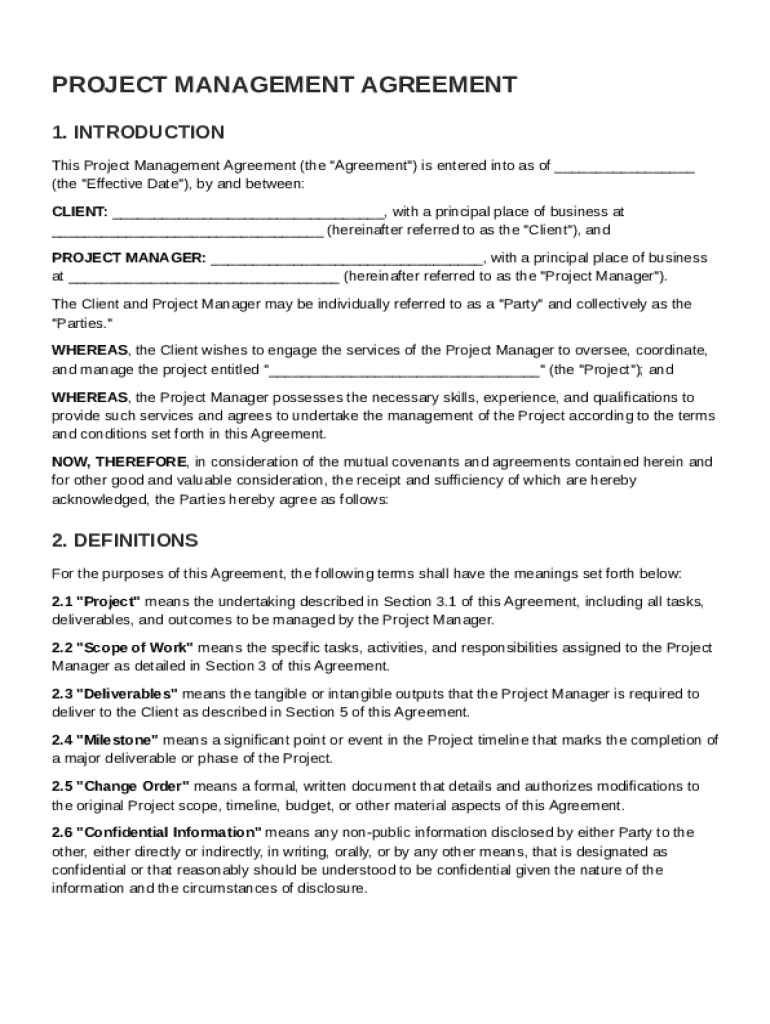
A Project Management Agreement Template serves as a framework for defining the roles and responsibilities between a Client and a Project Manager for a specific project. This agreement outlines critical elements such as project scope, deliverables, communication protocols, and payment terms. By specifying these components, the template ensures clarity and alignment between the parties involved, minimizing misunderstandings and disputes throughout the project lifecycle. The purpose of using such a template is to provide a standardized approach to managing projects, promoting efficiency and consistency in project execution.
Key Elements Included in the Template
- Project Scope and Deliverables: Clearly defining the scope and what deliverables are expected at the end of the project helps avoid scope creep.
- Roles and Responsibilities: Outlining who is responsible for what ensures that each party knows their obligations.
- Payment Terms and Budget: Explicit financial terms clarify payment schedules, methods, and amounts.
- Communication Plan: Establishing how and when parties will communicate throughout the project.
- Change Management Process: Procedures for managing project changes, including scope adjustments.
- Confidentiality Obligations: Terms to protect sensitive information exchanged during the project.
- Dispute Resolution: Methods and processes agreed upon should conflicts arise.
- Termination Conditions: Conditions under which the contract can be prematurely ended.
Practical Examples of Use
Consider a software development project where a company hires a project manager to oversee an app's development. The Project Management Agreement would define the app's features and timeline, the roles of developers and testers, and the manager's role in coordinating these efforts. It would also state the payment schedule for each completed milestone and strategies for addressing any delays.
Who Typically Uses the Project Management Agreement Template
The template is primarily used by two parties: clients who engage in professional services and project managers who provide those services. These typically include:
- Corporations: Seeking to streamline complex projects such as product launches or infrastructure upgrades.
- Small Businesses: Who outsource specific tasks like marketing campaigns or IT solutions.
- Freelancers and Consultants: Offering specialized project management services to guide client initiatives.
- Nonprofit Organizations: Engaging in time-sensitive campaigns or projects like grant management or community events.


Benefits for Different Users
- Corporate Clients: Gain structured project management with defined deliverables and timelines.
- Freelancers: Utilize it to communicate clear expectations with clients, ensuring project scope is manageable.
- Nonprofits: Use it to enhance coordination and maximize the impact of time-bound projects.
How to Use the Project Management Agreement Template
Using the template involves several systematic steps to ensure it aligns with the project's needs and stakeholder expectations.
- Customize the Template: Adjust standard clauses to reflect specific project objectives and client requirements.
- Define Key Terms: Clearly articulate project goals, scope, and deliverables.
- Outline Financials: Specify the budget details, including down payments, installments, and methods of payment.
- Review and Approve: Both parties should review the document for any ambiguity or missing information.
- Final Signatures: Once both parties agree on the terms, the agreement should be signed and retained in both digital and paper formats.
Customization Tips
- Adapt sections related to deliverables to reflect project-specific outcomes.
- Tailor the communication plan to suit project length and complexity.
- Modify budget terms according to the financial capacity and preference of parties involved.
Steps to Complete the Project Management Agreement Template
The completion process involves structured tasks to ensure accuracy and clarity in the document:
- Gather Required Information: Collect all necessary details, including project objectives, budget outlines, and contact information for all involved parties.
- Drafting the Agreement: Populate the template with the gathered information, ensuring each section is addressed comprehensively.
- Internal Review: Conduct an internal review with legal or project management advisors to validate coherence and feasibility.
- Client Review and Feedback: Send the draft to the client for input and incorporate any feedback received.
- Finalization: Make any final revisions and proceed to the signing stage.
Checklist for Accuracy
- Ensure all deliverables are clearly listed.
- Confirm names and contact details for accuracy.
- Cross-check financial terms for consistency with the agreed budget.
Important Terms Related to Project Management Agreement Template
Understanding terminology is crucial for effective use and interpretation of the agreement.
- Scope Creep: Refers to uncontrolled changes or continuous growth in a project's scope, which the template aims to avoid.
- Milestones: Significant points within a project timeline, which may trigger partial payments or reviews.
- Escrow: Holding funds in a third-party account until conditions are met.
- Force Majeure: Clauses that free parties from liability or obligation when an extraordinary event occurs beyond their control.
Terminology Contextual Examples
A marketing firm may include milestones as part of its Project Management Agreement to align payments with the delivery of design and advertising phases. In contrast, force majeure clauses might be crucial for a client working in areas prone to natural disasters, shielding them from unforeseen delays.
Legal Use of the Project Management Agreement Template
The agreement must comply with legal standards to be enforceable and valid.
- ESIGN Act Compliance: Ensures all electronic signatures gathered within the template are recognized under U.S. law.
- Confidentiality Clauses: Protect proprietary information from unauthorized disclosure or sharing.
- Jurisdictional Specifications: Identifies which state’s laws govern the contract, often correlating with the client or project manager’s headquarters location.
Legal Considerations
- Review by a Legal Professional: Essential to confirm compliance and adapt the general terms to regional regulations.
- Amendments and Modifications: Have processes in place should changes be necessary once the project commences.
State-specific Rules for the Project Management Agreement Template
Some states may require specific clauses or conditions to be part of any contract, including project management agreements.
- California, New York, and Texas: Often have different disclosure laws and contract requirements that should be checked for adherence.
- Governing Laws: Each state’s contract law nuances, including default terms or statutory requirements, should be incorporated into the agreement where applicable.
Adaptation Tips
Consult state-specific regulations during the initial drafting phase, employing local legal guidance if needed to understand jurisdictional mandates.
Examples of Using the Project Management Agreement Template
Real-world Scenarios
-
IT Project Implementation: An IT firm uses the agreement to manage a software upgrade for a corporate client, detailing deliverables, and timelines and outlining responsibilities for both IT personnel and the client’s tech team.
-
Construction Management: A construction project manager employs the template to organize a new building project, coordinating timelines and task responsibilities between architects, engineers, and contractors.
-
Event Planning: A nonprofit organization utilizes the agreement to coordinate a complex fundraising event, clarifying roles among various stakeholders like vendors, volunteers, and staff.
These examples illustrate the flexibility and utility of the Project Management Agreement Template in various industries, each benefitting from reduced ambiguity and streamlined project processes.