






Definition & Meaning
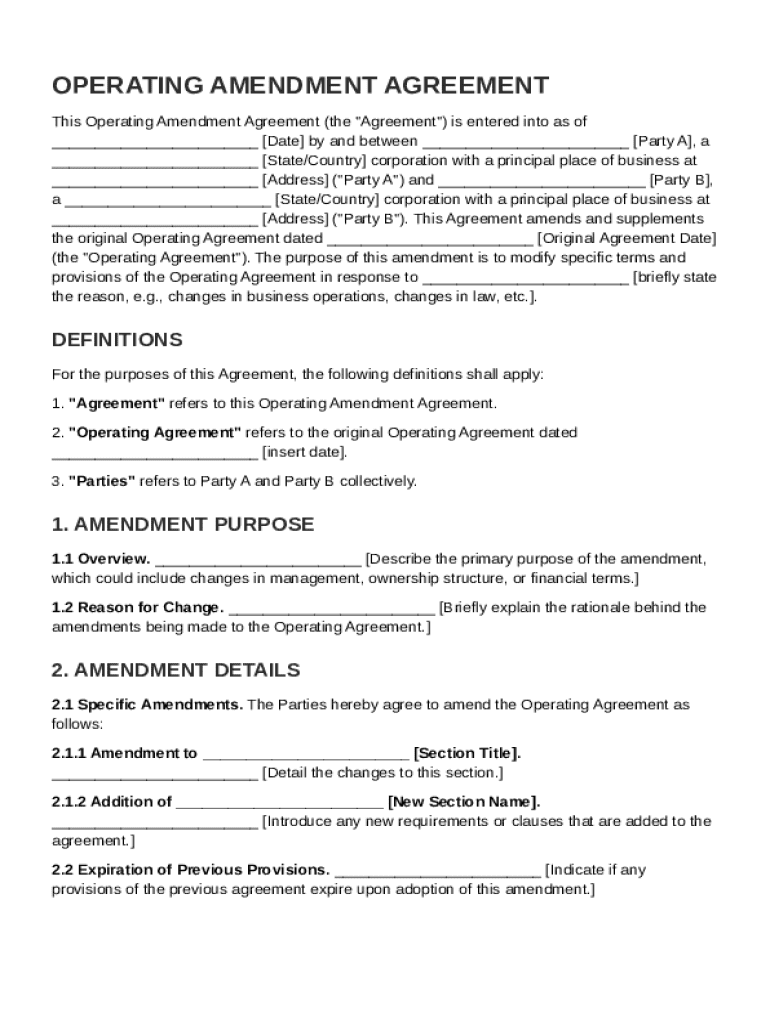
The Operating Amendment Agreement Template is a legal document designed to modify certain provisions of an existing Operating Agreement. This template is crucial for formalizing changes in business operations and ensuring that both Party A and Party B, who are involved in the original agreement, are fully aware and in agreement with the proposed alterations. The document’s primary function is to outline the specific amendments being made while reaffirming that all remaining terms of the initial agreement continue to remain valid and enforceable.
Examples include changing the allocation of profits within an LLC or altering management responsibilities. The purpose of the template is to provide a structured format that facilitates clarity and consensus, reducing potential disputes and legal challenges.
How to Use the Operating Amendment Agreement Template
-
Review the Original Agreement: Before making any amendments, both parties should thoroughly review the existing Operating Agreement. This ensures understanding of the current terms and identification of the specific sections requiring modification.
-
Identify Amendments: Clearly outline the changes needed, such as adjustments to profit-sharing ratios, managerial roles, or capital contributions.
-
Customize the Template: Utilize an editing tool like DocHub to fill in the necessary fields within the template. This includes the names of the parties, specific clauses being amended, and any new terms to be introduced.
-
Consult Legal Counsel: Although the template provides a comprehensive format, it's advisable for parties to seek legal advice to ensure compliance with state laws and that the modifications meet their intended objectives.
-
Sign and Store: Once completed, both parties should sign the document electronically through DocHub’s legally binding signature feature. Store the finalized agreement securely, ensuring its accessibility for future reference.
Key Elements of the Operating Amendment Agreement Template
-
Identification of Parties: Clearly specifies Party A and Party B involved in the agreement, along with the initial date of the original Operating Agreement.
-
Purpose of Amendment: Details the reasons for the amendments, providing context and justification for the changes.
-
Amendment Details: Breaks down each specific amendment, highlighting old versus new provisions.
-
Confirmation of Remaining Terms: Reaffirms that all terms not explicitly amended remain in full force and effect.
-
Authority and Execution: Includes clauses confirming that the individuals executing the amendment have the necessary authority to do so, ensuring legal enforceability.
Who Typically Uses the Operating Amendment Agreement Template
This template is predominantly utilized by business entities that have existing Operating Agreements, such as:
-
Limited Liability Companies (LLCs): Particularly common for LLCs looking to adjust their operating procedures or financial distributions.
-
Partnerships: Partnerships may employ the template to change partner responsibilities or profit-sharing agreements.
-
Corporations: While less common, corporations might use the template for specific operational tweaks not covered by by-laws.
The entities using the template often include both small to medium-sized businesses and larger corporations seeking to efficiently manage operational changes.


State-Specific Rules for the Operating Amendment Agreement Template
Operating Amendment Agreement Templates must comply with state laws, which can vary significantly. Key considerations include:
-
Filing Requirements: Some states may require filing amendments with the state’s business registrar, especially for LLCs.
-
Notification Protocols: States might have specific rules about notifying all involved parties and stakeholders regarding amendments.
-
Legal Provisions Specific to Business Structures: The applicability and structure of amendments might differ based on whether the entity is an LLC, partnership, or corporation.
Understanding these variations is critical to ensuring the amendment is not only legally binding but also compliant with local regulations.
Steps to Complete the Operating Amendment Agreement Template
-
Gather Necessary Information: Obtain the original Operating Agreement and a clear outline of the proposed amendments.
-
Fill In the Template: Insert the names of the parties, dates, and specific details of each amendment within the template using an editor like DocHub.
-
Review for Accuracy: Proofreading is essential to avoiding any misunderstandings or errors in the amended terms.
-
Obtain Approvals: Ensure that all necessary company stakeholders, such as members or board directors, have approved the changes.
-
Execute the Document: Use electronic signature capabilities to finalize the amendment, suggesting retention of digital copies for record-keeping.
-
Distribute Amended Agreement: Share the completed document with all relevant parties to ensure transparency and consensus.
Legal Use of the Operating Amendment Agreement Template
Legal use of this template involves:
-
Adherence to Contract Law: Ensuring modifications align with legal contract principles and do not contradict existing laws.
-
Maintain Documentation: Keeping comprehensive records of all amendments and correspondence related to the changes.
-
Dispute Resolution Clauses: Incorporating clauses that outline procedures for resolving any disputes that may arise from the amendments.
Important Terms Related to Operating Amendment Agreement Template
-
"Amendment": Refers to the official change or addition to the original agreement.
-
"Parties": The entities involved in the agreement, typically including the business entity and its members or partners.
-
"Effective Date": The date upon which the amendments become official and enforceable.
-
"Binding Agreement": Indicates that the amended terms are legally enforceable upon all parties.
These terms are fundamental to comprehending and effectively using the template for managing business agreements.