




01. Edit your form online
Type text, add images, blackout confidential details, add comments, highlights and more.

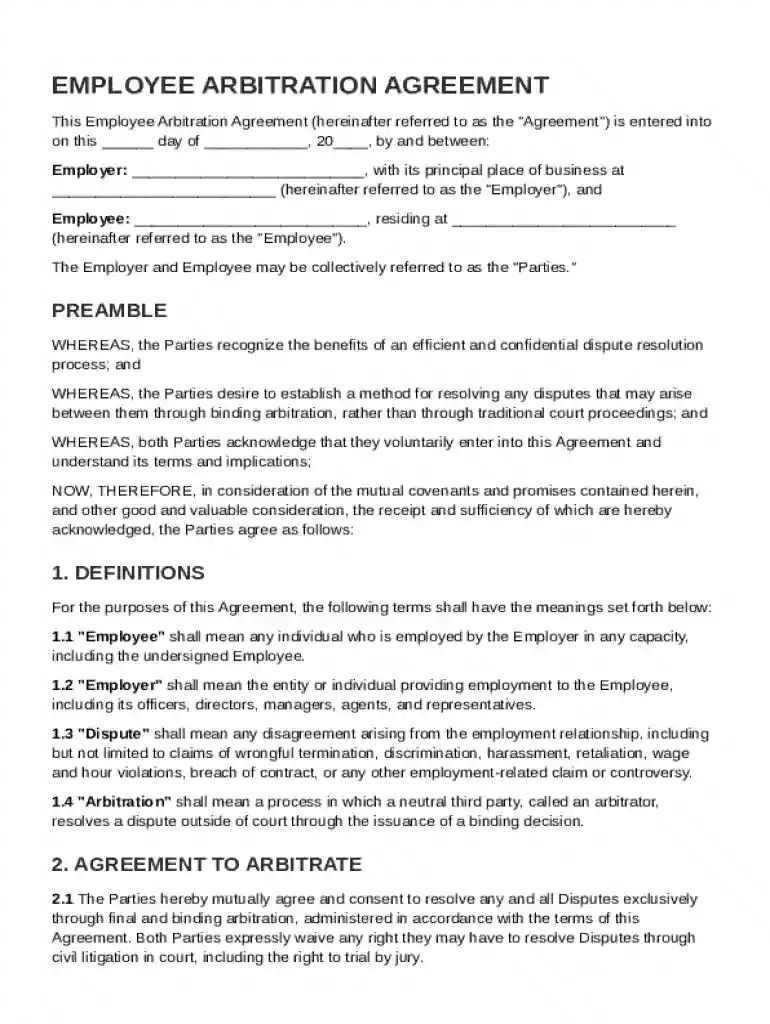
Type text, add images, blackout confidential details, add comments, highlights and more.

Draw your signature, type it, upload its image, or use your mobile device as a signature pad.

Send it via email, link, or fax. You can also download it, export it or print it out.
The Employee Arbitration Agreement Template is a formal document used to create a binding agreement between an employer and an employee, specifying that any disputes arising from employment will be resolved through arbitration rather than traditional court litigation. This legal instrument is designed to streamline dispute resolution by appointing a neutral arbitrator to make binding decisions on both parties' behalf. Typically, this agreement includes definitions of key terms, such as "arbitration," "dispute," and "arbitrator," aiming to clarify the process and components involved in arbitration.
Both parties waive their right to a jury trial, thus opting for a less formal mechanism aimed at reducing costs and expediting the resolution process.
This template typically includes several vital sections, each contributing to a well-rounded understanding and execution of the agreement:
For instance, the scope may cover claims related to workplace discrimination or wrongful termination, while the governing law might align with federal or state arbitration codes.
Processing an Employee Arbitration Agreement involves several critical steps:
A retail company preparing this document for new hires would ensure that the arbitration scope includes any disputes related to customer interactions or in-store protocols.
Primarily, both employers and employees benefit from using this template. Employers across various industries, such as telecommunications, finance, or healthcare, utilize this form to standardize dispute resolution procedures within their organizations.


In legal contexts, the Employee Arbitration Agreement Template serves multiple purposes:
Under the Federal Arbitration Act, this agreement is enforceable in court if drafted correctly, ensuring that arbitration decisions are upheld as binding.
Understanding the following key terms is crucial when working with this agreement:
These terms help participants anticipate the process dynamics and implications of committing to arbitration rather than litigation.
Variations in state laws affect how arbitration agreements are drafted and enforced:
Organizations with interstate operations should tailor their templates to address specific requirements in each jurisdiction where they employ staff.
Employers and employees leverage this template across several real-world scenarios:
A tech start-up that anticipates growth might implement these agreements to prepare for potential future employee grievances, showcasing foresight in handling workplace conflicts.
At DocHub, your data security is our priority. We follow HIPAA, SOC2, GDPR, and other standards, so you can work on your documents with confidence.


May 12, 2026 This work is written to help practitioners draft valid employment arbitration agreements across all 50 states. It includes numerous sampleRead more
May 17, 2013 A WORK-PERMIT IS NOT A REQUIREMENT FOR EMPLOYEE STATUS Contracts of employment are valid irrespective of whether the employee is not inRead more


