







Definition & Meaning
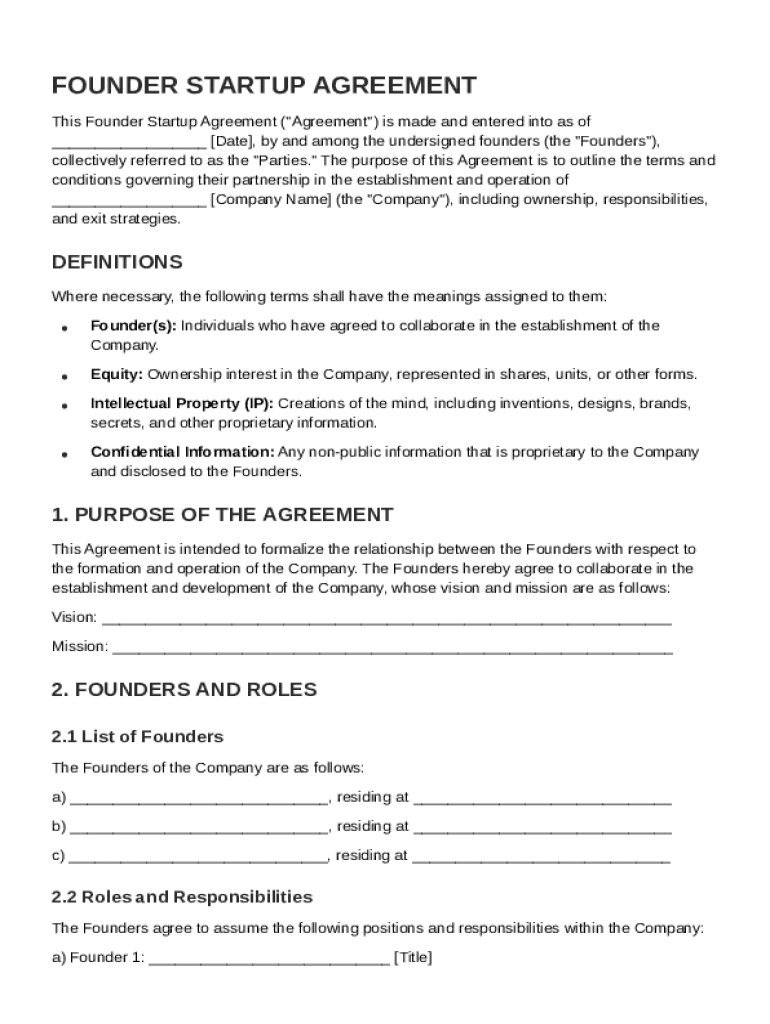
A Founder Startup Agreement Template is a contractual document designed to establish the foundational terms and conditions among the founders of a startup. The agreement plays a crucial role in formalizing the relationships between founders, helping to prevent misunderstandings and conflicts by clearly defining roles, responsibilities, and expectations. This template typically includes sections on equity distribution, capital contributions, intellectual property rights, and decision-making processes. By creating a structured framework, this agreement ensures that all parties are aligned with the startup's vision and objectives from the outset.
- Equity Distribution: Details the percentage of ownership each founder holds.
- Roles and Responsibilities: Outlines the specific duties and expectations for each founder.
- Capital Contributions: Specifies the amount of financial or in-kind contributions by each party.
- Decision-Making Processes: Defines how key decisions will be made, including voting rights.
- Intellectual Property Rights: Specifies ownership and usage rights of creations and inventions.
How to Use the Founder Startup Agreement Template
The Founder Startup Agreement Template should be utilized as the basis for discussions and negotiations among startup founders. Here's how to effectively use the template:
- Initial Review: Review the template with all founders to understand the standard terms included.
- Customization: Modify the agreement to fit the specific needs and circumstances of the startup. This may involve adjusting equity percentages or adding unique clauses pertinent to the company's industry or goals.
- Legal Consultation: Seek legal advice to ensure the agreement complies with applicable laws and offers adequate protection to all parties involved.
- Approval and Finalization: Obtain consent from all founders on the content of the agreement. Make sure every founder understands and agrees to the terms.
- Execution: Sign the document to make the agreement legally binding.
Considerations
- Ensure all pertinent areas such as equity and roles are thoroughly discussed.
- Be transparent about the potential for future changes to the agreement.
- Legal review is recommended for protecting the rights and obligations of each founder.
Key Elements of the Founder Startup Agreement Template
The template is composed of several key components, each playing a vital role in the governance of the startup:
- Equity Ownership: Outlines the percentage of company ownership assigned to each founder.
- Decision-Making Protocols: Establishes how decisions will be made and who holds voting power.
- Exit Strategy Provisions: Details what happens if a founder wants or needs to leave the startup.
- Non-Compete Clauses: Prevents founders from starting a competing business within a certain period after departure.
- Confidentiality Clauses: Protects sensitive company information and intellectual property.
Real-World Examples
- Technology Startups: Standard practice to include non-compete clauses due to the high value of intellectual property.
- Service-Based Companies: May focus more on role responsibilities and contributions of each member.
Legal Use of the Founder Startup Agreement Template
The legal use of the Founder Startup Agreement Template involves ensuring the document meets all applicable regulations while safeguarding the interests of all involved parties. It’s critical that the agreement is enforceable in court should disputes arise.
- Compliance with Laws: Ensure alignment with federal and state laws in the United States.
- Binding Terms: The agreement must be signed by all founders to be legally enforceable.
- Legal Admissibility: Consider having the document notarized to enhance its validity.
Legal Scenarios
- Dispute Resolution: Include clauses for arbitration or mediation to handle conflicts.
- Termination: Clearly define the procedures for dissolving a founder’s role or the agreement itself.
Steps to Complete the Founder Startup Agreement Template
- Identify Founders: List all individuals involved in the startup who will be party to the agreement.
- Define Contributions: Clearly define what each founder is contributing, whether financial, intellectual, or sweat equity.
- Draft Terms: Initial drafting of terms, focusing on equity split, roles, and governance.
- Iterate and Review: Engage all founders in reviewing and proposing amendments to the draft.
- Legal Consultation: Have an attorney review the document to ensure compliance and protection.
- Finalize Document: Incorporate any final changes and prepare the document for signing.
- Sign and Execute: Obtain signatures from all parties to formally execute the agreement.
Special Considerations
- Pay close attention to defining roles to avoid overlap and conflict.
- Consider future funding rounds when deciding initial equity distribution.
Important Terms Related to the Founder Startup Agreement Template
Several key terms are critical for understanding and utilizing the template:
- Equity Vesting: A schedule detailing how founders earn their shares over time.
- Dilution: Understand how future investments might affect ownership percentages.
- Intellectual Property (IP): Clarification on ownership of technology, brands, or processes developed.
- Cliff Period: Timeframe within the vesting schedule protecting against early departures.
- Voting Rights: Specifies which decisions require consensus and voting protocols.
Importance
- Clear terms help prevent misunderstandings that could sour relationships.
- Legal precision ensures that the document functions as intended across various legal disputes.
Who Typically Uses the Founder Startup Agreement Template
This type of agreement is most commonly used by:
- Startup Level Enterprises: Founders establish the company’s foundational legal agreements.
- Technology Firms: Protects the ownership of highly valuable intellectual property.
- Partnerships: Any business where equity among founders is distributed upon creation.
- Venture Capital-Backed Companies: Ensures compliance and clear role definitions for investor confidence.


Use Cases
- Two co-founders creating a tech startup with proprietary software solutions.
- A group of three launching a new e-commerce venture, needing clear role delineation and capital input expectations.
Software Compatibility
The DocHub platform ensures compatibility with multiple software types, enhancing functionality:
- Integration with Document Editors: Works seamlessly with DOC and PDF editors.
- Cloud Compatibility: Directly import and export files via services like Google Drive and Dropbox.
- Cross-Platform Accessibility: Access and edit documents on both desktop and mobile web browsers.
Practical Examples
- Founders can draft, review, and sign agreements anytime from laptops or tablets.
- Cloud integrations allow for easy version control and shared changes during the negotiation phase.




