




01. Edit your form online
Type text, add images, blackout confidential details, add comments, highlights and more.

Type text, add images, blackout confidential details, add comments, highlights and more.

Draw your signature, type it, upload its image, or use your mobile device as a signature pad.

Send it via email, link, or fax. You can also download it, export it or print it out.
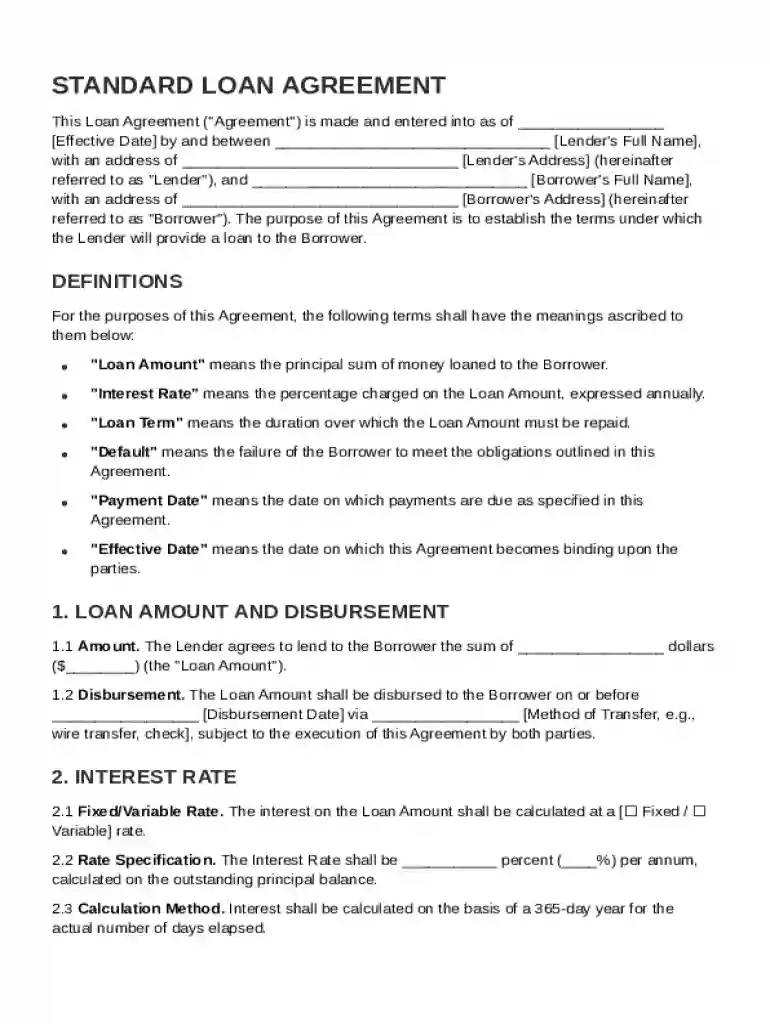
A Standard Loan Agreement Template is a pre-designed form used to formalize the details of a loan between a lender and a borrower. The template defines the roles, responsibilities, and expectations of both parties. It typically includes essential components such as the total loan amount, interest rate, and repayment terms. This template ensures that the agreement is binding and aligns with legal standards, providing a mutual understanding and framework for loan transactions.
Loan agreements serve as legal proof of the terms agreed upon, protecting both the lender's and borrower's interests. Additionally, they help prevent misunderstandings or disputes by clearly detailing all critical aspects of the loan arrangement. In essence, these documents set a structured foundation for financial transactions, often customizable to fit specific needs.
The Standard Loan Agreement Template encompasses several crucial elements:
Understanding these elements is crucial for both parties to maintain a transparent, functional, and enforceable loan arrangement.
Review the Template: Begin by thoroughly examining the template to ensure it meets your specific requirements. While the standard format is comprehensive, customization may be necessary based on the loan's unique aspects.
Fill in Loan Details: Enter specific information about the loan amount, interest rate, and repayment schedule. Be precise, as these form the agreement's core terms.
Include Borrower and Lender Information: Record the full names, addresses, and contact details of both parties. This information is vital for identification and legal compliance.
Define Terms and Conditions: Clearly state any covenants, representations, and default remedies. Ensure these terms are mutually agreed upon and understood.
Seek Legal Advice: It may be beneficial to consult with a legal professional to review the completed agreement, ensuring it complies with applicable laws and accurately reflects the agreed-upon terms.
Finalize and Sign: Once both parties are satisfied with the document, sign it. Consider using a platform like DocHub for electronically signing to make the process efficient and secure.
Using a Standard Loan Agreement Template legally binds both the lender and borrower to the stipulated terms. Under the ESIGN Act, electronically signed agreements like those facilitated by DocHub are legally valid and enforceable. This legal backing provides peace of mind and security for both parties.
It's essential to ensure the agreement adheres to state or federal regulations—governing law sections within the template can specify this. Additionally, customizing the template to include specific conditions unique to the loan or borrower can help avert potential legal disputes down the line.
Familiarity with certain key terms can enhance comprehension and utilization of the loan agreement:
Understanding these terms is critical for effectively navigating loan agreements and managing loan liabilities.
Loan agreements must sometimes adhere to specific state regulations regarding interest rates, fees, and borrower rights. For example, usury laws in different states cap the maximum interest rate lenders can charge. Adhering to these laws prevents the agreement from being considered void or unenforceable.
It is crucial for both parties to be aware of such state-specific regulations, and adapting the Standard Loan Agreement Template to comply with these rules is recommended. Consulting a legal expert with knowledge of local statutes can ensure adherence to these requirements.
Consider real-world scenarios where this template proves useful:
These examples illustrate the template's adaptability across various contexts, simplifying loan administration and documentation.
Choosing between digital and paper versions of the loan agreement can impact convenience and accessibility. Digital platforms like DocHub offer several advantages, including real-time editing, cloud storage, and secure electronic signatures. These features enhance collaboration and efficiency, making digital versions generally more suitable for modern transactions.
However, some traditionalists may prefer paper versions for their tangibility and simplicity, particularly in settings where digital literacy is low. Regardless, ensuring that either version is signed, securely stored, and easily retrievable is essential.
At DocHub, your data security is our priority. We follow HIPAA, SOC2, GDPR, and other standards, so you can work on your documents with confidence.




Aug 10, 2022 A loan agreement between the lender and borrower is created for every new loan, and it is legally enforceable. All loans on the SmartCredit.io
Simple loan agreement (small business) - SLS sample 07-11-17 (32 kB). Categories: Lending. NO LEGAL ADVICE OR ATTORNEY-CLIENT RELATIONSHIP.Read more


