







Definition & Meaning
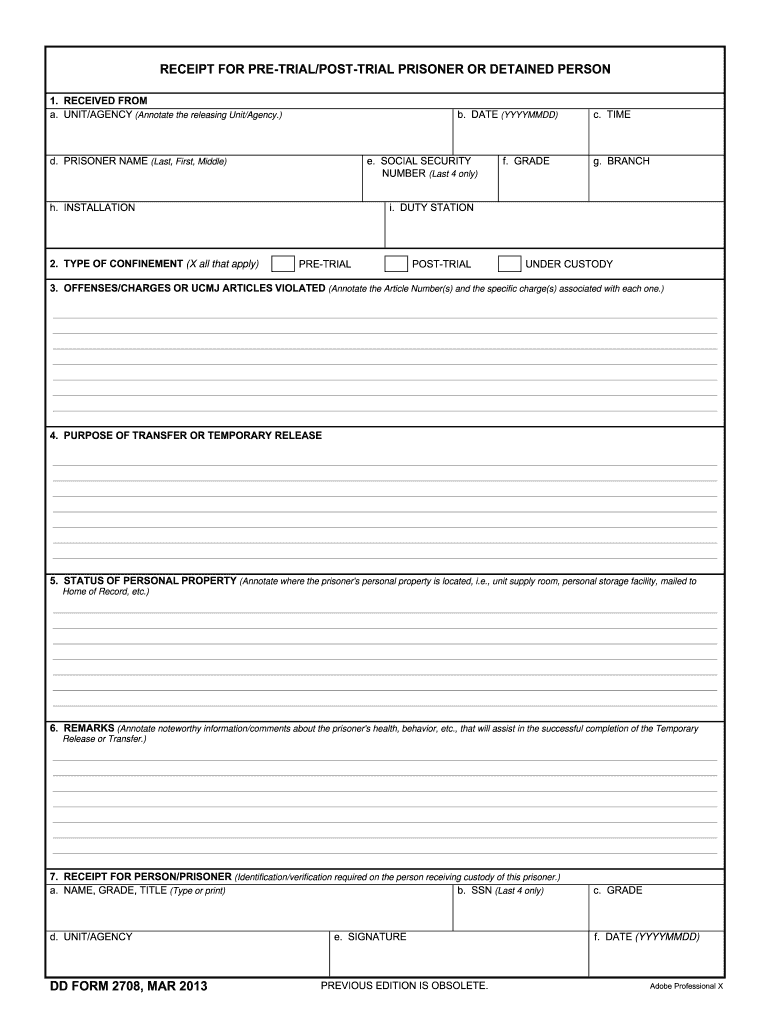
The "dd pre trial person" form is a critical legal document often used in the legal and correctional systems. It serves as a receipt during the transfer of a pre-trial detainee or inmate, detailing vital information about the individual and the circumstances of their custody. This document typically outlines specifics like the detainee's personal information, charges, the purpose of detention or transfer, and any conditions under which the transfer takes place. At its core, the form ensures transparency and accountability during the transfer process of individuals awaiting trial.
Key Components
- Releasing Agency Information: Lists the entity responsible for transferring custody.
- Detainee's Personal Details: Includes name, identification numbers, and demographic data.
- Type of Confinement: Details the nature of the detention, such as maximum, medium, or minimum security.
- Charges: Enumerates offenses the detainee is facing.
- Purpose of Transfer: Explains why the detainee is being moved.
- Status of Personal Property: Notes items accompanying the detainee.
- Remarks: Contains additional comments on detainee's condition or transfer specifics.
Steps to Complete the dd pre trial person
Filling out the "dd pre trial person" form requires accuracy due to its legal implications. Here's a step-by-step guide:
- Collect Required Personal Data: Start by gathering all necessary personal information about the detainee. Ensure that data like full name, identification numbers, and charges are correct to avoid discrepancies.
- Document Custody Details: Note the transferring and receiving entities clearly. Include contact information for possible follow-ups.
- Specify Transfer Purpose: Clearly articulate the reason behind the transfer, whether it’s for a court date, medical evaluation, or reassignment to another facility.
- Check Invalid or Unlabeled Data: Ensure no data fields are left blank unless not applicable. This prevents miscommunication during the exchange of custody.
- Authenticate with Signatures: Validate the document with signatures from the transferring and receiving parties to confirm validity.
Practical Considerations
- Ensure legibility in all handwritten sections.
- Double-check all date entries for accuracy.
- Confirm that all fields are completed before submission.
Legal Use of the dd pre trial person
The "dd pre trial person" form plays a crucial role in maintaining legal standards in the transfer of detainees. It maintains a record that protects both the individual being transferred and the agencies involved by ensuring a transparent process.
Compliance Factors
- Authenticity: The form must be filled out truthfully, reflecting accurate information to avoid legal repercussions.
- Confidentiality: Sensitive information must be handled with care to comply with privacy laws.
- Authorization: Only authorized personnel should fill out and authorize this form to maintain its legitimacy.
Real-world Example
If a detainee is transferred from a local jail to a federal facility, the filled form serves as an official record, tracing every responsible party involved in the handover.
State-specific Rules for the dd pre trial person
While the "dd pre trial person" form is used nationwide, certain state-specific regulations might affect its completion or submission. Some states may have additional requirements due to local legal statutes.
Variations to Consider
- Additional Signatures: Some states require an additional notary signature for the form to be valid.
- Extra Documentation: Documentation proving the purpose of the transfer may be more intricate in states with stricter legal frameworks.
- Regional Legal Terminologies: Language and legal terms used may vary slightly depending on local jurisdiction.
Key Elements of the dd pre trial person
Understanding the core components of the "dd pre trial person" form is crucial for properly executing its intended function.
Core Sections
- Identification and Verification: Ensures the right individual is being transferred.
- Offense Details: Lists offenses comprehensively to prevent any oversight.
- Transfer Logistics: Documents timing, location, and method of transfer.
Edge Cases
- Transfers between states might require submission to multiple legal entities, increasing the complexity.
- Special cases, like high-risk detainees, might necessitate additional security measures noted on the form.
Examples of Using the dd pre trial person
Understanding how the "dd pre trial person" form functions in practical scenarios illustrates its importance in the legal system.
- Example 1: A detainee is moved from a state prison to an external hospital for medical reasons. Here, the form records all specifications and permissions required for such a transfer.
- Example 2: In preparation for a high-profile trial, a detainee is transferred between jurisdictions to ensure they are present for court proceedings, with all steps and approvals documented on the form.
Steps to Obtain the dd pre trial person
Acquiring the "dd pre trial person" form can usually be done through specific legal or governmental channels.
- Contact Prison or Jail Administration: Request the form directly from the administration office handling detainee management.
- Access via Legal Counsel: Legal representatives or counsel can provide the form as part of legal proceedings involving a detainee.
- Online Platforms: Some jurisdictions offer printable versions through official justice department websites.
Important Considerations
- Verify the form’s version to ensure it meets the latest legal requirements.
- Check for any jurisdictional constraints that may affect obtaining and using the form.
Required Documents
Completing the "dd pre trial person" form might necessitate additional documents. Here's a list of potential requisites:
- Identification Proof: Government-approved ID, such as a driver's license or state ID card.
- Court Orders: Documents specifying the need and approval for transfer can support the form's individual case.
- Previous Custody Records: Any prior documentation related to the detainee's custody to provide a comprehensive background.
Document Handling
- Submit originals where required and keep copies for your records.
- Ensure documents are up-to-date to align with ongoing legal requirements.


