
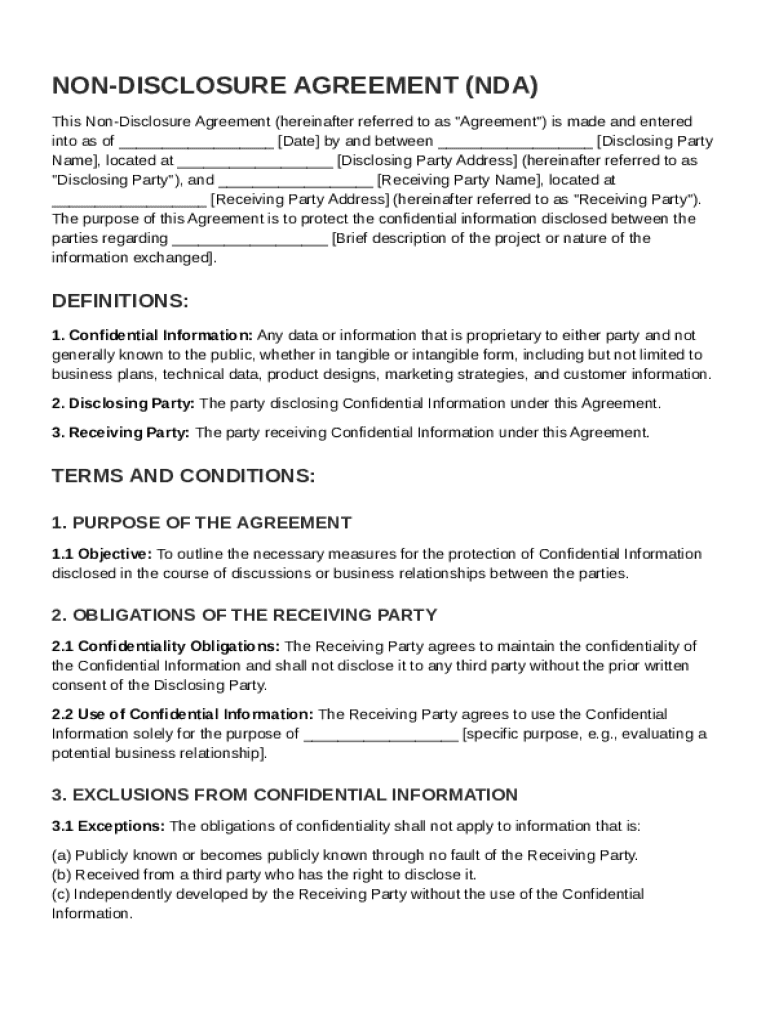







Definition & Meaning
A Legal Non-Disclosure Agreement (NDA) Template is a structured legal document designed to facilitate the protection of confidential information shared between two parties. Typically, this involves a Disclosing Party sharing sensitive data with a Receiving Party, with the agreement setting forth obligations to safeguard this information. The template outlines key components such as obligations, exclusions, and specified uses, thus ensuring both parties are clear about the terms of confidentiality. The NDA template is crucial in maintaining the integrity and privacy of vital business information and is used widely across various industries.
Key Elements of the Legal Non-Disclosure Agreement Template
A comprehensive Legal Non-Disclosure Agreement Template contains several critical sections:
- Identification of Parties: Clearly names and describes both the Disclosing Party and the Receiving Party.
- Definition of Confidential Information: Specifies what constitutes confidential information and what is excluded.
- Obligations of Confidentiality: Details the Receiving Party's responsibility to protect the disclosed data.
- Exclusions from Confidentiality: Lists scenarios where information may not be considered confidential, such as public domain information.
- Term and Duration: States the period during which the NDA is effective.
- Return of Materials: Requires the return or destruction of materials upon termination of the agreement.
- Governing Law: Specifies the jurisdiction's laws that apply to the NDA.
- Amendment Provisions: Outlines how modifications to the agreement can be made.
These elements ensure all parties understand their obligations and the extent of confidentiality.
Steps to Complete the Legal Non-Disclosure Agreement Template
- Identify the Parties: Clearly define the Disclosing and Receiving Parties, including legal names and contact information.
- Define Confidential Information: Explicitly list what information is classified as confidential.
- Outline Obligations: Specify the confidentiality obligations for the Receiving Party, including handling and use restrictions.
- Detail Exclusions: Identify any exclusions to confidentiality, such as information that is publicly available.
- Specify the Duration: Determine the length of time the agreement remains in force.
- Return Protocol: Establish procedures for returning or destroying confidential materials.
- Agree on Governing Law: Identify the state laws that will govern the NDA.
Completing these steps ensures all pertinent information is included in the finalized NDA template.
Legal Use of the Legal Non-Disclosure Agreement Template
The Legal Non-Disclosure Agreement Template is primarily used to legally bind parties to maintain the confidentiality of shared proprietary information. This is essential in various contexts, such as:
- Business Negotiations: Protects sensitive details during mergers or acquisitions.
- Employment Agreements: Safeguards corporate secrets as employees gain access to confidential business information.
- Partnerships: Ensures mutual confidentiality in joint ventures or collaborations.
Enforcing these agreements legally obligates the parties to adhere to the terms, allowing businesses to protect sensitive data effectively.
Important Terms Related to Legal Non-Disclosure Agreement Template
Understanding specific terms within the Legal Non-Disclosure Agreement Template is vital:
- Disclosing Party: The person or entity sharing confidential information.
- Receiving Party: The person or entity receiving confidential information under the conditions laid out in the NDA.
- Confidential Information: Data considered sensitive and protected under the NDA.
- Governing Law: The legal system or jurisdiction that oversees the NDA's enforcement.
- Term: The duration that the terms of the NDA are in effect.
Clear definitions of these terms help prevent misunderstandings between parties.
Who Typically Uses the Legal Non-Disclosure Agreement Template
The Legal NDA Template is used by a diverse range of individuals and entities, including:
- Entrepreneurs: Protects business ideas and plans.
- Corporations: Safeguards proprietary methods and trade secrets.
- Startups: Protects innovative concepts and business models.
- Consultants: Ensures the confidentiality of client information.
- Nonprofits: Maintains privacy of donor information and strategic plans.
This template serves as a fundamental tool for anyone needing to secure sensitive information.

Examples of Using the Legal Non-Disclosure Agreement Template
Practical application of the Legal NDA Template can be seen in various scenarios:
- Tech Companies: Use NDAs when disclosing software codes to outside contractors.
- Manufacturing Firms: Share product design details with suppliers under NDA terms.
- Healthcare Providers: Protect patient information when collaborating with third-party researchers.
Such examples highlight the template's versatility across different industries and practices.
Software Compatibility
The Legal Non-Disclosure Agreement Template can be integrated into numerous software platforms to streamline document management. It is commonly used with:
- DocHub: Facilitates editing, signing, and sharing within a secure, cloud-based environment.
- Google Workspace: Allows for seamless integration with Google Drive and collaboration in real-time.
- Cloud Storage Solutions: Enables easy access and management via services like Dropbox and OneDrive.
This compatibility ensures that users can handle NDAs efficiently and securely across digital platforms.
State-Specific Rules for the Legal Non-Disclosure Agreement Template
Different states have varying legal requirements for NDAs that need to be considered:
- California: Employers cannot require NDAs to suppress information about sexual harassment.
- New York: Public sector NDAs are regulated to ensure transparency.
- Texas: Enforces additional requirements for enforceability, particularly concerning consideration clauses.
Understanding state-specific rules is vital to ensure enforceability and compliance with local laws.




