




01. Edit your form online
Type text, add images, blackout confidential details, add comments, highlights and more.

Type text, add images, blackout confidential details, add comments, highlights and more.

Draw your signature, type it, upload its image, or use your mobile device as a signature pad.

Send it via email, link, or fax. You can also download it, export it or print it out.
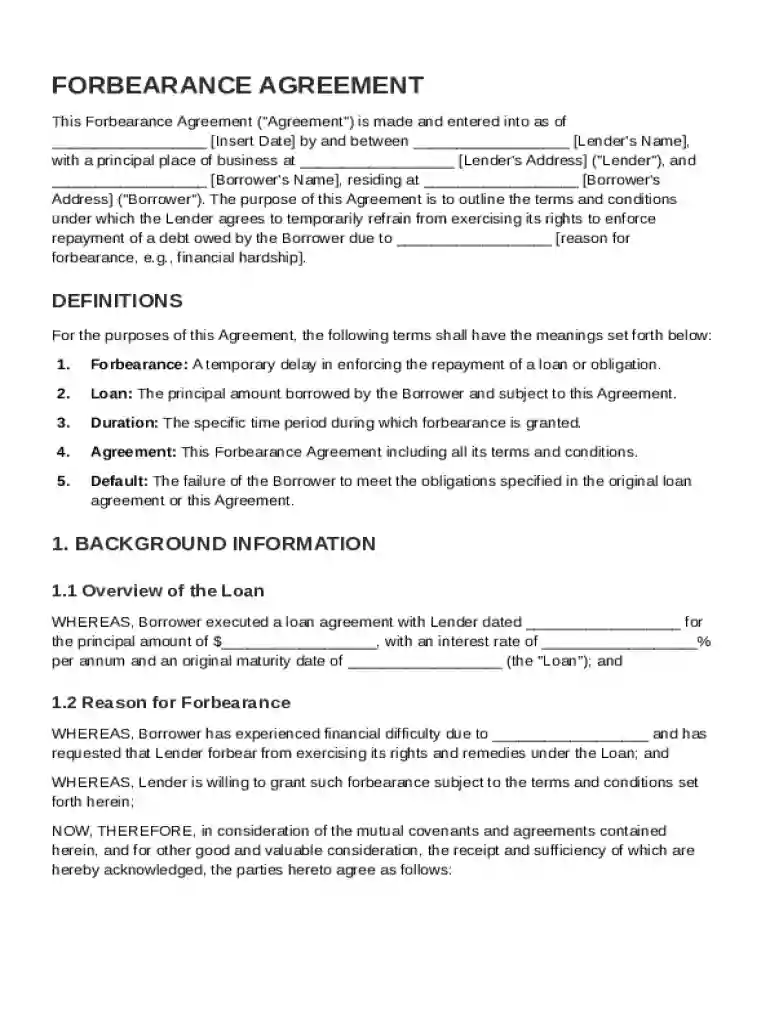
A Forbearance Agreement serves as a pivotal legal contract between a lender and borrower, detailing an arrangement where the lender temporarily suspends the enforcement of debt repayment obligations due to the borrower's financial hardship. It provides a structured approach to defer payments without defaulting and maintains the borrower's credit rating. The agreement explicitly outlines the terms and conditions, including the duration of relief, payment structure during the forbearance, and the borrower's responsibilities once the relief period concludes. This document is essential in offering financial relief to borrowers while retaining the lender's rights to enforce obligations should the borrower default post-forbearance.
The Forbearance Agreement Template is structured to include critical components essential for agreement efficacy and enforceability.
Forbearance Period: Specifies the duration for which repayment obligations are deferred.
Payment Terms: Outlines the borrower’s payment schedule during and after the forbearance period, detailing any interest accruals or fees.
Obligations of Both Parties: Clearly defines responsibilities both parties must adhere to during the agreement, such as maintaining insurance on collateral or providing financial updates.
Conditions Precedent: Lists any conditions that must be satisfied before the forbearance is effective, such as payment of arrears or execution of collateral documents.
Lender's Rights upon Default: States the legal remedies available to the lender if the borrower fails to comply with the terms post-forbearance period, including reinstatement of the original debt schedule or foreclosure.
Miscellaneous Provisions: This section addresses governing laws, clauses for amendment, and severability clauses ensuring the agreement's continued validity even if a part of it is unenforceable.
Filling out the Forbearance Agreement Template requires attention to detail to ensure both parties' interests are protected.
Begin with Identification: Start by filling in the lender’s and borrower’s details, including full legal names, addresses, and contact information.
Outline the Forbearance Terms: Clearly document the timeline for the temporary payment relief and any intermediate financial obligations.
Detail Payment Adjustments: Specify any changes in payment terms, such as interest adjustments or penalties during the relief period.
Add Parties' Obligations: Thoroughly articulate the obligations each party is expected to fulfill during the forbearance period.
Include Contingency Measures: Include conditions that address potential future borrowing or security adjustments.
Signatories and Notarization: Conclude by ensuring all necessary signatures are notarized to affirm the agreement’s validity.
The legality of a Forbearance Agreement is paramount, especially within the U.S.
Compliance with Federal Law: Ensure the agreement adheres to relevant federal laws, such as the Fair Debt Collection Practices Act, to avoid unlawful practices.
Adherence to State Regulations: State laws vary, affecting the application of certain clauses. It is prudent to engage legal counsel familiar with state-specific regulations.
Binding Nature: Legal counsel can ensure that the agreement is enforceable, incorporating necessary legal language and considering potential debtor defenses.
Execution and Notarization: For legal effect, ensure that the document is executed in accordance with notarial laws applicable in the lender’s and borrower's jurisdictions.
Understanding key legal and financial terminology is essential for negotiating a Forbearance Agreement.
Default: Refers to the borrower's failure to meet legal obligations as specified in the original loan agreement.
Interest Accrual: Specifies how interest will be calculated and compounded during the forbearance period.
Repayment Schedule: An outlined timetable for reduced or postponed payments, detailing amounts and dates due.
Modification Clause: Offers provisions for altering contract terms upon mutual agreement.
Security Interest: Any collateral pledged by the borrower to secure the loan, potentially subject to adjustment upon agreement signing.
Establishing eligibility for a Forbearance Agreement typically involves assessing the borrower's financial situation.
Demonstrable Financial Hardship: Borrowers must provide evidence, such as unemployment or medical expenses, impacting income.
Previous Payment History: Lenders often require a record of past timely payments to consider eligibility.
Verification of Income and Assets: Borrowers may need to submit income statements and asset lists to assess repayment capability post-forbearance.
Assessment of Loan Status: The loan must be current or within the grace period for forbearance consideration.


The Forbearance Agreement Template is particularly beneficial for:
Individuals Facing Temporary Hardship: Borrowers experiencing short-term financial setbacks, like job loss or medical emergencies.
Small Business Owners: Those facing cash flow disruptions and seeking to maintain operations.
Educational Loan Borrowers: Students or graduates during periods of economic downturn or job-seeking phases.
Mortgage Holders: Homeowners encountering unforeseen financial circumstances needing temporary payment relief.

Real-world cases highlight the versatility of Forbearance Agreements:
Case Study: Financial Crisis Impact: During economic downturns, financial institutions help clients maintain loan accounts by offering forbearance.
Educational Sector: Schools offering forbearance on tuition loans for students awaiting resumption of classes or employment.
Small Business Interruption: Small businesses affected by natural disasters utilizing forbearance to manage temporary revenue losses and avoid defaults.
These examples illustrate the myriad ways in which the Forbearance Agreement Template aids borrowers in navigating financial difficulties.
At DocHub, your data security is our priority. We follow HIPAA, SOC2, GDPR, and other standards, so you can work on your documents with confidence.





Entering a credit forbearance agreement sends a powerful signal to the market that the firm can and will negotiate to win concessions from lenders following
Such a declaration of agreement on my part would not be worth much to anybody. It would, certainly, prove nothing, as to what part I might have taken, had I


