
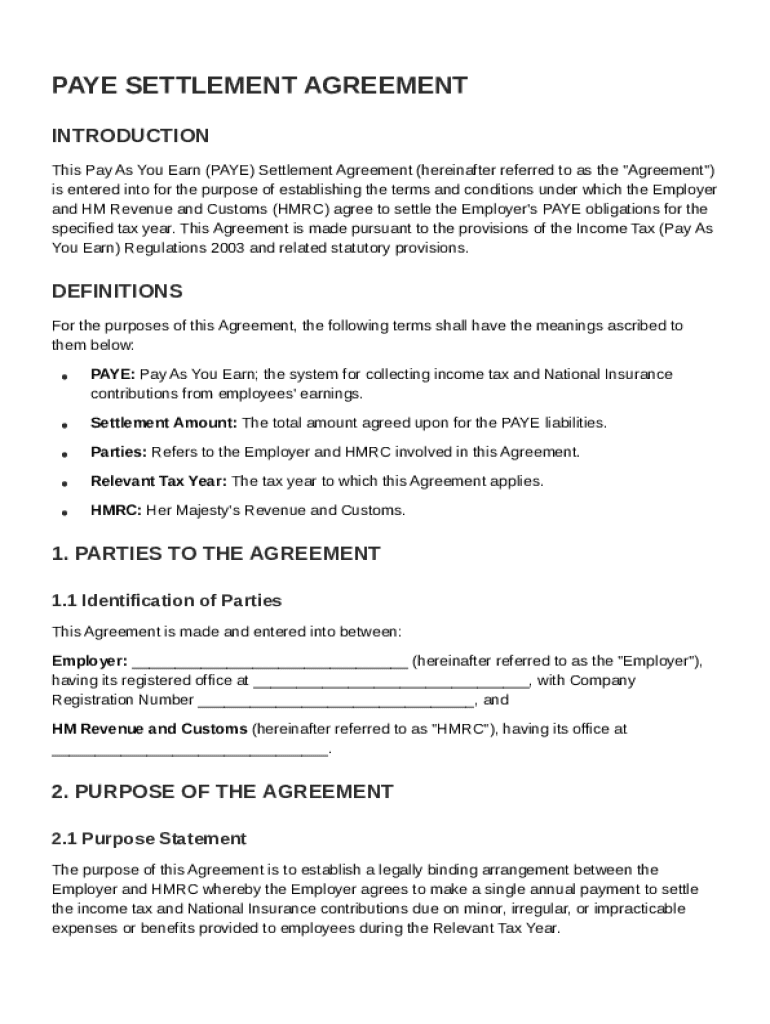







Definition and Meaning of the PAYE Settlement Agreement Template
The PAYE Settlement Agreement (PSA) template is a document that facilitates the agreement between an employer and HM Revenue and Customs (HMRC) in the UK. It outlines the terms under which an employer can make a single annual payment to cover all income tax and National Insurance contributions on minor, irregular, or impractical to evaluate employee benefits. Although primarily a UK-centric term, understanding its role can offer insights for U.S.-based businesses with international operations. This template specifies crucial elements, including involved parties, payment terms, confidentiality conditions, and the process of amendments and termination.
Key Elements of the PAYE Settlement Agreement Template
- Parties Involved: Lists the employer and HMRC as the primary parties.
- Payment Terms: Details the annual payment method for covering employee benefits.
- Confidentiality: Establishes obligations to maintain the privacy of disclosed information.
- Amendments and Termination: Conditions under which the agreement can be modified or ended.
- Governing Law: Specifies the laws that will govern the agreement.
Each element ensures that both parties have a clear understanding of their responsibilities and rights, thereby minimizing potential disputes.
Legal Use and Considerations
Employers using the PSA template must comply with legal standards to ensure its enforceability. The document must be signed by authorized representatives of both parties and adhere to relevant employment and tax laws. Missteps in legal adherence could result in penalties or invalidation of the agreement.
How to Use the PAYE Settlement Agreement Template
To effectively utilize the PAYE Settlement Agreement template, an employer should first gather all relevant employee benefit data to accurately calculate tax obligations. Next, the template should be completed with precise information pertaining to the benefits covered and payment terms. Ensuring accuracy at this stage is crucial to prevent disputes or additional liabilities.
- Identify Employee Benefits: Include only minor, irregular, or impractical-to-evaluate benefits.
- Calculate Tax Obligation: Accurately determine the taxes due on these benefits.
- Complete the Template: Fill in all necessary fields with precise data.
- Review and Sign: Both parties must validate the agreement through signatures.
- Submit to HMRC: Follow submission guidelines to ensure acceptance.
Steps for Completion
Completing the PAYE Settlement Agreement template involves several specific steps:
- Consult with a tax advisor to confirm the accuracy of calculations.
- Gather necessary documentation to support benefit details.
- Review the template with legal counsel to ensure compliance with governing laws.
- Ensure that all stakeholder approvals are obtained before final submission.
Importance of the PAYE Settlement Agreement Template
The PSA template is crucial for employers seeking to streamline tax administration related to employee benefits. By consolidating payments into a single annual transaction, businesses can reduce administrative overhead, avoid unexpected tax liabilities, and budget more effectively. This agreement simplifies compliance and enhances financial predictability.
Benefits to Employers
- Administrative Efficiency: Minimizes the complexity of processing individual payments.
- Cost Predictability: Allows financial planners to account for annual tax expenses more effectively.
- Simplified Compliance: Eases adherence to tax regulations concerning minor employee benefits.
Who Typically Uses the PAYE Settlement Agreement Template
The PAYE Settlement Agreement template is typically used by employers across various sectors who provide minor, irregular, or impractical-to-value benefits to their employees. While it is most applicable to UK-based entities, U.S.-based multinational companies with operations in the UK might also utilize it. Common users include small to medium-sized enterprises (SMEs) and large corporations aiming to simplify their tax processes.


Business Types and Scenarios
- Multinationals: Firms operating across borders require clear tax processing systems.
- SMEs: Smaller businesses benefit from simplified, predictable tax payments.
- Corporations: Large enterprises often have extensive employee benefit programs.
Obtaining the PAYE Settlement Agreement Template
Employers can typically obtain the PAYE Settlement Agreement template through official government channels or a certified tax advisor. In addition, many legal and tax consulting firms offer customized templates to fit specific business needs. Engaging a tax professional ensures that the template meets legal standards and accurately reflects the employer's obligations.
Penalties for Non-Compliance
Failure to adhere to the terms set forth in a PAYE Settlement Agreement can lead to significant penalties imposed by HMRC. These penalties include additional tax charges and interest on unpaid amounts. Employers must therefore ensure they fully understand and abide by the agreement terms to avoid financial repercussions.
Implications of Non-Compliance
- Financial Penalties: Monetary fines can be substantial.
- Increased Scrutiny: HMRC may subject violators to more frequent audits or reviews.
- Reputational Damage: Non-compliance can harm a company's standing with employees and regulatory bodies.
Employers are encouraged to regularly review the compliance of their settlement agreements and consider periodic audits to ensure adherence.




