






Definition and Meaning
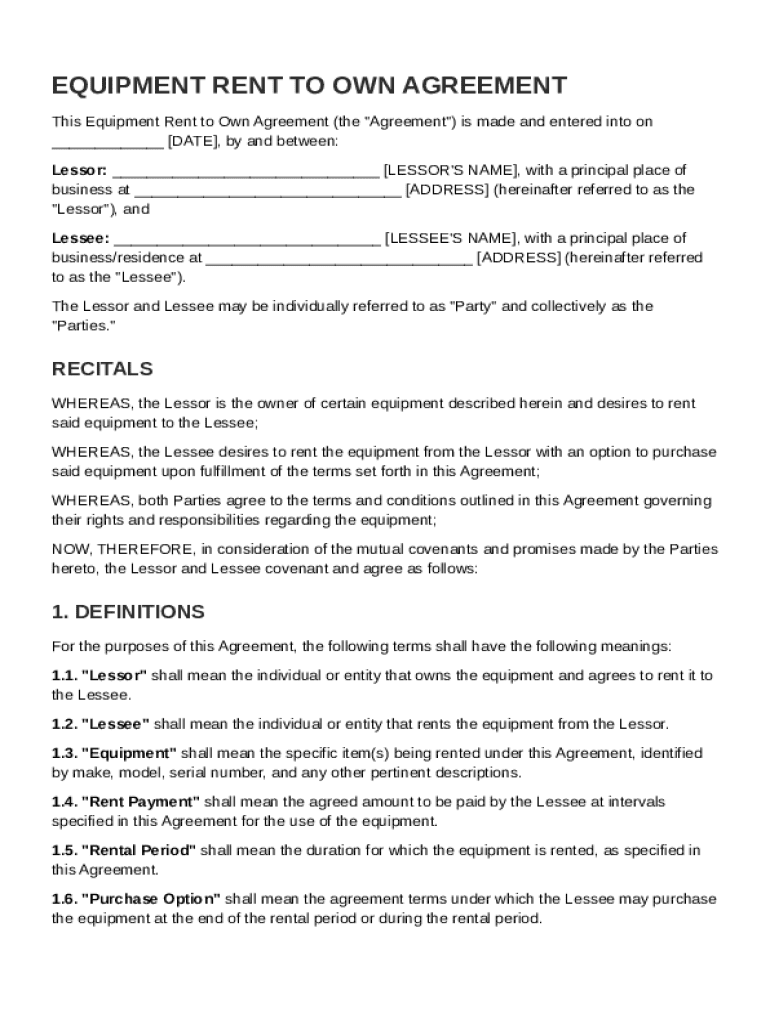
The Equipment Rent to Own Agreement Template is a legal document outlining the terms under which equipment is provided by a lessor to a lessee with an option to purchase it after certain conditions are met. This agreement specifies key aspects such as definitions of the involved parties, rental terms, and payment obligations, thus setting a clear contractual relationship. It is particularly important because it clarifies both parties' rights and responsibilities regarding the rental and potential ownership, which helps avoid disputes.
Key Elements of the Equipment Rent to Own Agreement Template
Within this agreement, several critical elements constitute its foundation. These include:
- Rental Terms: Details on the duration of the lease and the option to purchase.
- Payment Obligations: Clear elaboration on payment schedules and penalties for late payment.
- Maintenance Responsibilities: Designation of responsibilities for equipment upkeep and repairs.
- Liability and Insurance Requirements: Specifications on insurance coverage responsibilities and liabilities.
- Termination Conditions: Conditions under which the agreement may be terminated by either party.
- Governing Law: Jurisdictional rules applicable to the agreement.
Important Terms Related to the Equipment Rent to Own Agreement Template
Several terms are integral to understanding the scope and implementation of this agreement:
- Lessor and Lessee: The provider (lessor) and receiver (lessee) of equipment.
- Option to Purchase: The opportunity for the lessee to buy the equipment after meeting certain conditions.
- Rental Rates: The monetary charges levied on the lessee for the use of equipment.
- Depreciation: Decrease in value of the equipment over time, affecting purchase decisions.
- Default: Failure to meet the terms, potentially resulting in termination or penalties.
How to Use the Equipment Rent to Own Agreement Template
Utilizing this template involves several steps, ensuring it is tailored to the specific needs of the parties involved:
- Identification Details: Include detailed information about the lessor and lessee.
- Equipment Description: Provide comprehensive descriptions of the equipment being rented.
- Specify Terms: Clearly state rental periods, payment plans, and purchase options.
- Legal Review: Consult with legal professionals to confirm compliance with applicable laws.
- Execution of Agreement: Ensure both parties sign the document and retain copies for records.
Steps to Complete the Equipment Rent to Own Agreement Template
Completing the agreement requires attention to detail and accurate information:
- Review Standard Template: Familiarize yourself with the standard clauses and modify as necessary.
- Fill Out Personal/Business Information: Include all relevant contact and business details for both parties.
- Customize Payment and Term Sections: Adjust these sections to reflect accurate pricing and timelines.
- Include Special Clauses: Add any specific terms agreed upon by both parties, such as special maintenance provisions.
- Finalize and Sign: Ensure the document is signed with both parties consenting to the terms.
Legal Use of the Equipment Rent to Own Agreement Template
The legal aspect of this agreement ensures it complies with the relevant state laws, making it binding. Legal counsel should be sought to vet the agreement, ensuring adherence to:
- State Laws: These govern the enforcement and interpretation of the agreement.
- Contractual Obligations: The enforceability of the agreement based on the outlined terms.
State-Specific Rules for the Equipment Rent to Own Agreement Template
Different states may impose unique requirements or constraints on rent-to-own agreements. These factors might include:
- Regulatory Compliance: State-specific consumer protection laws to be considered.
- Disclosure Requirements: Varying rules about what must be disclosed in the contract.
- Maximum Interest Rates: Some states regulate the interest rates or fees that can be charged.
Examples of Using the Equipment Rent to Own Agreement Template
To understand practical applications, consider these scenarios:
- Construction Companies: Utilize this template to acquire heavy machinery with limited upfront capital.
- Event Management Firms: Rent audio-visual equipment for events with the possibility of purchasing if long-term use is needed.
- Small Businesses: Acquire office equipment with an option for eventual ownership, minimizing initial investment.
Business Types That Benefit Most from Equipment Rent to Own Agreement Template
Certain businesses stand to gain significantly from this type of agreement:
- Startups: With limited initial capital, they can access necessary equipment.
- Seasonal Businesses: Obtain seasonal equipment temporarily or acquire over time as business cycles fluctuate.
- SMEs with Cash Flow Constraints: Allows for financial flexibility by spreading out payments.