






Definition and Meaning of the Advance Agreement Template
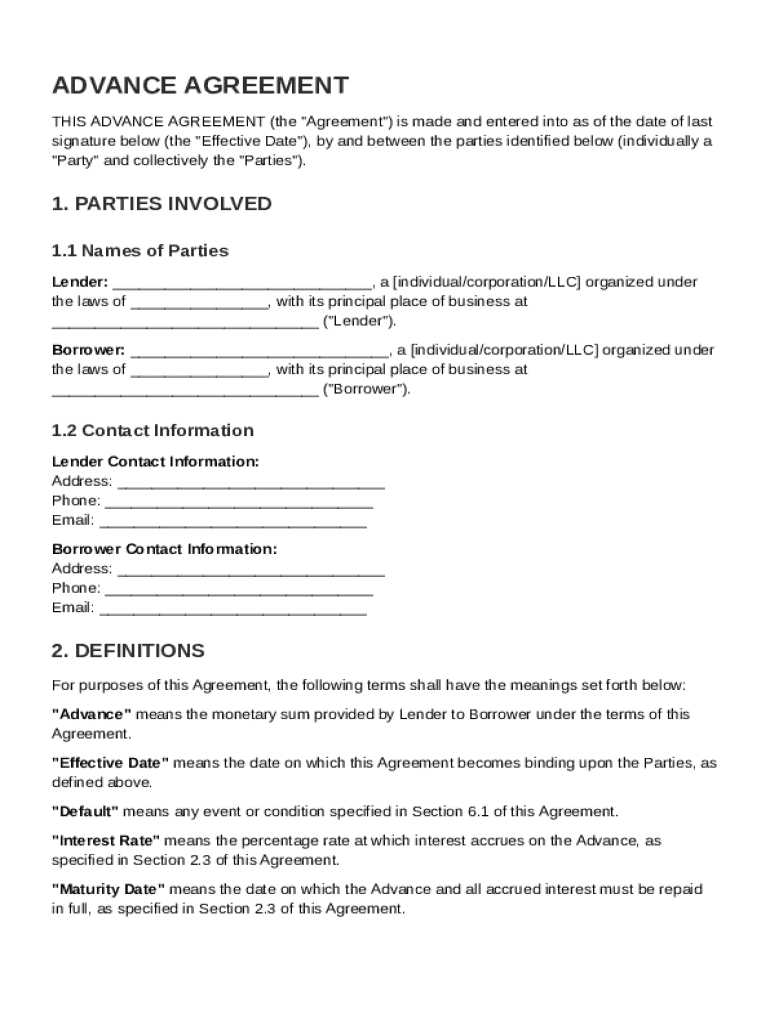
The Advance Agreement Template is a legally binding document that establishes the conditions under which a Lender provides a monetary Advance to a Borrower. It outlines the key components such as parties involved, definitions of critical terms, the advance amount, and its purpose. The document also specifies interest rates, repayment terms, and the obligations of both parties. The template is designed to serve as a comprehensive contract between the Lender and the Borrower, ensuring clarity and understanding in financial transactions.
Key Elements
- Parties Involved: Identifies the Lender and Borrower explicitly by name, ensuring legal recognition.
- Advance Amount and Purpose: Specifies the amount provided and the specific use case, preventing misuse.
- Interest Rates and Repayment Terms: Clearly defined terms for interest rates and repayment schedule.
- Obligations and Covenants: Details mutual expectations and specific actions prohibited or mandated for each party.
Steps to Complete the Advance Agreement Template
- Identify the Parties: Start by providing full legal names and contact details of both Lender and Borrower.
- Define Key Terms: It's essential to include a clear section explaining industry-specific terms used throughout the document.
- Detail the Advance: Specify the exact amount, purpose, and any associated conditions or limitations.
- Set Interest Rates and Repayment Terms: Include details about interest computation, payment schedules, and any penalties for late payments.
- List Conditions Precedent: Outline actions or documents required before disbursement.
- Include Covenants and Defaults: Detail actions that constitute default and outline remedial actions.
- Governing Law and Miscellaneous Provisions: State the jurisdictional law applied and include any other relevant provisions.
Common Mistakes to Avoid
- Failing to specify the exact Advance amount and its intended use.
- Overlooking the detailed description of repayment terms and interest rates.
Important Terms Related to Advance Agreement Template
Understanding legal terms within the Advance Agreement Template is crucial for clarity and legal compliance.
- Advance: The amount of money lent by the Lender to the Borrower.
- Interest Rate: The percentage at which interest will accrue on the borrowed sum.
- Repayment Terms: The schedule and conditions for repaying borrowed funds.
- Default: Failure of the Borrower to meet the obligations outlined in the agreement.
Real-world Examples
- A company taking an advance to secure early inventory purchases.
- An individual borrowing funds to finance a real estate investment.
Legal Use of the Advance Agreement Template
Legal use of the template involves adhering to the ESIGN Act ensuring that electronic signatures are valid and enforceable in the United States. The agreement acts as a crucial framework for lending scenarios, ensuring all parties meet their obligations.
Legal Considerations
- Ensure the document is consistent with federal and state laws.
- Include mandatory legal disclaimers about the binding nature of electronic signatures.
Software Compatibility and Integration
DocHub, a leading platform, offers seamless integration capabilities with popular software, enhancing usability of the Advance Agreement Template.
Compatible Tools and Platforms
- Google Workspace: Direct import from Gmail and Drive facilitates easy document management.
- Cloud Storage Services: Supports Dropbox, OneDrive, and other cloud platforms for secure storage and sharing.
Benefits of Digital Forms
- Enhanced accessibility and efficiency in document management.
- Real-time collaboration and update synchronization.
Typical Users of the Advance Agreement Template
This template is versatile and caters to a wide range of individuals and businesses seeking to formalize lending transactions.
- Small Business Owners: Often use it to secure short-term liquidity.
- Loan Officers and Financial Advisers: Utilize it to streamline client transactions.
- Private Lenders: Individuals offering capital to borrowers for specific projects or investments.
Case Studies
- A startup using the template to borrow funds required for product development.
- A private lender providing financial assistance to family business expansions.
State-Specific Rules for the Advance Agreement Template
Lending laws can vary significantly from state to state, affecting how the Advance Agreement Template is utilized and enforced.
Notable State Variations
- California: Strict regulations around interest rates and borrower protection.
- Texas: Specific guidelines on usury limits and repayment conditions.
Ensuring Compliance
- Verify state-specific regulations before drafting the agreement.
- Consider consulting with a legal expert familiar with state laws to ensure compliance and enforceability.
Versions and Alternatives to the Advance Agreement Template
While the Advance Agreement Template offers a comprehensive framework, there may be other versions or alternatives better suited for specific needs.
Popular Alternatives
- Promissory Notes: Simpler documents primarily focused on the borrower's promise to pay back with defined terms.
- Loan Agreements: More detailed contracts that may include additional features like collateral clauses.
Selecting the Right Template
- Evaluate the specific needs and complexity of the transaction.
- Consider the relationship between parties and existing legal requirements.