






Definition & Meaning
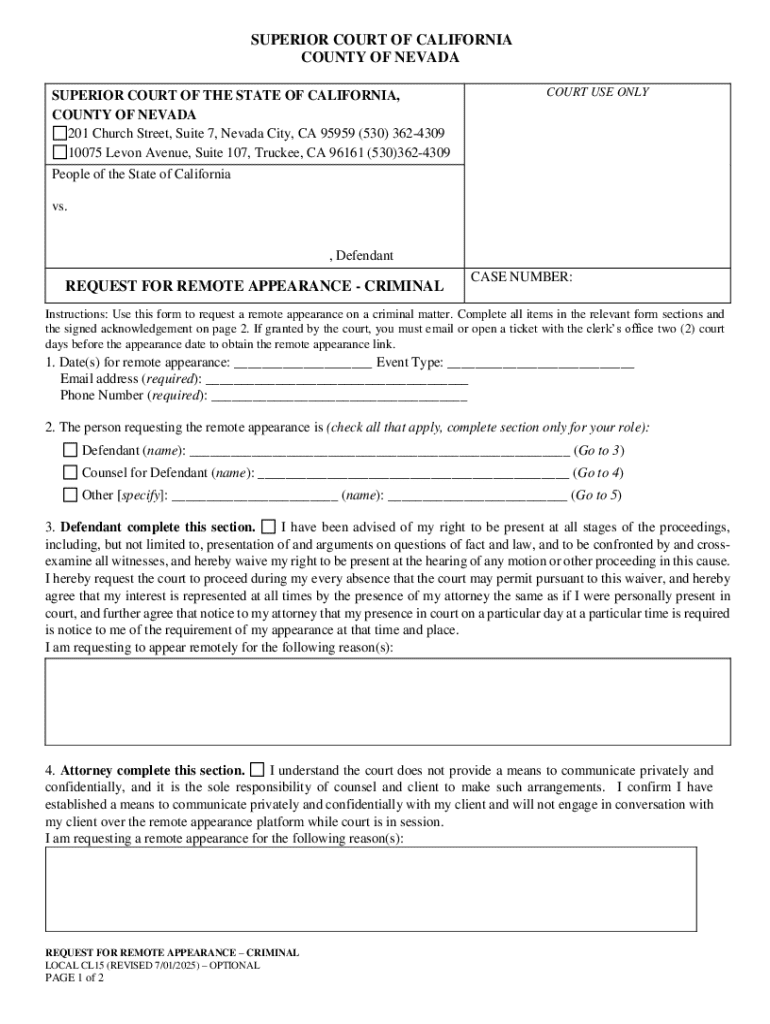
The "Request for Remote Appearance - Criminal" form is an official document issued by the Superior Court of California, County of Nevada, designed for individuals involved in criminal proceedings who wish to appear in court remotely. This form serves as a formal application to participate in legal processes via electronic means rather than attending in person. This option can be critical in situations where physical presence in court is challenging due to geographical, health, or scheduling constraints. The form not only specifies the procedural requirements but also identifies the legal rights and responsibilities associated with a remote court appearance.
How to Obtain the Request for Remote Appearance - Criminal
To acquire the "Request for Remote Appearance - Criminal" form, one can explore various channels. Typically, the form is available on the official website of the Superior Court of California, County of Nevada, under the forms section pertaining to criminal cases. Alternatively, individuals can visit the courthouse in person to request a physical copy. Some legal offices and online legal document services might also provide access to the form for convenience. Ensure that the form retrieved is the most recent version to comply with any updates in legal procedures or requirements.
Steps to Complete the Request for Remote Appearance - Criminal
Completing the form requires careful attention to detail and involves several steps to ensure accuracy and compliance.
-
Identify the Case Information: Enter all relevant details about the criminal case, including the case number, court location, and the names of the involved parties.
-
State the Reason for the Request: Clearly and concisely articulate the reasons for seeking a remote appearance. This might include logistical challenges, health concerns, or other personal circumstances that prevent physical attendance.
-
Acknowledge the Terms: Understand and acknowledge the legal implications of a remote appearance, including a waiver of rights that might be pertinent to a physical presence.
-
Provide Contact Information: Provide current and accurate contact details to ensure the court can provide necessary updates or instructions regarding the remote appearance arrangement.
-
Sign and Date: Ensure the form is signed and dated, validating the information provided and the request's authenticity.
-
Review and Submission: Double-check all entered details for accuracy before submission. The form can typically be submitted online, via mail, or in-person at the courthouse.
Why You Should Request for Remote Appearance - Criminal
Opting for a remote court appearance can offer numerous advantages.
-
Accessibility: Individuals unable to travel to court due to distance, health issues, or mobility restrictions can still participate fully in their legal proceedings.
-
Cost Efficiency: Reduces the need for travel and accommodations, potentially alleviating financial burdens associated with in-person court appearances.
-
Time-Saving: Minimizes time lost traveling or waiting in court, allowing individuals to focus on personal, professional, or other legal responsibilities.
-
Health Safety: Particularly useful during public health crises, ensuring that proceedings can continue without compromising individuals' health concerns.
Who Typically Uses the Request for Remote Appearance - Criminal
The form primarily serves defendants involved in criminal cases and their counsel, but it can also be utilized by other parties such as witnesses or victims who have valid reasons for requesting remote participation. Legal professionals or advocates working with these individuals often coordinate the completion and submission of such requests to ensure compliance with legal norms and court expectations. The availability of this option supports individuals with disabilities, those living in remote areas, or participants in multi-jurisdictional cases.


Key Elements of the Request for Remote Appearance - Criminal
This form includes several critical components that must be filled out accurately:
-
Case Information: Details such as the case number, parties involved, and date of proceedings.
-
Applicant Details: The personal information of the person requesting the remote appearance, including contact and identification details.
-
Rationale for Request: A section where applicants must state their reasons for requesting a remote appearance, supported with evidence if necessary.
-
Legal Acknowledgments: Includes clauses where the applicant confirms their understanding of the legal effects of appearing remotely.
-
Signatures: Required from the applicant and, if applicable, their legal representative.
State-Specific Rules for the Request for Remote Appearance - Criminal
While the form is specific to the Superior Court of California, County of Nevada, it may be subject to variations based on state or local rules governing remote appearances in criminal cases.
-
Specific Jurisdictional Requirements: Some counties may have additional requirements or forms that must accompany the main request to ensure compliance.
-
State Regulations: Understand any state-level statutes or court rules that define the procedures, rights, and responsibilities of a remote appearance.
-
Conditional Approvals: In some cases, approval for remote appearances may be conditional on the nature of the crime, the stage of the legal process, or the arguments presented in the request.
Legal Use of the Request for Remote Appearance - Criminal
The form facilitates legal compliance by providing a structured method for requesting and approving remote appearances. It is essential for maintaining procedural fairness while allowing flexibility within the justice system.
-
Court Approval: Before a remote appearance is allowed, a judge must approve the request, ensuring judicial oversight and adherence to due process.
-
Legal Rights and Waivers: It includes disclosures about the rights preserved or waived due to not physically being in court, ensuring informed consent from the applicant.
-
Enforcement and Compliance: During remote appearances, legal standards such as evidence rules and etiquette still apply, maintaining the integrity and effectiveness of the legal process.