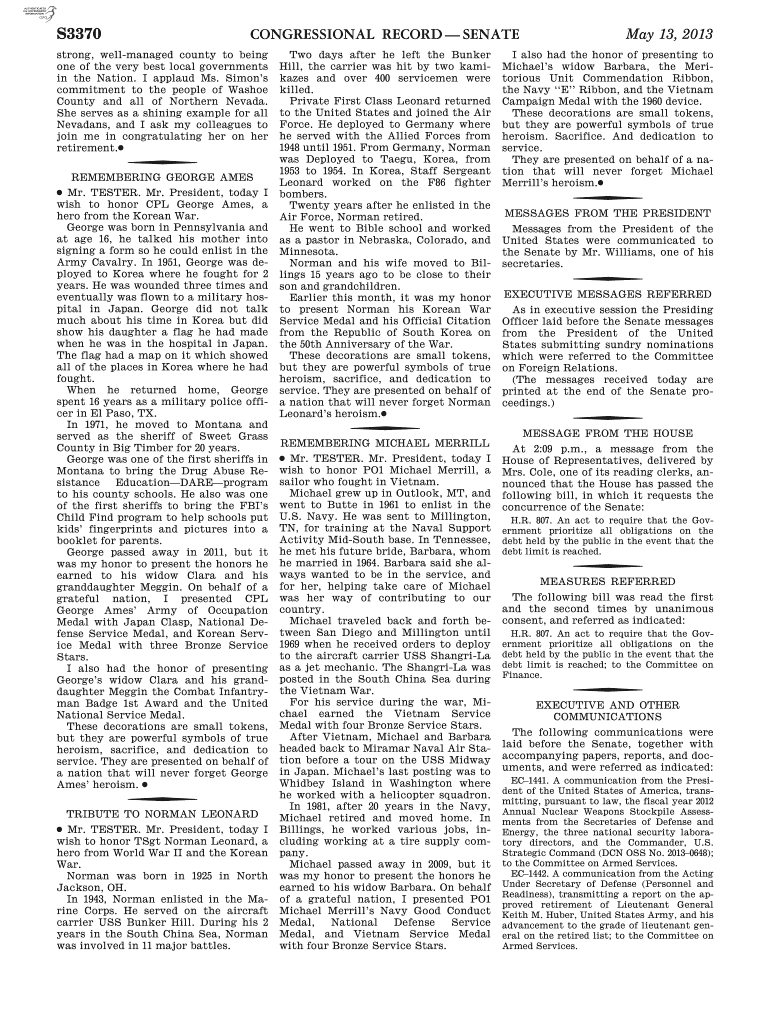







Definition and Meaning
The "CONGRESSIONAL RECORD SENATE S3370 - Congress" refers to a specific section within the Congressional Record that documents the proceedings and debates of the United States Senate. The Congressional Record is a comprehensive, official transcript of discussions, speeches, and decisions made in Congress, serving as a vital tool for transparency and accountability in the legislative process. This particular record, S3370, may include detailed discussions, legislative updates, and notable events occurring on specific dates.
How to Use the CONGRESSIONAL RECORD SENATE S3370 - Congress
Accessing and utilizing the "CONGRESSIONAL RECORD SENATE S3370 - Congress" involves several steps. First, individuals can find the document through government websites or archives that store Congressional Records. Researchers and citizens can use the document to gain insights into Senate proceedings and understand legislative changes or debates. The record can be referenced for verifying historical data or understanding legislative intent.
- Researchers can analyze voting trends and legislative priorities.
- Lawyers and policymakers use it for understanding the legal discussions surrounding specific bills.
- Journalists rely on it for accurate reporting on Congressional activities.
Key Elements of the CONGRESSIONAL RECORD SENATE S3370 - Congress
This record includes several critical elements that provide detailed insights into Senate activities:
-
Debates and Discussions: Offers detailed narratives of the debates held on the Senate floor, presenting arguments for and against various legislative actions.
-
Legislative Proposals: Lists new bills introduced, amendments suggested, and the progress of pending legislation.
-
Votes and Decisions: Records the outcomes of Senate votes, showing how each senator voted on specific issues.
-
Tributes and Recognitions: Includes acknowledgments of notable figures or significant events, often highlighting contributions of individuals such as military personnel or civic leaders.
Important Terms Related to CONGRESSIONAL RECORD SENATE S3370 - Congress
Understanding the terminology used within the Congressional Record is vital:
- Amendment: A formal change or addition proposed during the debate on a bill.
- Quorum: The minimum number of senators needed to conduct business.
- Filibuster: A prolonged speech that obstructs progress in a legislative assembly.
- Cloture: A procedure to end a filibuster and bring a bill to a vote.
Legal Use of the CONGRESSIONAL RECORD SENATE S3370 - Congress
The Congressional Record serves as an official documentation tool and holds significant legal weight:
- Judicial Reference: Courts may refer to the record for interpreting legislative intent behind laws.
- Legislative History: It provides detailed historical context for specific laws, which can influence future legislative processes.
- Transparency and Accountability: Ensures that legislative proceedings are transparent to the public, fostering trust in legislative bodies.
Examples of Using the CONGRESSIONAL RECORD SENATE S3370 - Congress
Practical use cases of the record include:
- Academic Research: Scholars use it to study political history, policy shifts, and legislative dynamics.
- Media Reporting: Journalists cite the record to provide factual accounts of Congressional deliberations.
- Public Awareness: Citizen groups reference it to advocate for policy changes or understand government actions.
Required Documents
Accessing or utilizing the Congressional Record, including S3370, does not typically require additional documents. However, understanding associative legislative documents, such as bill versions or amendment texts, may enhance comprehension:
- Bill Texts: Accompanying documents that specify the language of proposed laws.
- Amendments and Reports: Supplementary records that detail changes or findings related to the legislation.
Steps to Complete Understanding of the CONGRESSIONAL RECORD SENATE S3370 - Congress
To fully comprehend the contents and implications of S3370, follow these steps:
-
Locate the Record: Access the official government archives or websites hosting the Congressional Records.
-
Identify Key Sections: Focus on debates, voting outcomes, and legislative changes that relate to your area of interest or research.
-
Analyze Discourse: Review speeches and discussions to gauge the underlying rationale behind legislative decisions.
-
Correlate with Current Events: Connect the historical data from the record to current legislative trends and events to assess ongoing policy impacts.