







Definition & Meaning
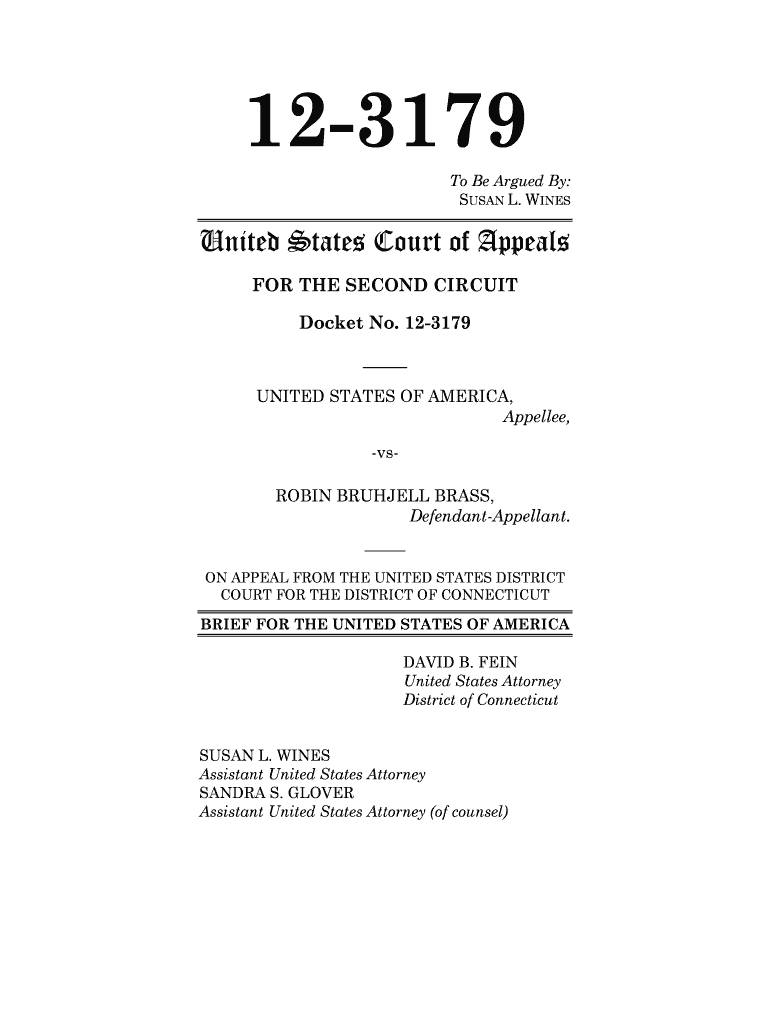
The "March 18, 2013 US v Brass 2nd circuit brief - US Department of Justice - justice" is a legal document submitted to the United States Court of Appeals for the Second Circuit. It involves the appeal of Robin Bruhjell Brass, who was convicted of a Ponzi scheme that defrauded victims of almost two million dollars. This brief serves as a detailed argument from the US Department of Justice, outlining the background of Brass's criminal activities and justifying the district court's decision on sentencing.
Key Elements of the Brief
- Case Background: Provides an overview of Robin Bruhjell Brass's fraudulent activities and the impact on her victims.
- Government's Argument: The prosecution argues for upholding an above-Guidelines sentence due to the harm caused.
- Sentencing Enhancements: Details on how the district court arrived at the sentence, including potential enhancements.
- Request for Affirmation: The brief concludes with a request to affirm the lower court's ruling.
Legal Use of the Brief
The brief plays a crucial role in appellate courts as it communicates the legal arguments to the judges. It embodies the government's perspective on why the sentence should be upheld, serving as an advocacy tool to maintain the integrity of judicial outcomes. Legal professionals, including judges and attorneys, rely on such briefs for case resolution by examining presented arguments and evidence.
Who Typically Uses the Brief
- Attorneys: Use it to prepare for court, understand case precedents, and draft their arguments.
- Judges: Utilize the brief to examine legal arguments and determine the case outcome.
- Law Students: Study it as an educational resource for understanding appellate procedures and legal reasoning.
- Victims and Advocacy Groups: Understand trial proceedings and potential impacts on similar cases.


How to Obtain the Brief
Official court documents such as this can be accessed through various channels:
- Online Court Records: Many jurisdictions offer access to public records, including appellate briefs, through online portals.
- Court Clerk's Office: Physical copies may be requested at the notifying court's clerk office.
- Legal Research Services: Platforms like Westlaw or LexisNexis may provide access to legal documents for subscribers.
Important Terms Related to the Brief
- Ponzi Scheme: A form of fraud involving a non-existent enterprise where returns to earlier investors are paid from new investors' contributions.
- Guidelines Sentence: A sentencing framework established by the Sentencing Commission, offering standard sentences for various offenses.
- Appellate Court: A higher court that reviews the decisions and results of lower court cases when their outcomes are appealed.
State-Specific Rules and Applications
Although the brief deals with a federal case, there may be references or implications pertinent to state-specific laws, particularly when considering local jurisdictional aspects. Familiarity with both federal and state legal systems may be necessary for comprehensive understanding and application.
Steps to Complete the Brief
- Drafting: Includes organizing the factual and legal basis for the appeal, alongside citations from trial records and applicable law.
- Review and Edit: Legal teams may iteratively refine the brief for clarity, accuracy, and persuasive power.
- Submission: Submit the finalized brief according to the appellate court's procedural guidelines, ensuring adherence to deadlines and presentation standards.
Examples of Using the Brief
- Case Study: Reviewing the brief in classroom settings to demonstrate successful appellate advocacy techniques.
- Legal Argumentation: Attorneys in different circuit cases might adapt strategies from the brief to suit their case specifics.
- Public Information: Advocacy groups can use the brief to inform stakeholders about legal interpretations concerning large-scale financial fraud.
Required Documents
When dealing with appellate briefs, typically required documents for preparation include:
- Court's Opinion: From the lower court that rendered the decision.
- Trial Transcripts: Detailed records of courtroom proceedings.
- Evidence Exhibits: Items presented during the trial which are crucial for the appeal argument.
Choosing to cover these aspects provides a thorough and practical examination of the "March 18, 2013 US v Brass 2nd circuit brief" and offers insight into its significance in the legal landscape.




