




01. Edit your form online
Type text, add images, blackout confidential details, add comments, highlights and more.

Type text, add images, blackout confidential details, add comments, highlights and more.

Draw your signature, type it, upload its image, or use your mobile device as a signature pad.

Send it via email, link, or fax. You can also download it, export it or print it out.
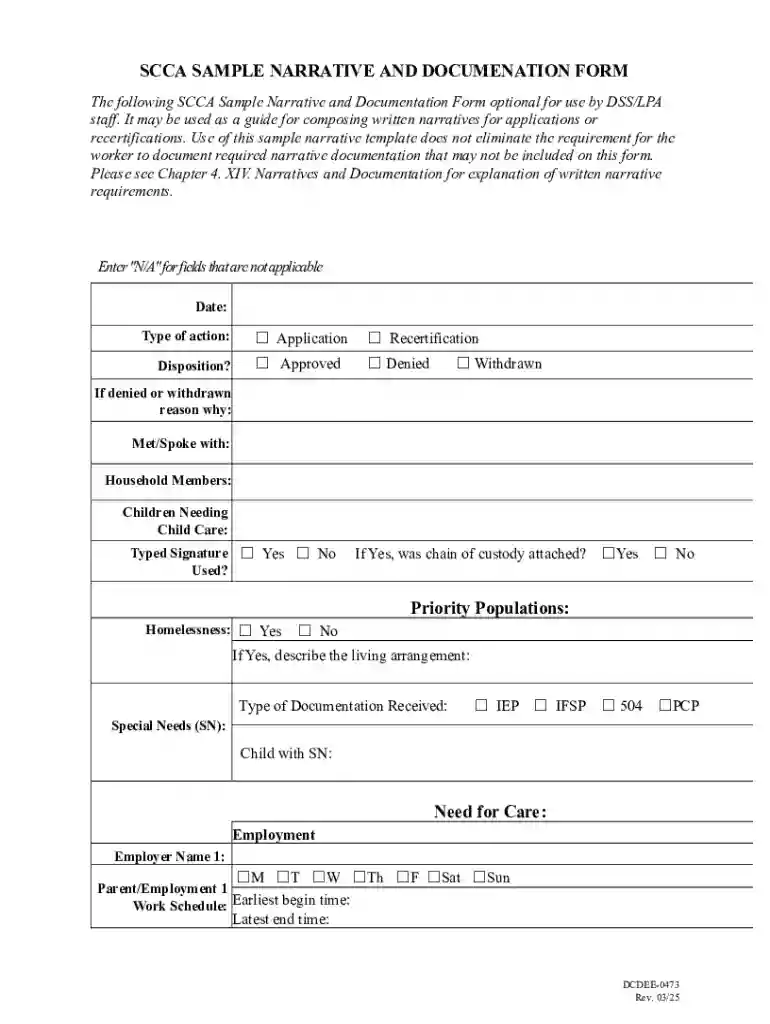
The SCCA Sample Narrative and Documentation Form is utilized by DSS/LPA staff to draft comprehensive written narratives for applications or recertifications. This form serves as a detailed guide in documenting various aspects of a case, such as household information, employment details, developmental needs, and income sources. It guides staff in capturing a clear picture of the individual or family's situation without replacing comprehensive narrative documentation as specified by related guidelines. This structure ensures consistency and thoroughness in the data gathered for case evaluations.
Users of the SCCA Sample Narrative and Documentation Form typically follow a series of steps to effectively utilize this document in a systematic manner:
Initial Review:
Gather Required Information:
Complete Each Section Thoroughly:
Review and Verification:
Consult if Necessary:
Identify Required Sections:
Input Household Information:
Detail Employment Status:
Report Developmental Needs:
Catalog Income Sources:
Account for Unusual Circumstances:
Complete the Narrative:
Household Composition:
Employment Details:
Developmental Needs:
Income and Financial Sources:
Unusual Circumstances:
Each section plays a critical role in presenting a comprehensive view of the subject's situation, allowing for an informed analysis and decision-making process.
DSS/LPA Staff:
Narrative Documentation:
Case Evaluation:
Understanding these terms is essential for accurately completing the form and ensuring alignment with best practices in documentation standards.
Case One: Family Assistance:
Case Two: Single Parent Application:
These examples underscore the versatility and utility of the form across diverse scenarios, ensuring that each case is approached with the necessary attention to detail.
Each state may have its own specifications and guidelines for completing the SCCA Sample Narrative and Documentation Form. Here are potential differences:
Documentation Requirements:
Approval Workflow:
Users are advised to consult their state's specific social services guidelines to ensure compliance with all procedural requirements.
Using digital or paper versions of the SCCA Sample Narrative and Documentation Form can affect workflow efficiency and ease of access:
Digital Version:
Paper Version:
Choosing between formats might depend on the availability of resources, departmental policies, and the nature of client interactions.
We've got more versions of the Scca Sample Narrative and Documentation Form form. Select the right Scca Sample Narrative and Documentation Form version from the list and start editing it straight away!
| Versions | Form popularity | Fillable & printable |
|---|---|---|
| 2025 | 4.3 Satisfied (21 Votes) |
At DocHub, your data security is our priority. We follow HIPAA, SOC2, GDPR, and other standards, so you can work on your documents with confidence.




The paper discusses the application and use of communication practices, principles, and theories in the production of an evidence-based patient information
The following SCCA Sample Narrative and Documentation Form optional for use by DSS/LPA staff. It may be used as a guide for composing written narratives for


