






Definition & Meaning
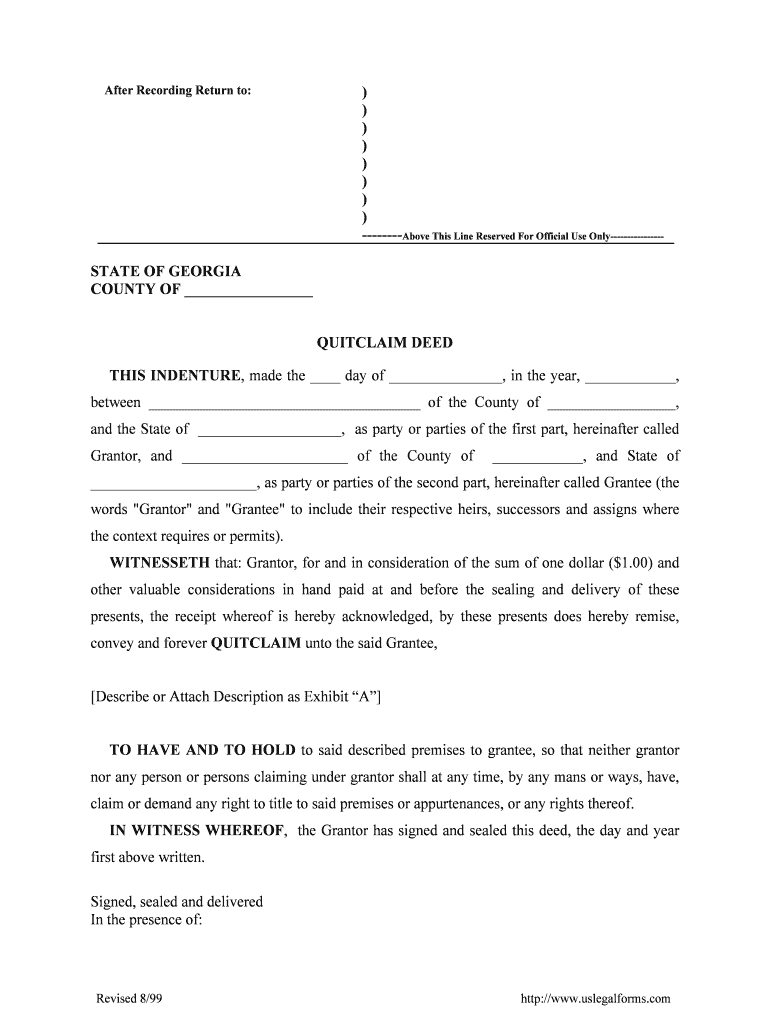
A Georgia quitclaim deed is a legal document utilized for the transfer of property rights between parties in Georgia, typically involving a Grantor and a Grantee. This type of deed conveys whatever interest the Grantor holds in the property, without warranties or guarantees about the property’s title. This makes it distinct from warranty deeds, which assure a clear, unencumbered title to the property. Quitclaim deeds are often used in cases of simple property transfers among family members, divorces, or when clearing up title issues.
How to Use the Georgia Quitclaim Deed
Using a Georgia quitclaim deed involves several steps to ensure a correct and legally-binding transfer of rights. First, both the Grantor and Grantee need to agree on the terms of the transfer. The Grantor then completes the quitclaim deed form, including crucial information like names, addresses, and a legal description of the property. It's essential to enter precise details as inaccuracies can lead to disputes or delays. The completed deed must be notarized, and while the law does not require witnesses in Georgia, having one may provide additional assurance.
Steps to Complete the Georgia Quitclaim Deed
-
Prepare the Document: Start by filling out a quitclaim deed form specific to Georgia. Include necessary information such as the legal names of the Grantor and Grantee, the property’s address, and its legal description.
-
Detail Consideration: Although nominal consideration can be as little as one dollar, stating the consideration establishes the intent of transfer.
-
Sign the Document: Both parties need to sign the document in front of a notary public to validate the deed. In Georgia, notarization is a crucial step for recording.
-
Record the Deed: Submit the notarized deed to the Clerk of Superior Court in the county where the property is located. Recording establishes a public record of the transfer.
-
Retention of Copies: Keep copies of the recorded deed for personal records and future reference, especially if property disputes arise.
Legal Use of the Georgia Quitclaim Deed
In Georgia, quitclaim deeds serve various legal purposes and are often used in situations where property ownership needs clarification or correction. For instance, they can clear a cloud on a title or easily transfer property between family members, such as from parent to child. They are also employed in divorce settlements to modify joint tenancy or when transferring interest within a business context. Importantly, these deeds do not warrant the Grantee's complete ownership, making them unsuitable for all transactions, particularly those involving significant sums or requiring title warranties.
Important Terms Related to Georgia Quitclaim Deed
-
Grantor: The person or entity transferring their rights or interest in a property.
-
Grantee: The individual or party receiving the property rights or interest.
-
Consideration: A nominal amount exchanged during the transfer, often specified as one dollar in quitclaim deeds.
-
Legal Description: A detailed description of the property, separate from the postal address, typically used in legal documentation.
-
Notarization: The process of having a document witnessed by a notary public to verify the identities of the parties involved and prevent fraud.
Key Elements of the Georgia Quitclaim Deed
Several critical components must be included in a Georgia quitclaim deed for it to be valid and enforceable:
-
Parties' Information: Full legal names and addresses of the Grantor and the Grantee.
-
Property Description: The legal description is necessary to identify the property being transferred.
-
Signature and Notarization: The Grantor must sign the deed in the presence of a notary public to legalize the document. While not mandatory, having a witness may reinforce its validity.
-
Consideration: Even if it’s nominal, stating a consideration verifies the transfer's legitimacy.
State-Specific Rules for the Georgia Quitclaim Deed
Georgia has specific statutes governing the use and filing of quitclaim deeds. The state does not require witnesses for signing, although notarization is mandatory. Furthermore, a quitclaim deed does not guarantee or warrant that the Grantor's interest is valid, as it only transfers the Grantor's current interest, if any. The deed must be recorded in the county where the property is situated to protect the Grantee's interest and provide notice to third parties.
Examples of Using the Georgia Quitclaim Deed
A practical example of using a Georgia quitclaim deed includes transferring property within a family. Suppose a parent owns a family home and wishes to add an adult child to the deed, facilitating a shared ownership. Here, a quitclaim deed efficiently transfers the parent's portion of interest to the child without complex legal proceedings. Additionally, quitclaim deeds can resolve any title disputes, such as when clearing defects in the title revealed during a title search.
Who Typically Uses the Georgia Quitclaim Deed
Quitclaim deeds are widely used by individuals needing quick, straightforward property transfers without title guarantees. Common users include:
- Family Members: Parents passing property to children or reassigning ownership post-divorce.
- Couples: Spouses altering ownership during marriage dissolution.
- Business Entities: Modifying the ownership structure within partnerships or corporations.
- Co-Owners: Transferring interests among co-owners.
These deeds are beneficial when the original owner desires to relinquish ownership efficiently, knowing the risks and limitations of no title warranty.