




01. Edit your form online
Type text, add images, blackout confidential details, add comments, highlights and more.

Type text, add images, blackout confidential details, add comments, highlights and more.

Draw your signature, type it, upload its image, or use your mobile device as a signature pad.

Send it via email, link, or fax. You can also download it, export it or print it out.
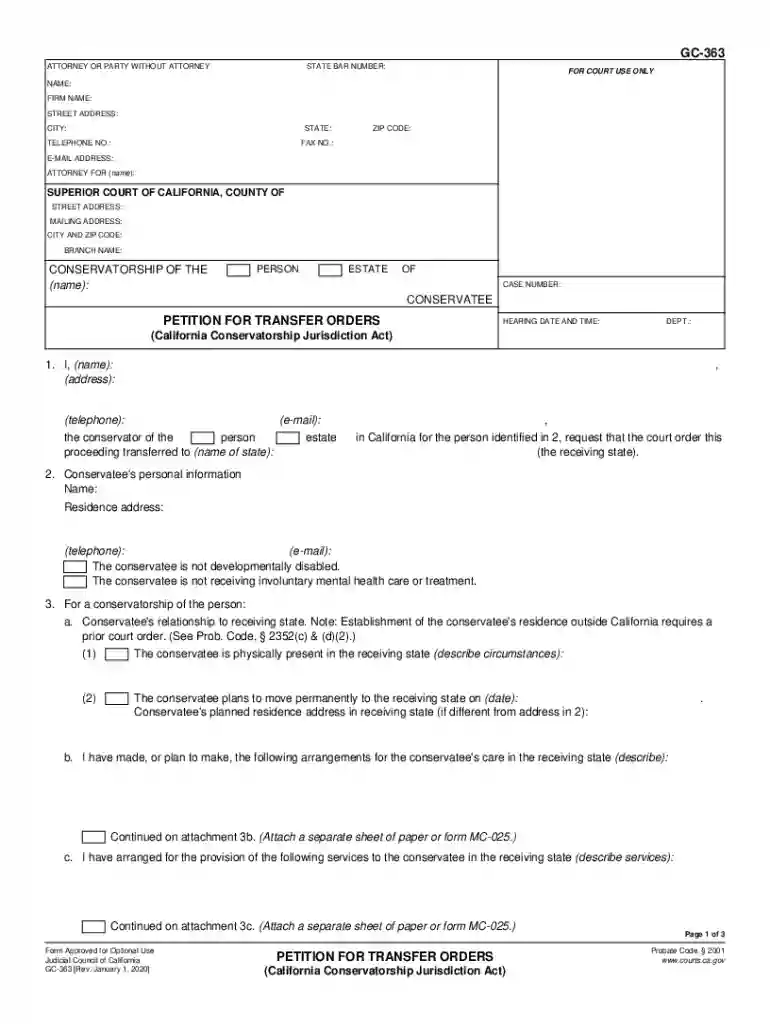
The GC-363 form, officially titled "Petition for Transfer Orders," is integral to the California Conservatorship Jurisdiction Act. This legal document facilitates the transfer of conservatorship orders across state lines. By completing this form, conservators can seek permission to relocate the conservatee to another state while ensuring continued legal oversight. The form includes critical information about the conservator, conservatee, and details of the planned move, ensuring the court is well-informed about the impact and logistics of the transfer.
Effectively utilizing the GC-363 form begins with accurately filling in personal and specific circumstances related to the conservatorship. It involves providing detailed information about the conservatee's care needs and intended arrangements in the new state. Providing this insight is vital to securing the court's approval for the transfer. Users must meticulously follow each section's instructions to ensure all relevant details, such as objections to the transfer and the benefits it offers, are thoroughly documented.
The GC-363 form must comply with legal standards set forth by the California Conservatorship Jurisdiction Act. This entails providing truthful information and following legal protocols to facilitate the transfer process. The form's legal use ensures that conservatorship responsibilities are maintained legally and ethically during relocations, thus protecting the conservatee's welfare.
Understanding the language of the GC-363 form is crucial:
This form is primarily used by conservators who are responsible for managing the welfare and affairs of conservatees. It is often necessary when a conservatee's move to another state promises better care facilities, proximity to family, or improved living conditions. Legal representatives may also use this form to support their clients in achieving a seamless legal transition.


California law governs this form, but transferring conservatorship necessitates compliance with both the original and receiving states' laws. This means understanding state-specific requirements, such as filing deadlines and additional documentation, which can vary depending on local regulations. Engaging with legal counsel familiar with inter-state conservatorship laws can be advantageous.
To complete the GC-363 form, you will need:
By assembling these documents, users can ensure a more efficient completion and submission process.
The GC-363 form can be submitted via multiple channels:
Understanding the preferred method of your jurisdiction can mitigate delays and streamline the process.
The form's primary sections include:
Each component plays a crucial role in conveying the need and readiness for the conservatorship transfer.
We've got more versions of the GC-363 PETITION FOR TRANSFER ORDERS(California Conservatorship Jurisdiction Act) Judicial Council fo form. Select the right GC-363 PETITION FOR TRANSFER ORDERS(California Conservatorship Jurisdiction Act) Judicial Council fo version from the list and start editing it straight away!
| Versions | Form popularity | Fillable & printable |
|---|---|---|
| 2020 | 4.3 Satisfied (21 Votes) |
At DocHub, your data security is our priority. We follow HIPAA, SOC2, GDPR, and other standards, so you can work on your documents with confidence.


May 3, 2017 The incompetency proceeding is initiated by a petition filed by a petitioner against a respondent, who is the alleged incompetent person.
Ask the court for permission to transfer a conservatorship case registered in California to another state. Get form GC-363. Effective: January 1, 2020.Read more


