






Definition & Meaning
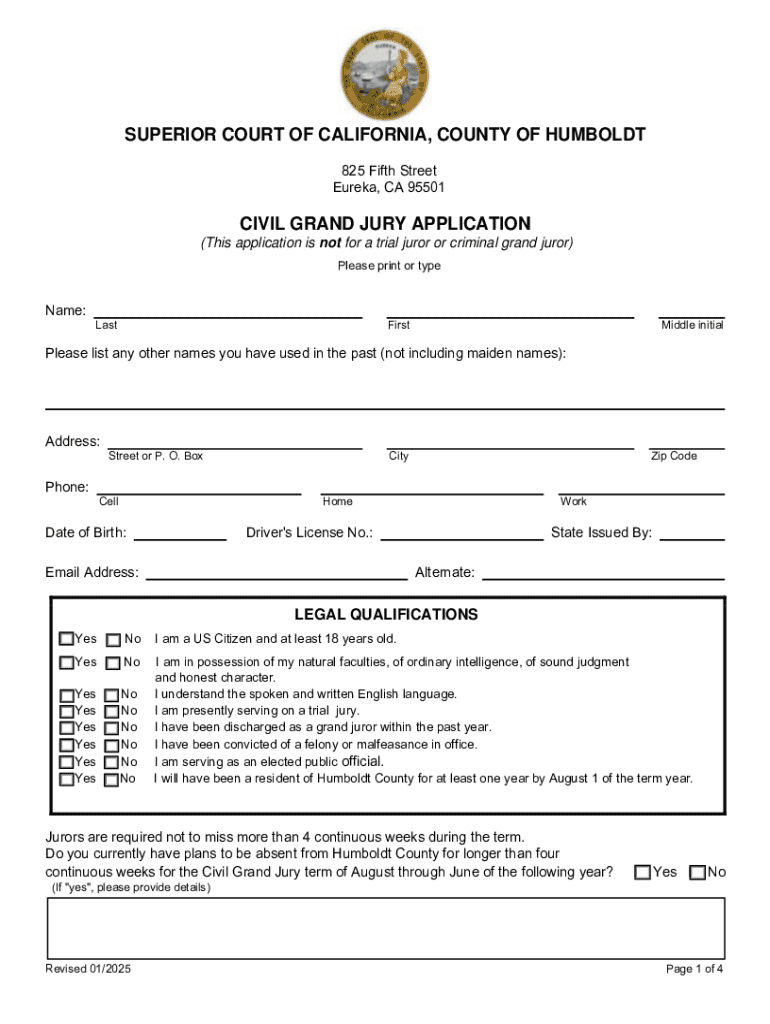
The "Civil Grand Jury Application" is a formal document utilized by individuals seeking to participate as jurors in a civil grand jury, specifically in jurisdictions like Humboldt County, California. The role of a civil grand juror is to investigate local government operations to ensure accountability and transparency. The application gathers essential information to determine an applicant's eligibility, commitment, and ability to serve effectively. It encompasses personal, educational, and demographic data, contributing to a jury pool that reflects diverse societal perspectives. Understanding the purpose behind the application is critical, as it lays the groundwork for civic engagement and oversight.
Eligibility Criteria
Eligibility criteria for the Civil Grand Jury Application typically include age, residency, and citizenship requirements. Applicants must generally be at least 18 years old and citizens of the United States. Furthermore, they must reside in the county where they wish to serve. Eligibility extends beyond basic qualifications, often requiring a clean legal record, as past felonies may disqualify an applicant. Understanding these criteria is crucial, as they ensure each candidate is legally and ethically fit to impartially evaluate local government actions. The criteria not only guarantee fairness but also uphold the integrity of the civil grand jury system.


Steps to Complete the Civil Grand Jury Application
Completing the Civil Grand Jury Application involves several steps:
-
Gather Required Information: Applicants must collect personal data, including contact details, educational and employment history, and community service involvement.
-
Understand Jury Obligations: It is vital for applicants to appreciate the time commitments, which often include attending regular meetings and being available for jury duties.
-
Fill Out the Application Form: The form requires precise and honest responses. Applicants are expected to provide comprehensive information, ensuring accuracy and relevance.
-
Submit Supporting Documents: Some jurisdictions may request additional documentation, such as identification proof or references, to verify the applicant's eligibility.
-
Review and Submit: Before submission, applicants should review the form for completeness and accuracy, then submit it through the specified method, whether online or via mail.
Completing these steps diligently enhances the likelihood of selection, paving the way for active participation in local governance.
Important Terms Related to Civil Grand Jury Application
Several terms are significant within the context of the Civil Grand Jury Application:
- Applicant: An individual seeking to become a member of the civil grand jury.
- Eligibility: The set of requirements that an applicant must meet to qualify for jury service.
- Jurisdiction: The county or area where the jury operates and the application is submitted.
- Confidential: The nature of certain aspects of the jury proceedings, ensuring privacy and security.
Understanding these terms is essential, as they provide clarity on the application process and the role of a civil grand juror. Familiarity with this terminology can significantly aid in navigating the application and jury duties effectively.
How to Obtain the Civil Grand Jury Application
Prospective jurors can obtain the Civil Grand Jury Application through various channels:
- Online Access: Most counties provide downloadable forms on their official websites, simplifying access.
- County Clerk's Office: Physical copies are typically available at local government offices, directly obtainable during working hours.
- Community Centers: Some regions might offer applications through public libraries or community centers.
Knowing where to find the application accelerates the initiation of the application process. These accessible sources ensure that every eligible citizen has the opportunity to participate in this vital civic duty without encountering barriers to entry.
Key Elements of the Civil Grand Jury Application
The application comprises several critical sections:
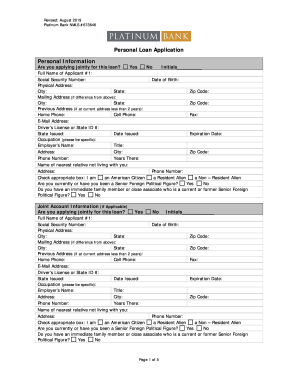
- Personal Information: Includes name, address, and contact details to establish basic identification and eligibility.
- Educational Background: Captures academic history to assess the applicant's capacity for analytical and evaluative tasks.
- Work Experience: Provides insight into the applicant's professional skills and their potential contribution to jury duties.
- Community Service: Highlights engagement with community activities, reflecting civic-mindedness.
Each element plays a role in evaluating an applicant's suitability and readiness to serve, ensuring a well-rounded and capable jury pool. These components collectively help paint a comprehensive picture of the applicant's qualifications and potential contributions.
Application Process & Approval Time
The application process involves submission, review, and notification:
-
Submission: Applicants submit their completed forms through designated channels.
-
Review: The selection committee examines applications for eligibility and suitability, often conducting interviews for further assessment.
-
Notification: Candidates are informed of their selection status. Those chosen receive instructions regarding orientation and training.
Approval times can vary, typically spanning several weeks to a few months, depending on the volume of applications and the specific county's procedures. Understanding this timeline is critical, helping applicants manage expectations and prepare for potential jury service.
Who Typically Uses the Civil Grand Jury Application
Generally, individuals keen on civic responsibility and governance oversight utilize this application. These applicants often:
- Possess a Strong Sense of Civic Duty: They are motivated by a desire to influence local government transparency and accountability.
- Value Community Engagement: Many are actively involved in local community activities and initiatives.
- Seek Personal Growth: Participation fosters skills in critical thinking, ethics, and community leadership.
Understanding the typical user profile helps elucidate the diversity and commitment expected of potential jurors. It underscores the importance of the application as a gateway for citizens to contribute meaningfully to their communities.