






Definition & Meaning
A "Plea in Absentia" is a legal mechanism allowing a defendant to enter a plea without being physically present in court. Typically used in criminal proceedings, this process enables individuals to waive their right to appear in person for the plea entry and sentencing. The plea can be made voluntarily and intelligently through legal representation, ensuring the defendant understands their rights and the implications of the plea. This option is particularly useful for defendants who cannot attend court due to geographic, health, or scheduling constraints, facilitating a more efficient judicial process while respecting the defendant's rights.
How to Use the Plea in Absentia
To utilize a Plea in Absentia, the defendant, usually with the assistance of an attorney, must express the intention to waive their right to personal appearance. The process involves:
- Obtaining agreement from the court, acknowledging the plea submission with the defendant absent.
- Ensuring that the defendant signs documents waiving the right to be present and confirming understanding of the charges.
- The attorney formally submitting the plea on the defendant’s behalf in accordance with court procedures.
Real-world scenarios include defendants living outside the jurisdiction of the court or those with significant personal obligations that preclude attendance.
Steps to Complete the Plea in Absentia
- Consultation with Legal Counsel: Engage with an attorney to discuss the viability of a Plea in Absentia and understand the legal implications.
- Document Preparation: Complete necessary certifications, including affirmation of understanding the charges, and waiver of the right to appear.
- Attorney’s Submission: The attorney submits the plea to the court, certifying that it is made voluntarily and intelligently.
- Court Review: The judge reviews the plea submission and documentation to determine its acceptance based on legal criteria.
- Court Decision: If satisfied with the validity and voluntariness of the plea, the court accepts it and proceeds with sentencing in the defendant's absence.
Why Should You Plea in Absentia
Opting for a Plea in Absentia can provide several advantages:
- Convenience: Defendants unable to attend court due to distance, health issues, or personal commitments can resolve legal matters without travel.
- Efficiency: It streamlines the judicial process by preventing delays associated with coordinating physical appearances.
- Cost-Effectiveness: It reduces expenses related to travel, accommodation, and missed work days for the defendant.
Conditions that typically favor using a Plea in Absentia include minor offenses where the court primarily imposes fines or community service rather than incarceration.
Legal Use of the Plea in Absentia
In the United States, the legal acceptance of a Plea in Absentia aligns with both state and federal court procedures, provided the defendant’s rights are fully protected. U.S. courts, such as those in California, require:
- Valid Waiver: The defendant must knowingly and voluntarily waive the right to be physically present.
- Adequate Representation: The plea should be facilitated by legal professionals to ensure compliance with procedural and substantive legal standards.
- Judicial Oversight: The court must confirm the plea’s validity and that it aligns with justice administration principles.
Specific statutes govern how and when a Plea in Absentia may be used, often depending on the nature of the charges.
Key Elements of the Plea in Absentia
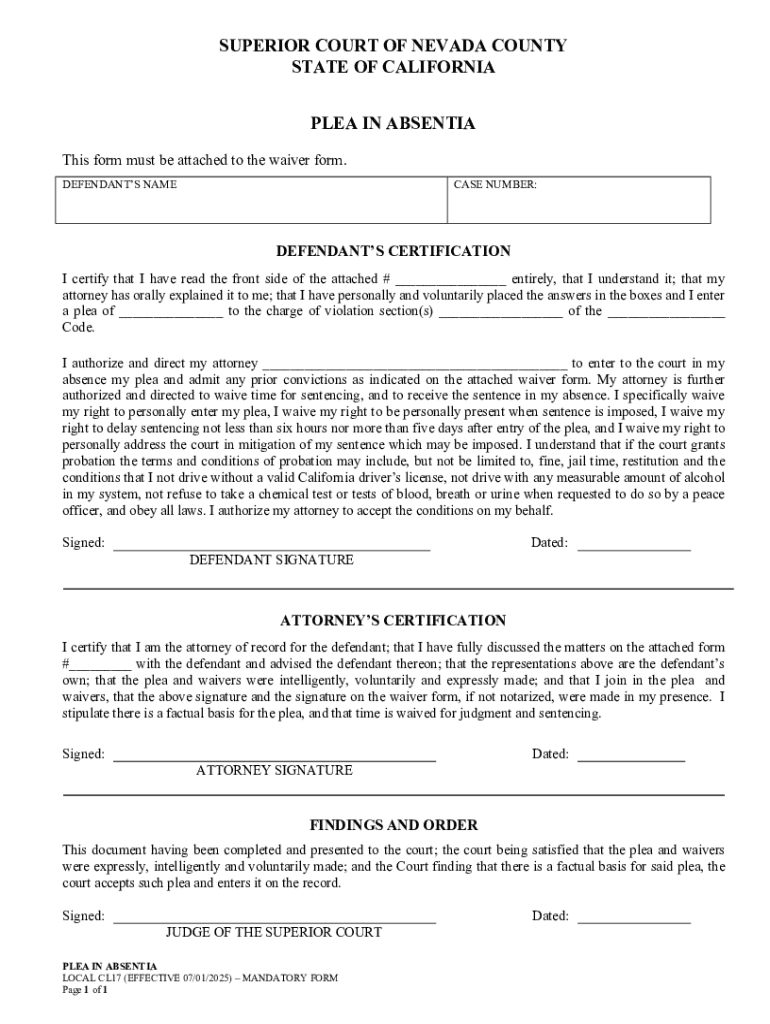
- Defendant’s Certification: A declaration by the defendant affirming the understanding of charges and waiver of the right to court appearance.
- Attorney’s Certification: The attorney verifies that the plea was made intelligently and is in the defendant's best interest.
- Judicial Findings: The court’s determination regarding the plea’s validity, ensuring compliance with applicable laws.
These elements form the core of a Plea in Absentia, providing a structured framework to ensure procedural integrity and fairness.
State-Specific Rules for the Plea in Absentia
Different states may have distinctive regulations concerning the application of the Plea in Absentia:
- California: Emphasizes detailed waivers and accepts pleas primarily for misdemeanors.
- New York: Allows use under specific conditions, particularly for non-violent offenses.
- Texas: Requires a more comprehensive waiver document package and thorough attorney involvement.
Understanding these nuances can assist defendants and their attorneys in effectively navigating the complexity of state-specific legal landscapes. Additionally, local counsel's assistance is crucial to ensure adherence to regional requirements.
Examples of Using the Plea in Absentia
Consider scenarios such as:
- Out-of-State Defendants: A resident of Florida facing charges in California opts for a Plea in Absentia to avoid expensive travel.
- Health-Constrained Individuals: A physically disabled defendant gains approval for Plea in Absentia due to impracticability of court visits.
- Business Professionals: A corporate executive charged with a minor infraction in another state utilizes this option to maintain work commitments.
These examples highlight the practical application and benefits of a Plea in Absentia, emphasizing the diversity of situations where it is advantageous.