01. Edit your form online
Type text, add images, blackout confidential details, add comments, highlights and more.

Type text, add images, blackout confidential details, add comments, highlights and more.

Draw your signature, type it, upload its image, or use your mobile device as a signature pad.

Send it via email, link, or fax. You can also download it, export it or print it out.
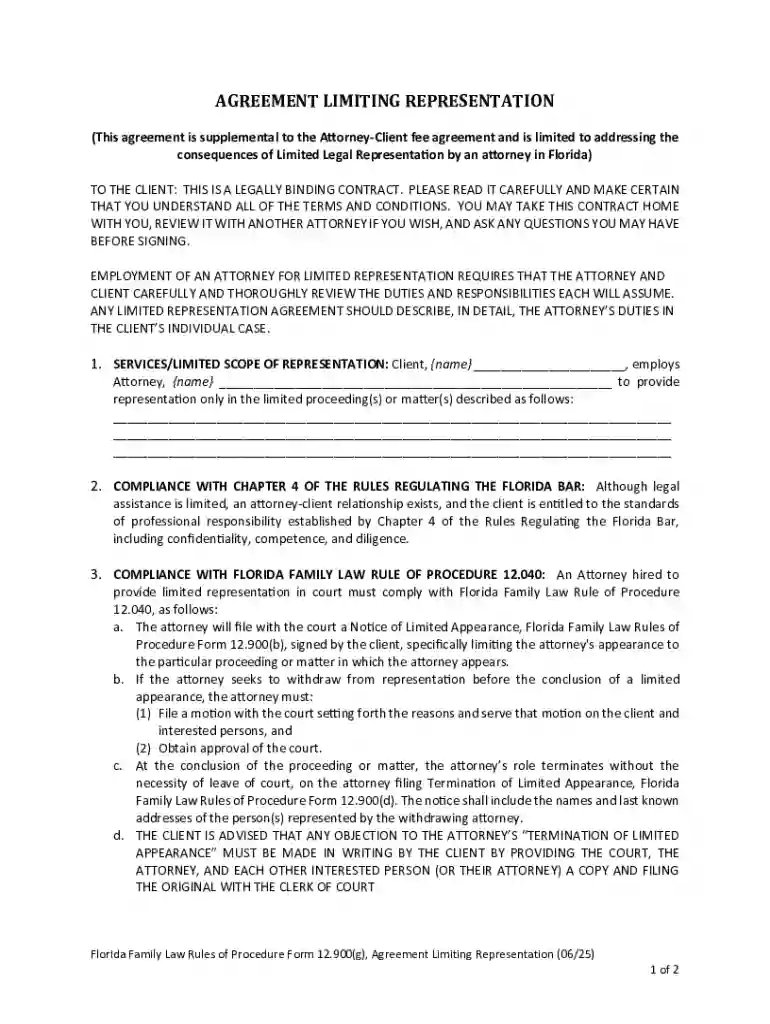
Form 12 900(g), commonly known as the "Agreement Limiting Representation," is a legal document used in Florida Family Law. This form formalizes an arrangement where an attorney provides limited legal services to a client rather than full representation. It's critical for outlining the specific services that will be offered and the conditions under which these services will be provided. The form supplements the Attorney-Client fee agreement and specifies the scope limitations, enabling both parties to have a clear understanding of their roles and responsibilities.
Form 12 900(g) can be obtained through various means to ensure accessibility and convenience. It is typically available through the official website of the Florida State Courts or may be provided directly by the attorney handling the case. Additionally, various legal aid websites and physical court locations may offer copies for individuals who may not have internet access. It's essential to ensure the form is up-to-date by referring to the most recent version available from these sources.
Completing Form 12 900(g) involves a series of steps that both parties must carefully execute to ensure validity:
Personal Information: Begin by filling out the section with the client's and attorney’s personal information, including names, addresses, and contact details.
Scope of Services: Clearly outline the specific legal services the attorney agrees to provide. This may include consultation, document preparation, or representation in specific proceedings.
Fee Agreement: Detail the fees involved for the services outlined and any payment schedules or conditions. Both the attorney and client must agree on the financial terms before proceeding.
Client Responsibilities: Specify what is expected from the client in terms of cooperation and provision of necessary documents or information.
Signatures: Both parties must sign and date the form to affirm their agreement to the terms outlined.
Form 12 900(g) is most often used by clients who require only limited legal assistance rather than full representation. This form is beneficial in cases where the client has budget constraints, seeks control over certain aspects of their legal process, or has a clear understanding of what specific legal aid they need without engaging a lawyer for comprehensive services. Clients may include individuals going through family law-related matters such as divorce or custody, where only selective legal tasks are required.
Understanding the terminology used in Form 12 900(g) is crucial for both the attorney and the client:
Since Form 12 900(g) is utilized within the context of Florida Family Law, it adheres to state-specific rules and regulations. The Florida Bar dictates that such agreements must comply with relevant rules and procedures. This includes ensuring that the notice of limited appearance is filed correctly and the procedure for the termination of representation is followed as per state mandates. Lawyers must ensure that any limited representation is visibly separate from full representation cases in compliance with local court rules.
The Key elements of Form 12 900(g) include:
Practical scenarios where Form 12 900(g) might be used include:
Failure to complete or use Form 12 900(g) correctly can lead to significant penalties, including misunderstandings about representation scope, potential overcharges due to lack of clear fee agreements, and issues with court compliance. Both parties need to ensure the form is properly filled, understood, and agreed upon to avoid legal conflicts and ensure that the limited representation is appropriately honored.
The completed Form 12 900(g) can typically be submitted through several methods. Online submission may be available depending on local court digital provisions, allowing for faster processing. Alternatively, the form can be mailed to the appropriate legal office or submitted in person at the courthouse. The method chosen needs to fit legal requirements and should be verified in advance to ensure proper filing and acknowledgment.
We've got more versions of the Form 12 900(g) form. Select the right Form 12 900(g) version from the list and start editing it straight away!
At DocHub, your data security is our priority. We follow HIPAA, SOC2, GDPR, and other standards, so you can work on your documents with confidence.