Personnel and Accounting Integrated Data PIA 2026

Get Form
Personnel and Accounting Integrated Data PIA Preview on Page 1

Here's how it works

01. Edit your form online
Type text, add images, blackout confidential details, add comments, highlights and more.

02. Sign it in a few clicks
Draw your signature, type it, upload its image, or use your mobile device as a signature pad.

03. Share your form with others
Send it via email, link, or fax. You can also download it, export it or print it out.

Definition and Purpose of the Personnel and Accounting Integrated Data PIA

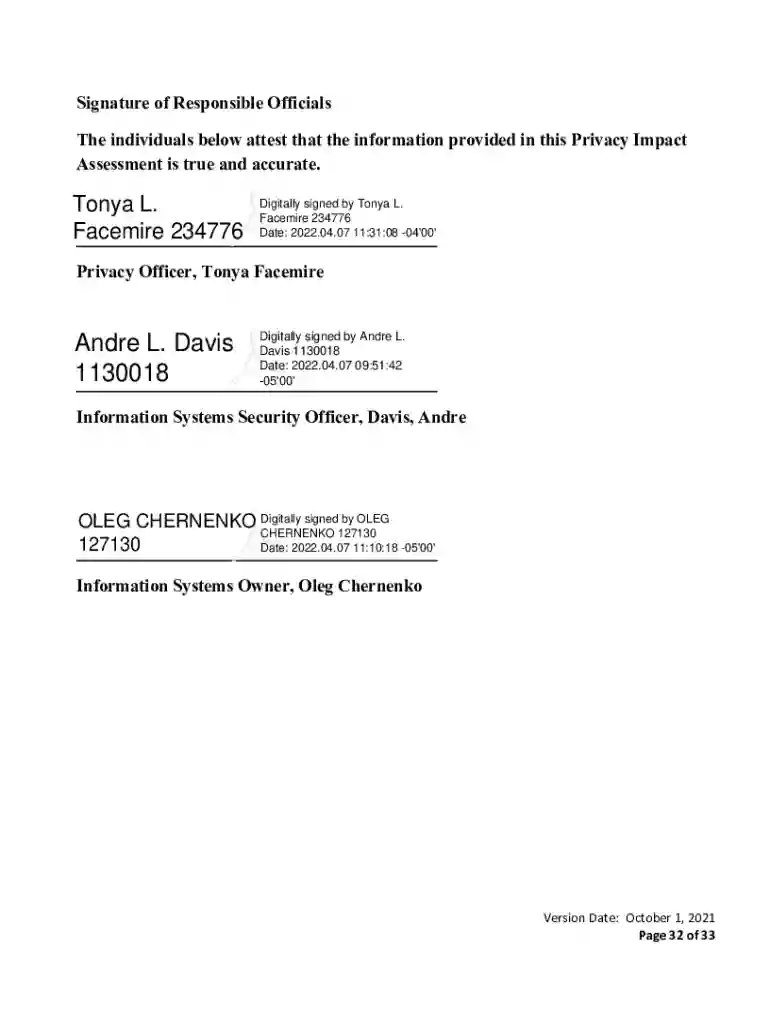
The Personnel and Accounting Integrated Data PIA, used by the Veterans Health Administration, serves as a Privacy Impact Assessment for the PAID system. This system is designed to report payroll and human resources data efficiently, ensuring sensitive information is handled responsibly. The PIA is crucial for identifying and mitigating privacy risks associated with data collection and sharing. By providing a structured framework for assessing privacy implications, it supports adherence to federal laws and regulations concerning data security and privacy.

Key Features and Components

The PIA includes several critical components that ensure privacy and compliance:

  • Sensitive Information Management: Details the types of sensitive data collected, such as personal identifiers and payroll information.
  • Privacy Risk Assessment: Identifies potential privacy risks and outlines measures for mitigation.
  • Data Sharing Practices: Documents protocols for sharing information within and outside the Veterans Health Administration.
  • Compliance with Regulations: Ensures alignment with federal privacy laws, including those governing the retention and disposition of records.

Steps for Completing the Personnel and Accounting Integrated Data PIA

Completing the Personnel and Accounting Integrated Data PIA involves several structured steps to ensure a comprehensive privacy evaluation.

  1. Identify Data Types: Determine what types of personal and sensitive data are collected and processed by the PAID system.

  2. Evaluate Data Handling Processes: Analyze how data is stored, used, and shared within the organization and with external partners.

  3. Risk Mitigation Strategies: Develop strategies to mitigate identified privacy risks, focusing on enhanced security measures and access controls.

  4. Documentation and Approval: Ensure all findings and recommended actions are documented in the PIA, followed by obtaining necessary approvals from relevant authorities within the organization.

Practical Implementation

  • Use Case Scenarios: Apply specific scenarios, such as a data breach response, to test the robustness of privacy measures.
  • Consultation with Legal Team: Engage with legal counsel to verify compliance with relevant laws and regulations.

Important Terms Related to Personnel and Accounting Integrated Data PIA

Understanding the terminology associated with the Personnel and Accounting Integrated Data PIA is vital for effective implementation and compliance.

  • Privacy Impact Assessment (PIA): A formal exercise to evaluate the implications and risks associated with the handling of personal information.
  • Sensitive Personal Information (SPI): Data that requires protection due to its sensitive nature, such as Social Security numbers and banking details.
  • Data Sharing Policies: Protocols dictating how and with whom data is shared, both internally and with third parties.
  • Compliance Requirements: Legal and organizational mandates aimed at securing personal data and maintaining privacy.

Contextual Definitions

  • OAuth 2.0: A framework for authorization that provides secure access to systems without exposing user credentials.
  • 256-bit SSL Encryption: A security measure used to protect data during transmission, ensuring confidentiality and integrity.

Legal Use of the Personnel and Accounting Integrated Data PIA

The legal framework surrounding the Personnel and Accounting Integrated Data PIA is crucial for ensuring organizational compliance and protection of individual privacy.

Governing Regulations

  • Federal Privacy Laws: These laws, including the Privacy Act, dictate how personal data should be managed, ensuring transparency and accountability.
  • Data Retention Policies: Establish guidelines for how long data can be stored and when it must be securely disposed of.

Mitigating Legal Risks

  • Regular Compliance Audits: Schedule audits to verify adherence to privacy laws and regulatory requirements.
  • Training Programs: Implement comprehensive training for employees on privacy policies and data protection practices.

Who Typically Uses the Personnel and Accounting Integrated Data PIA

The primary users of the Personnel and Accounting Integrated Data PIA are entities within the Veterans Health Administration responsible for handling payroll and human resource data.


decoration image ratings of Dochub

Key Users and Stakeholders

  • HR Departments: Responsible for ensuring the integrity and confidentiality of employee data.
  • Compliance Officers: Tasked with monitoring adherence to privacy laws and organizational policies.
  • IT Security Teams: Focus on implementing technical measures to protect sensitive information.

Collaborative Efforts

  • Cross-Departmental Collaboration: Encourage cooperation between HR, IT, and legal departments to ensure comprehensive privacy management.

Examples of Using the Personnel and Accounting Integrated Data PIA

Practical examples of utilizing the Personnel and Accounting Integrated Data PIA demonstrate its application in real-world settings.

Case Studies and Scenarios

  • Data Breach Incident: Analyzing a past incident where the PIA helped mitigate privacy risks after a data breach, emphasizing its role in protecting sensitive information.
  • Policy Development: Using the PIA framework to develop new data handling policies that enhance security and compliance.

Learning from Experience

  • Feedback Mechanisms: Establish channels for continuous feedback and improvement of the PIA process based on user experiences and emerging privacy trends.

Key Elements of the Personnel and Accounting Integrated Data PIA

When working with the Personnel and Accounting Integrated Data PIA, several key elements must be considered to ensure its effectiveness.

Core Components

  • Data Inventory: A comprehensive list of all data types collected and processed by the system.
  • Risk Assessment Matrix: A tool for evaluating the severity and likelihood of identified risks.
  • Mitigation Plans: Detailed strategies for reducing or eliminating privacy risks.

Enhancing PIA Efficacy

  • Regular Updates: Keep the PIA updated to reflect changes in data usage and privacy laws.
  • Stakeholder Engagement: Involve all relevant parties in the creation and ongoing review of the PIA to maintain alignment and accountability.

Who Issues the Personnel and Accounting Integrated Data PIA

The issuance of the Personnel and Accounting Integrated Data PIA is a responsibility that lies within specific departments of the Veterans Health Administration.

Issuing Authority

  • Veterans Health Administration (VHA): The VHA is tasked with overseeing the deployment and compliance of the PAID system, ensuring that all privacy assessments are conducted in accordance with federal standards.

Role of the Issuing Entity

  • Oversight and Enforcement: The VHA provides oversight to ensure the system adheres to established privacy practices and takes corrective action when violations occur.
  • Guidance and Support: Offers guidance to departments on implementing effective privacy measures and leveraging the PIA for improved data management.

State-Specific Rules for the Personnel and Accounting Integrated Data PIA

Different states may have specific regulations and requirements regarding the Personnel and Accounting Integrated Data PIA, reflecting their unique legal landscapes.

Understanding State Variations

  • State Privacy Laws: Some states may have stricter privacy requirements than federal laws, impacting how the PIA is implemented.

Aligning with State Regulations

  • State Compliance Checks: Ensure the PIA adheres to any state-specific data protection laws to avoid legal issues.
  • Customized Policies: Develop policies tailored to meet both federal and state requirements, fostering comprehensive compliance.
be ready to get more

Complete this form in 5 minutes or less

Get form

Got questions?

We have answers to the most popular questions from our customers. If you can't find an answer to your question, please contact us.
Contact us
The Summit Data Platform (SDP) is an open-architected, multi-cloud data enterprise data management and analytics platform. SDP delivers an integrated suite of tools for the ingestion, conditioning, and curation of multi-source data sets into consumable data products.
A data platform can integrate the capabilities of individual solutions and bring all the data into a single place, where it can be secured, shared, and used most effectively. Data platforms offer more docHub benefits to large organizations, including: Centralizing and standardizing data functions in one platform.
HR Smart is considered a major application and serves as the enterprises central human resources system for all of VAs 320,000 employees and 100,000 clinical trainees. HR Smart is built on PeopleSoft Enterprise Human Resources, an Oracle-owned, commercial off-the-shelf (COTS) product.

Security and compliance

At DocHub, your data security is our priority. We follow HIPAA, SOC2, GDPR, and other standards, so you can work on your documents with confidence.

Learn more
ccpa2
pci-dss
gdpr-compliance
hipaa
soc-compliance
be ready to get more

Complete this form in 5 minutes or less

Get form