




01. Edit your form online
Type text, add images, blackout confidential details, add comments, highlights and more.

Type text, add images, blackout confidential details, add comments, highlights and more.

Draw your signature, type it, upload its image, or use your mobile device as a signature pad.

Send it via email, link, or fax. You can also download it, export it or print it out.
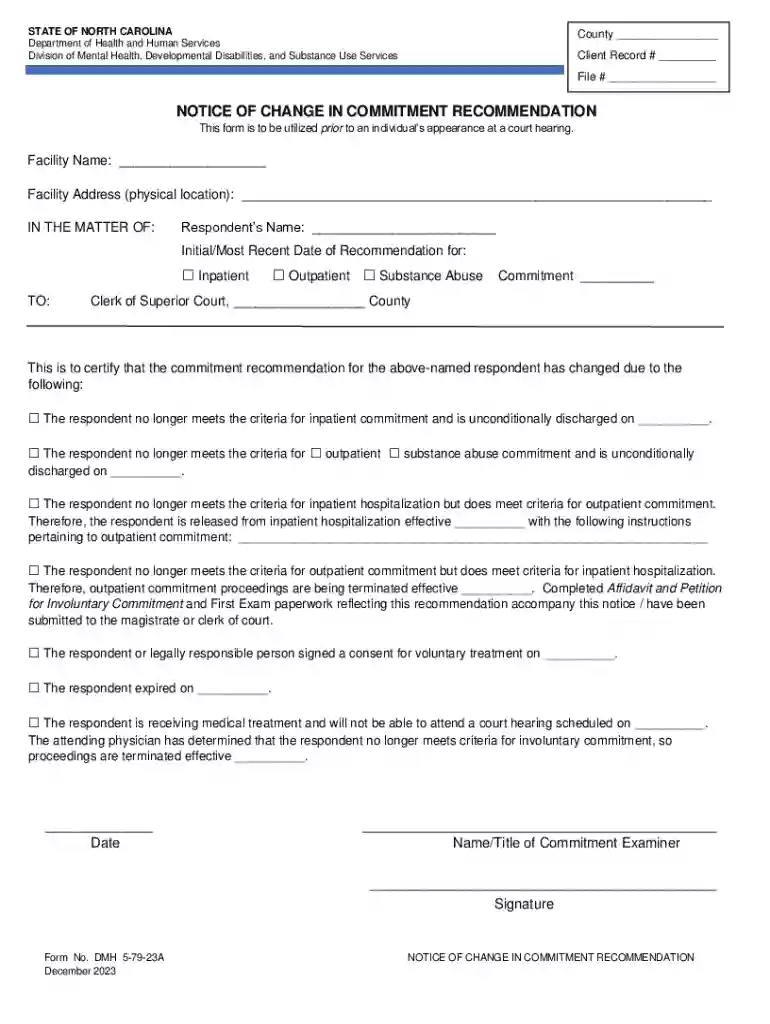
A "Notice of Change in Commitment Recommendation" is a formal document issued primarily by the North Carolina Department of Health and Human Services. It is designed to communicate changes in a respondent's commitment status prior to a court hearing. This document plays a critical role in the management of individuals undergoing mental health treatment, where adjustments in commitment—be it discharge or transition between inpatient and outpatient care—are necessary. The form encompasses scenarios such as voluntary treatment agreements, changes due to medical incapacity, and shifts between different levels of care. Its significance lies in providing the necessary documentation to legally support these changes.
To utilize this document effectively, understanding its application is key. The process generally begins when a mental health professional identifies a need to alter a respondent's commitment due to evolving circumstances or treatment progress. After the necessary evaluations, the form is completed to detail the recommended change. It must specify the nature of the commitment alteration, whether it is a full discharge, voluntary treatment shift, or a transfer between inpatient and outpatient settings. The completed form is then submitted to relevant judicial or health department authorities for approval, ensuring the respondent’s treatment aligns with their current medical and psychological needs.
The legal importance of this document is emphasized in its role to formally recommend and authorize changes in an individual’s mental health treatment commitment. It ensures compliance with existing health care regulations and medical legal standards. The document must align with both state and federal guidelines governing mental health care, guaranteeing that any decision made regarding a patient’s commitment is legally supported and medically justified. The form cinches together medical evaluations, patient rights, and health care regulations to form a comprehensive legal document that smooths the decision-making process involved in mental health treatment adjustments.
Although primarily utilized in North Carolina, the "Notice of Change in Commitment Recommendation" must adhere to specific regulations that may vary between states. Each state may have different legal requirements regarding who can complete the form, the types of changes that can be recommended, and how these changes are processed by the authorities. Practitioners need to be acquainted with their state’s specific health department guidelines and judicial processes regarding commitment changes to ensure compliance and effectiveness of the submitted recommendations.
A respondent undergoing inpatient treatment for severe depression has shown significant improvement and desires to transition to outpatient care. A mental health professional completes the form recommending this change, detailing the improvements and the suitability of outpatient treatment based on medical evaluations.
Another scenario involves a respondent deemed medically incapacitated to continue their treatment in one facility and requires transfer to a specialized care center. The form is used to document this need, ensuring a smooth transition and continuation of necessary treatment under new care arrangements.
The "Notice of Change in Commitment Recommendation" can be submitted through various channels to accommodate different preferences and requirements. It is essential to know the acceptable method of submission as outlined by the relevant authorities:
Understanding these submission methods helps mitigate delays and ensure the form is processed within the expected timeframe.
We've got more versions of the Notice of Change in Commitment Recommendation form. Select the right Notice of Change in Commitment Recommendation version from the list and start editing it straight away!
| Versions | Form popularity | Fillable & printable |
|---|---|---|
| 2023 | 4.2 Satisfied (37 Votes) |
At DocHub, your data security is our priority. We follow HIPAA, SOC2, GDPR, and other standards, so you can work on your documents with confidence.


May 24, 2026 Commitments can lower unit costs, but your architecture will evolve. Commitment discounts reduce flexibility; negotiate exit terms and ensure
This form is to be utilized prior to an individuals appearance at a court hearing. Substance Abuse Commitment. This is to DocHub that the commitment
Jan 1, 2009 Notice of discharge and the reasons for release shall be reported in writing to the clerk of superior court of the county in which commitmentRead more


