







Definition & Meaning
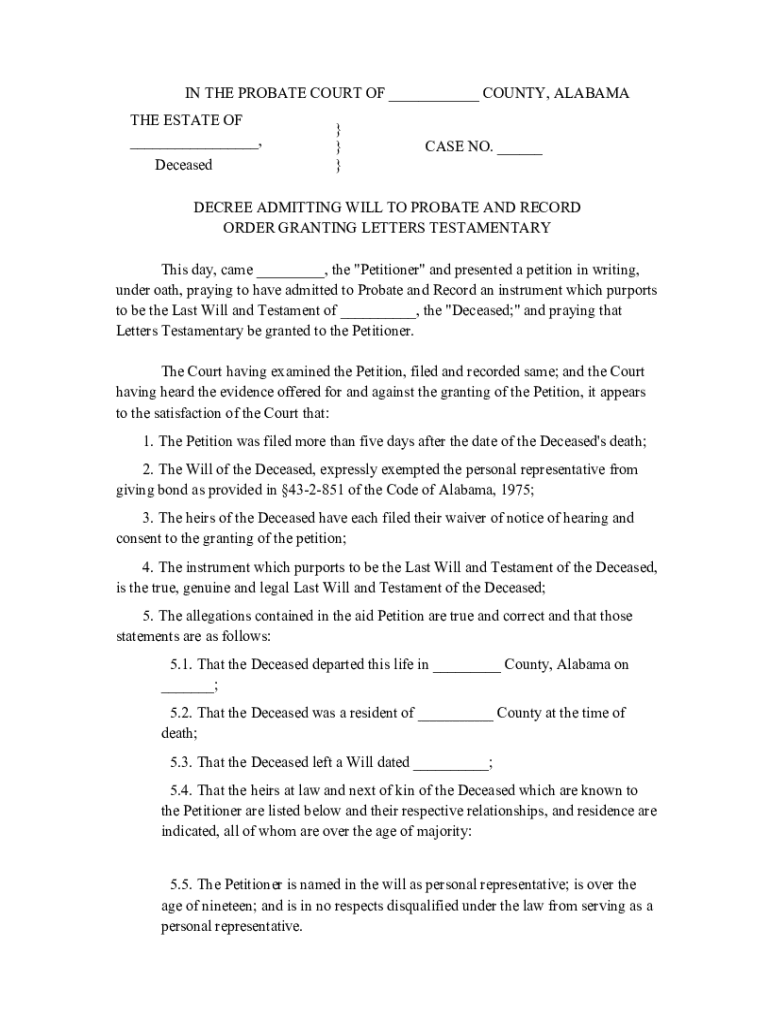
The "Alabama Decree Admitting Will and Order Granting Letters Testamentary" is a legal document issued by a probate court within the state of Alabama. This decree serves a dual purpose: first, it admits the Last Will and Testament of a deceased individual to probate, confirming its validity; second, it grants Letters Testamentary to an executor or petitioner. These letters empower the designated executor to manage and administer the deceased person's estate according to the will's instructions. The decree is fundamental in confirming the proper execution of the will and ensuring the seamless transfer of the decedent’s assets to their rightful heirs.
Key Elements of the Alabama Decree Admitting Will and Order Granting Letters Testamentary
Several critical elements must be present for a decree to serve its function effectively:
- Confirmation of Will's Validity: The probate court must verify that the will was executed in compliance with Alabama's legal standards, often requiring signatures from witnesses.
- Heirs’ Consents and Waivers: Any consents or waivers from the heirs need to be documented, ensuring that all necessary parties are informed and agree to the execution of the will.
- Appointment of Executor: Letters Testamentary are issued to the executor or personal representative, giving them the legal authority to oversee estate administration.
- Details of Residency and Death: Essential information about the deceased, such as their last known address and date of death, should be clearly stated.
Steps to Complete the Alabama Decree Admitting Will and Order Granting Letters Testamentary
- File a Petition: The executor must file a petition for probate with the appropriate Alabama probate court.
- Submit Required Documents: Include the original will, a death certificate, and any necessary consents/waivers from beneficiaries.
- Attend a Probate Hearing: A hearing may be scheduled where the will's validity is examined, and any objections from heirs can be addressed.
- Receive Court Approval: If the will is validated and no issues arise, the court issues the decree and letters testamentary.
- Execute Estate Administration: The executor uses these documents to manage the estate, pay debts, and distribute assets.
Who Typically Uses the Alabama Decree Admitting Will and Order Granting Letters Testamentary
This decree is primarily used by individuals involved in estate administration in Alabama:
- Executors or Personal Representatives: Appointed by the deceased, they are responsible for carrying out the terms of the will.
- Beneficiaries: Heirs named in the will rely on this document to ensure that the executor has the legal authority to distribute assets.
- Probate Attorneys: Legal professionals assist with the preparation and filing of necessary documents in probate court.
- Financial Institutions: Banks or investment firms may require proof of the executor’s authority before releasing funds or assets to beneficiaries.


How to Obtain the Alabama Decree Admitting Will and Order Granting Letters Testamentary
The decree is obtained through a series of legal steps:
- Initiate Probate Process: Begin by filing with the probate court in the county where the deceased resided.
- Provide Necessary Documentation: The original will, death certificate, and any required consents from beneficiaries are needed.
- Communicate with the Probate Court: Ensure all procedural requirements are met to facilitate the issuance of the decree.
- Await Court’s Decision: After reviewing the documents and information, the court either grants the decree or requests additional information or hearings.
Legal Use of the Alabama Decree Admitting Will and Order Granting Letters Testamentary
Issued under Alabama probate law, this decree serves several legal functions:
- Estate Management: It authorizes the executor to handle estate affairs, including asset distribution.
- Fraud Prevention: Confirms the executor's legitimacy, preventing fraudulent claims from unauthorized parties.
- Debtor Communications: Allows executors to notify creditors of the estate’s administration, addressing outstanding debts appropriately.
- Property Transactions: Permits executors to sell or distribute the deceased’s property according to the will’s specifications.
State-Specific Rules for the Alabama Decree Admitting Will and Order Granting Letters Testamentary
Alabama probate procedures include specific regulations:
- Witness Requirement: Wills must be signed by at least two witnesses to be considered valid.
- Residency Specifications: The probate must be opened in the county of the deceased’s last legal residency.
- Timeliness: Executors are generally required to file within a certain period after death, typically within six months, to avoid penalties or delays.
Examples of Using the Alabama Decree Admitting Will and Order Granting Letters Testamentary
Consider these illustrative scenarios:
- Case Study: An estate includes a house and several financial assets. The executor uses the decree to transfer property titles to beneficiaries and access bank accounts to settle estate debts.
- Practical Application: A deceased parent’s will includes minor children as beneficiaries. The decree ensures that funds are set aside in a trust managed appropriately until they reach adulthood.
- Complex Scenario: The deceased has international assets. The executor may need to work with foreign entities to ensure assets are managed and distributed according to the will and applicable international probate laws.




