







Definition and Meaning of Opinion Writing: OREO
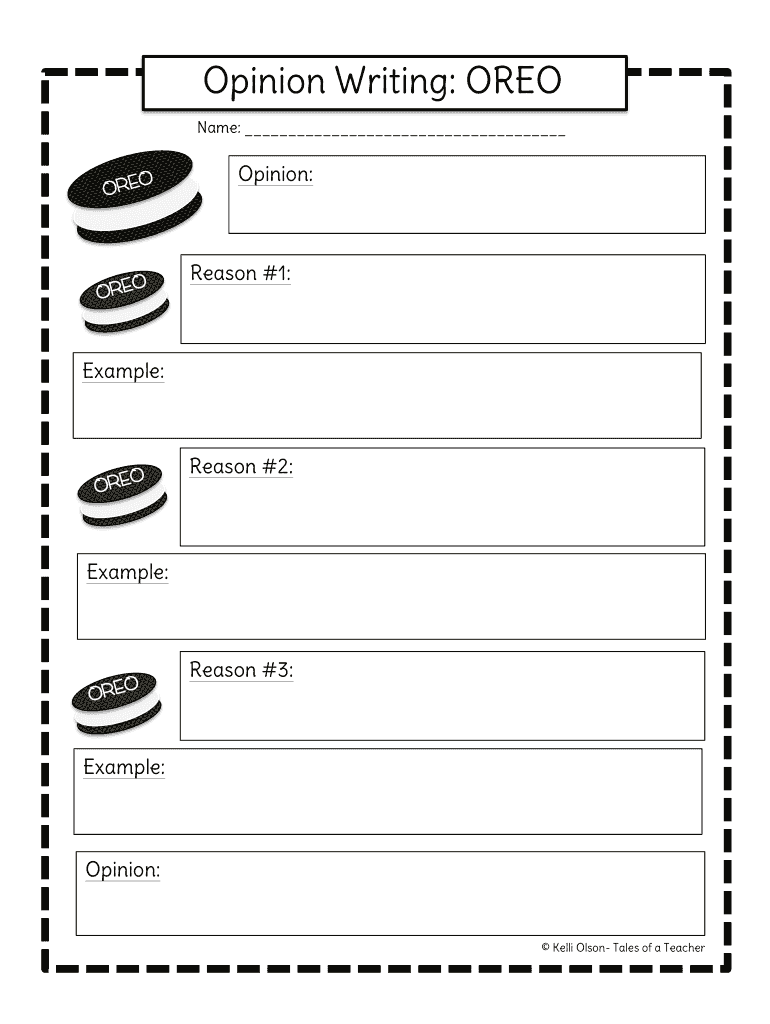
The "Opinion Writing: OREO" format is a structured method designed to help students and writers express their opinions in a clear and logical manner. The acronym "OREO" stands for Opinion, Reason, Example/Evidence, and Opinion restated. This method provides a framework that assists in organizing thoughts and arguments coherently, enabling the writer to present a persuasive or informative piece of writing. Within this framework, the writer starts by stating their opinion, provides reasons to support their viewpoint, backs up those reasons with examples or evidence, and concludes with a restatement of the opinion, reinforcing their stance on the subject.
Steps to Complete the Opinion Writing: OREO
-
State Your Opinion: Begin by clearly articulating your opinion on the topic. This should be a statement that reflects your stance or the main idea you wish to convey. It sets the stage for the rest of your writing.
-
Provide Reasons: Following your opinion, list reasons that support your viewpoint. Each reason should be logical and compelling, serving as the foundation for your argument.
-
Offer Examples or Evidence: For every reason presented, include examples or evidence. This could be statistics, anecdotes, case studies, or factual information that enhances credibility and persuasion.
-
Restate Your Opinion: Conclude the writing by restating the original opinion. This reinforces the argument and brings the piece full circle, ensuring that the main point is crystal clear.
Why Use the Opinion Writing: OREO Method
The OREO method is beneficial for several reasons. It fosters organized thinking, helping writers to construct arguments that are both coherent and persuasive. By requiring explicit examples or evidence, the method trains writers to back up their claims, enhancing the robustness of the argument. This structure is particularly useful in educational settings, where students are learning how to develop critical thinking and articulate their ideas effectively. Moreover, the method encourages clarity, making arguments easier to follow and understand, which is crucial in engaging and convincing an audience.
Who Typically Uses the Opinion Writing: OREO Method
The primary users of the Opinion Writing: OREO method are students in elementary and middle schools. Teachers commonly employ this format to teach young learners the fundamentals of essay and opinion writing. However, the usefulness of this approach is not limited to the classroom. Writers, bloggers, and educators in various fields might also use this method to structure opinion articles, blog posts, and even speeches, as it helps in organizing thoughts in a concise and impactful manner.


Key Elements of the Opinion Writing: OREO
- Opinion: The writer’s main argument or stance.
- Reasons: Logical explanations supporting the opinion.
- Examples/Evidence: Data, anecdotes, or facts validating each reason.
- Restated Opinion: A reconfirmation of the initial opinion to conclude the piece.
Each element plays a crucial role in building a convincing piece of writing. An effective OREO template ensures that arguments are not only persuasive but also credible and well-supported, contributing to a stronger overall narrative.
Important Terms Related to Opinion Writing: OREO
Understanding specific terms is vital when using the OREO method:
- Thesis Statement: Another term for the opinion or main argument.
- Supporting Details: The reasons and evidence that bolster the opinion.
- Transition Words: Phrases that help in smoothing the flow from one point to another, such as "for example," "additionally," and "in conclusion."
- Counterargument: Not part of the basic OREO structure but often taught alongside it to strengthen argumentative writing skills.
Examples of Using the Opinion Writing: OREO Method
-
Example 1: A student writes about the importance of school uniforms by stating they believe uniforms create equality (Opinion). They argue that this minimizes bullying (Reason), supported by a study that shows reduced incidents in schools with uniforms (Example). They finish by restating their opinion.
-
Example 2: In a blog post, a writer discusses the benefits of remote work. They say remote work increases productivity (Opinion) and cite a survey where 85% of respondents reported higher efficiency at home (Example). The opinion is reiterated at the end to emphasize the point.
Digital vs. Paper Version of Opinion Writing: OREO
Both digital and paper formats of opinion writing using the OREO method have their benefits:
-
Digital: Tools like word processors allow for easy editing, rearranging, and sharing of content. They also offer features like spellcheck and grammar suggestions, which ensure polished final drafts.
-
Paper: Writing by hand can enhance memory retention and idea generation. It's also beneficial where digital access is limited, such as in some classroom settings.
Ultimately, the choice between digital and paper depends on personal preference and context, though both achieve the same instructional goal of enhancing argumentative writing skills.




