01. Edit your invoice ddp online
Type text, add images, blackout confidential details, add comments, highlights and more.

Type text, add images, blackout confidential details, add comments, highlights and more.

Draw your signature, type it, upload its image, or use your mobile device as a signature pad.

Send invoice ddp via email, link, or fax. You can also download it, export it or print it out.
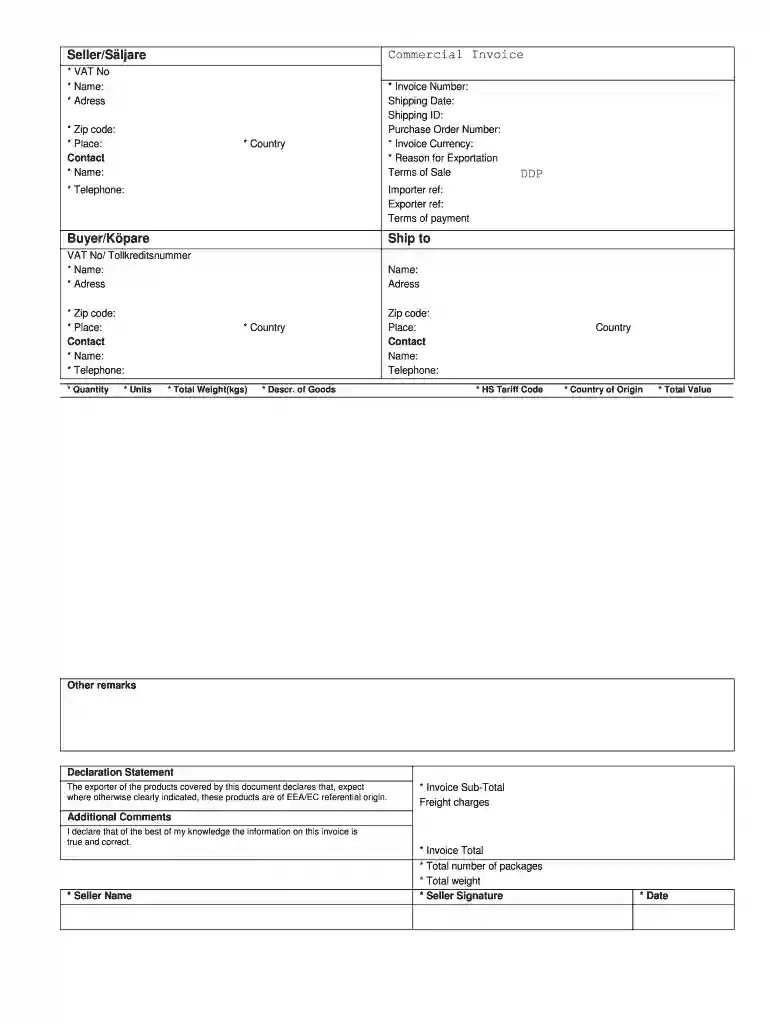
A commercial invoice is a critical document in international trade that serves as a legal contract and a customs declaration. This document records the transaction between the seller and the buyer, detailing the products sold, their quantities, and the agreed price. The invoice serves multiple purposes: it facilitates the flow of goods across borders, assists in the calculation of tariffs and duties, and provides essential information for the customs authorities of both the export and import countries. The commercial invoice is essential for any international sale and must be completed with precision to avoid delays and compliance issues.
When creating a commercial invoice, certain components must be included to ensure it is compliant and fulfills its legal and logistical purposes. These elements include:
Each entry in the commercial invoice should be clear, concise, and accurate to ensure there are no misunderstandings or delays at customs.
The commercial invoice is used at various stages of the shipping process. Initially, it is generated by the seller once the sale agreement is confirmed. It is then included in the shipment documentation, handed over to the carrier, and is one of the first documents inspected by customs authorities at both export and import checkpoints. Customs officials use the commercial invoice to assess duties and taxes. The invoice is also often used by freight forwarders to coordinate logistics and delivery of the shipment.
In practice, businesses rely on commercial invoices to maintain clear records of their international transactions, aiding in inventory control and financial accounting.
Completing a commercial invoice involves several steps to ensure accuracy and compliance:
These steps are crucial for smooth processing and to avoid potential legal disputes or shipping delays.
Commercial invoices are utilized by several stakeholders involved in international trade:
Every party involved benefits from the precise and accurate information these invoices provide, making them indispensable in global trade operations.


Understanding common terms associated with commercial invoices is important for both buyers and sellers:
Familiarity with these terms ensures better communication and understanding throughout the trade process.
The commercial invoice serves as a legal document in international trade and meets various regulatory requirements. It is often used as evidence in disputes related to the sale and delivery of goods. Different jurisdictions may have specific requirements for what a commercial invoice must include, such as specific declarations about the origin of the products. Moreover, inaccuracies can lead to penalties, fines, or additional scrutiny from customs authorities, making it essential that the invoice is filled out correctly and honestly.
The transition to digital processes has transformed how commercial invoices are used and stored. Electronic versions offer greater flexibility and efficiency, as they can be easily shared, stored, and archived. Digital invoices often integrate with software used for inventory and financial management, such as QuickBooks and SAP, making them preferable over traditional paper versions.
That being said, some entities may still require paper copies for certain transactions, especially when dealing with jurisdictions or trade partners that have not fully transitioned to digital systems. In such cases, maintaining the capability to generate both digital and paper invoices is advisable for businesses engaged in international trade.
At DocHub, your data security is our priority. We follow HIPAA, SOC2, GDPR, and other standards, so you can work on your documents with confidence.