






Definition & Meaning
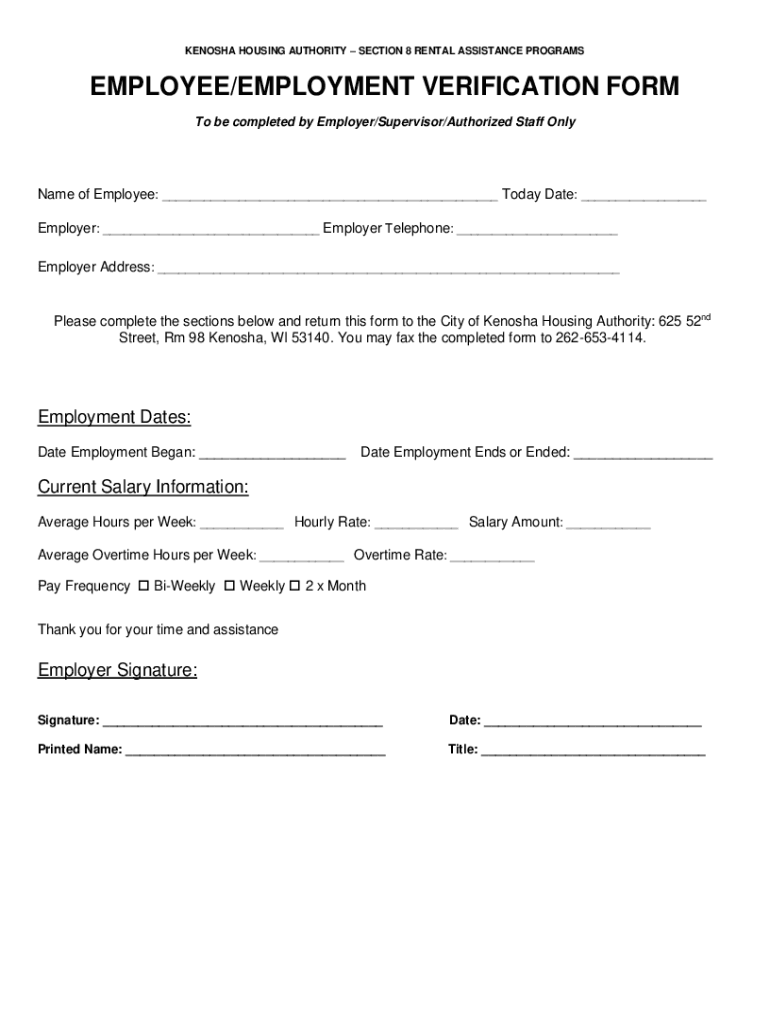
The Employee Employment Verification Form is an official document used to confirm an individual's employment details, such as dates of employment, position held, and salary information. It is typically filled out by an employer or a designated representative. This form is essential in various scenarios, including applying for loans, rental agreements, or government assistance programs where proof of stable employment is required. In the context of the Kenosha Housing Authority's Section 8 Rental Assistance Programs, it plays a critical role in verifying income eligibility.
Key Elements of the Employee Employment Verification Form
The form comprises several critical sections designed to capture comprehensive employment information:
- Employee Information: Contains personal details of the employee like full name, address, and social security number.
- Employer Details: Includes the employer’s name, address, and contact information.
- Employment Details: Covers job title, department, employment start date, and, if applicable, the end date.
- Income Information: Requires details such as pay frequency (weekly, bi-weekly, monthly), current salary/hourly wage, and any bonuses or commissions.
- Certification and Signature: An employer representative must sign to verify the authenticity of the information, adding their position and the date.
How to Use the Employee Employment Verification Form
To utilize the Employment Verification Form effectively, follow these steps:
- Acquire the Form: Obtain the form from the respective authority or the requesting party.
- Complete the Employee Information Section: Enter the employee’s personal information accurately.
- Fill Out the Employer Details: Ensure all employer information, including contact numbers, is current.
- Detail Employment and Income: Accurately document the employee's job details and income; ensure any bonuses or commissions are noted.
- Authenticate with a Signature: A managerial-level individual must verify and provide their signature to validate the information.
- Submit the Form: Return the completed form as specified, whether by mail, online submission, or in-person delivery.
Who Typically Uses the Employee Employment Verification Form
This form is predominantly used by entities that require proof of employment for:
- Housing Authorities: For determining eligibility for rental assistance or housing programs.
- Financial Institutions: When processing credit applications, such as mortgages or personal loans.
- Government Agencies: For assessing eligibility in various assistance programs, including unemployment benefits.
- Employers: Occasionally, for internal verifications or audits.


Steps to Complete the Employee Employment Verification Form
Completing the form involves clear, concise steps:
- Gather Necessary Information: Compile all relevant employee and employer details beforehand.
- Carefully Input Information: Fill out each section meticulously to avoid errors.
- Verify for Accuracy: Double-check all entries to ensure they align with official records.
- Obtain Necessary Signatures: Secure the signature of an authorized employer representative.
- Submit by the Deadline: Ensure the form reaches the requesting party within the designated timeframe.
Why You Should Use the Employee Employment Verification Form
Using this verification form provides several benefits:
- Fulfills Compliance Requirements: Meets the documentation standards needed for various legal and financial processes.
- Ensures Accuracy: With clear sections, it minimizes misunderstandings or miscommunication regarding employment details.
- Facilitates Processes: Streamlines applications for loans, housing, and other services requiring employment verification.
- Enhances Trust: By providing a verified document, it builds credibility with institutions or parties requiring proof.
Legal Use of the Employee Employment Verification Form
This form is legally recognized for verifying employment information, aligning with both federal and state requirements. It safeguards against fraudulent claims by providing official and authenticated details of employment. Employers must comply with privacy laws by ensuring sensitive information is handled securely and only shared with authorized parties.
Examples of Using the Employee Employment Verification Form
In real-world scenarios, an employee seeking to rent an apartment may need to provide the verification form to confirm their income level aligns with the landlord’s requirements. Similarly, a bank may request this document to check income stability when an individual applies for a loan. These cases illustrate the form’s role in validating financial credibility and employment status.
Form Submission Methods (Online / Mail / In-Person)
There are various ways to submit the completed form, depending on the process preferred by the receiving entity:
- Online Submission: Some entities offer electronic submission through secure platforms.
- Mail: Physical copies can be sent directly via postal services to the specified address.
- In-Person Delivery: Direct submission at an office location might be required for certain applications, ensuring personal delivery and reception verification.