







Definition and Purpose
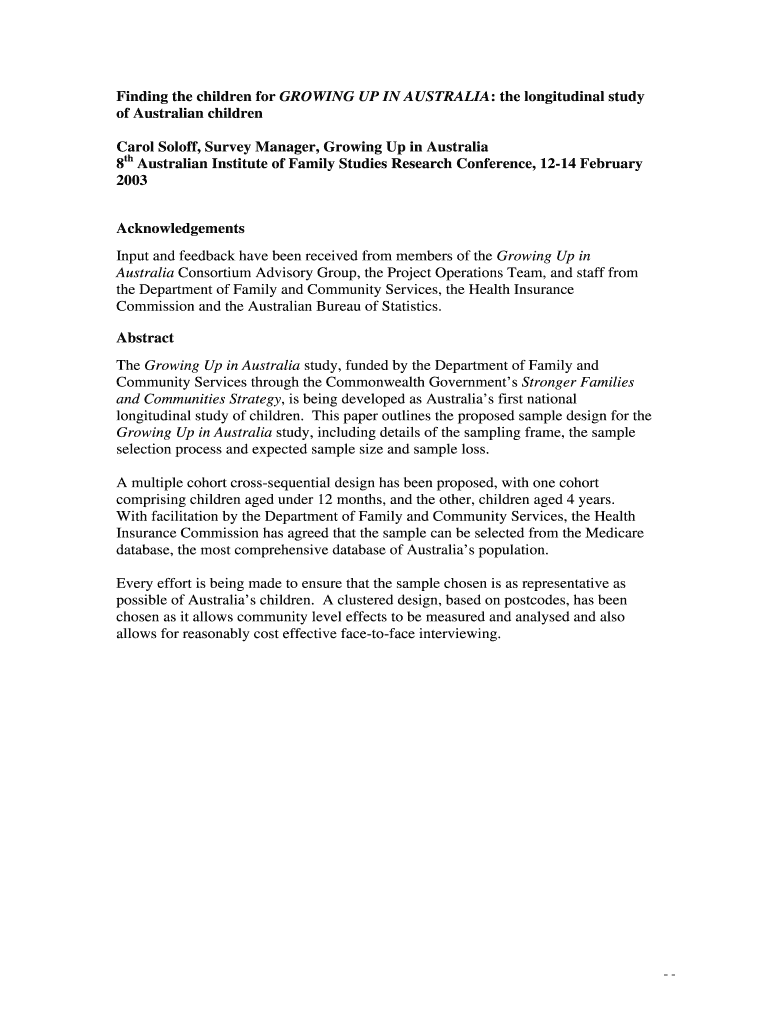
The "Finding the Children for Growing Up in Australia, the Longitudinal" is a component of the national longitudinal study aiming to understand the development and influencing factors on children in Australia. It involves tracking two cohorts: children under 12 months and those aged 4 years, with a target sample size of 5,000 per cohort. Its purpose is to gather demographic, behavioral, and social data to analyze developmental pathways and influence national policies accurately.
Methodology Overview
The methodology for this longitudinal study utilizes a sampling strategy that employs Medicare data to ensure representative sampling. This method not only addresses privacy concerns but also mitigates potential sample loss by standardizing the selection of participants across demographics.
Sampling Strategy
- Target Cohorts: Children under 12 months and those aged 4 years.
- Sample Size: 5,000 per cohort.
- Data Source: Medicare records to ensure comprehensive demographic representation.
How to Obtain the Form
The form associated with "Finding the Children for Growing Up in Australia, the Longitudinal" can be acquired through official channels affiliated with the study. Typically, relevant participants are contacted directly by the study administrators, ensuring their inclusion in this research.
Steps to Access the Form
- Eligibility Confirmation: Ensure eligibility by confirming the child's age and residency requirements.
- Direct Contact: Await contact from the study administrators for initiation.
- Official Channels: Utilize study-affiliated communications for obtaining the form directly, if not initially contacted.
Steps to Complete the Form
Completing the form involves several steps aimed at ensuring accurate data collection while respecting participant privacy.
- Personal Information: Fill in mandatory sections with child's details and parental consent.
- Demographic Details: Provide detailed demographic data to aid in precise cohort representation.
- Health and Social Background: Include relevant health and social information pertinent to the child’s developmental milestones.
Importance of the Study
By participating in this study, insights into developmental trajectories are gained, influencing health, education, and welfare policies in Australia. The data aids in crafting responsive programs addressing health disparities among children.
Participants and Uses
Parents of eligible children under 12 months and aged 4 years are the primary users. The data collected benefits:
- Policy Makers: In forming child welfare and educational policies.
- Researchers: Analyzing developmental patterns.
- Healthcare Providers: Understanding health trends in early childhood.
Legal and Privacy Considerations
Given the use of sensitive data like Medicare records, the study adheres strictly to privacy laws. Participants are assured that data handling complies with privacy legislation, offering transparency about data usage and storage.
Privacy Protections
- Data Encryption: All data collected is securely encrypted.
- Consent Protocols: Full disclosure and consent obtained from parents/guardians.
Key Elements of the Form
The form includes several sections critical to ensuring comprehensive data is collected for the study:
- Participant Consent: Explicit consent from parents or guardians.
- Detailed Questionnaires: Covering health, behavior, and social contexts.
- Follow-up Mechanisms: Authorization for future contact to track development.
Real-World Application Examples
Data from the study has led to the implementation of targeted interventions for children at risk of developmental delays. It also informs educational strategies and healthcare programs tailored to diverse demographic needs.
By participating, families contribute to a robust dataset that informs national child development policy, ensuring resources are efficiently allocated to nurture the next generation's growth.




