01. Edit your form online
Type text, add images, blackout confidential details, add comments, highlights and more.

Type text, add images, blackout confidential details, add comments, highlights and more.

Draw your signature, type it, upload its image, or use your mobile device as a signature pad.

Send it via email, link, or fax. You can also download it, export it or print it out.
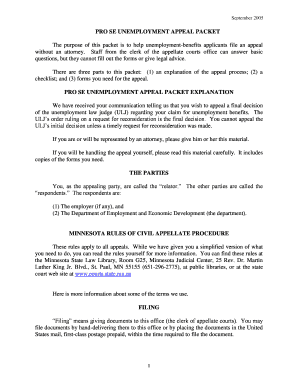
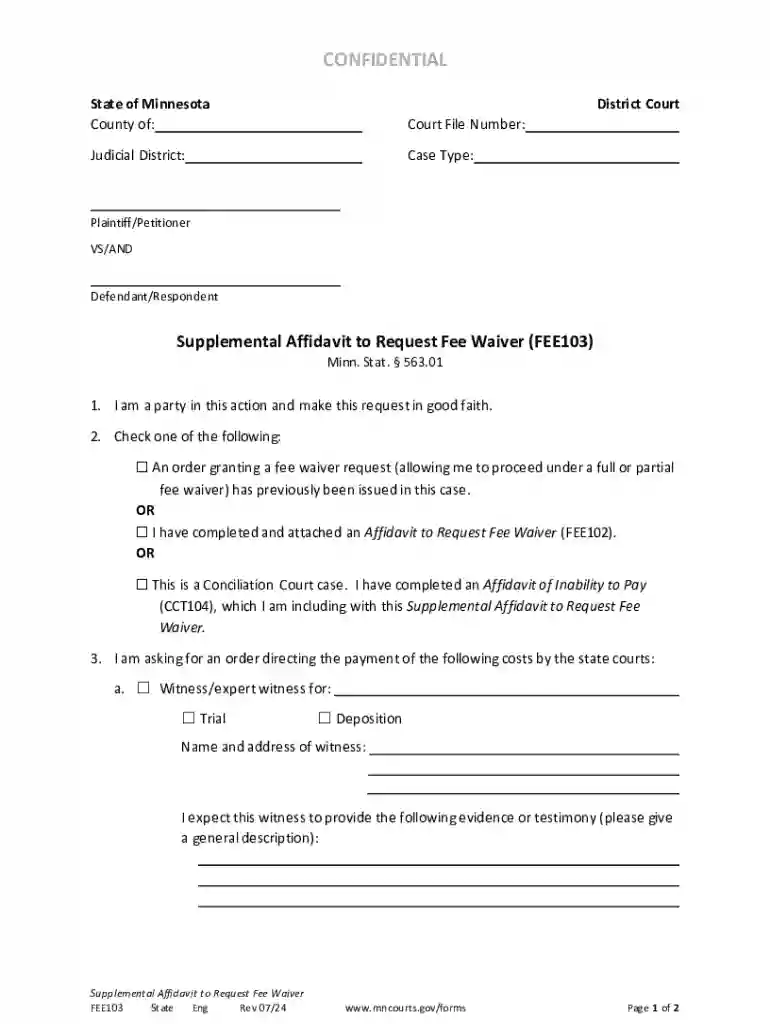
The Supplemental Affidavit to Request Fee Waiver (FEE103) is a legal document used in Minnesota court cases. This form enables individuals involved in legal actions to request a waiver of court fees due to financial hardship. The form requires the requester to detail their financial status and outline the necessary costs associated, such as witness fees, transcript expenses, and other court-related costs. By filing this affidavit, individuals demonstrate their inability to pay standard court fees, which can be crucial in ensuring access to justice regardless of financial constraints.
Financial Declaration:
Estimated Costs:
Supporting Documents:
To use the Supplemental Affidavit to Request Fee Waiver (FEE103), follow these general steps:
Complete the Form:
Gather Supporting Documents:
Review and Sign:
Download the Form:
Provide Personal Information:
Detail Financial Information:
Estimate Court Costs:
Attach Evidence:
Submit the Affidavit:
The Supplemental Affidavit to Request Fee Waiver (FEE103) serves a vital role in ensuring access to legal proceedings for individuals unable to afford the associated fees. It is primarily for:
Individuals with Limited Income:
Specific Case Types:
Eligibility typically hinges on the individual's current financial standing and the legal nature of the case.


Minnesota Regulations:
Filing Deadlines:
Online:
Mail:
In-Person:
Consider Jane Doe, involved in a child custody dispute in Minnesota. With a low income and significant childcare expenses, she files the FEE103 to request a waiver of the fees for filing legal documents and obtaining necessary transcripts. By providing detailed financial information and supporting documents, her request is granted, allowing her to continue participating in her legal case without financial burden. Another scenario is John Smith, faced with eviction proceedings; filing the FEE103 helps him waive service fees, enabling him to respond and defend his case adequately.
We've got more versions of the Supplemental Affidavit to Request Fee Waiver (fee103) form. Select the right Supplemental Affidavit to Request Fee Waiver (fee103) version from the list and start editing it straight away!
At DocHub, your data security is our priority. We follow HIPAA, SOC2, GDPR, and other standards, so you can work on your documents with confidence.