






Definition & Meaning
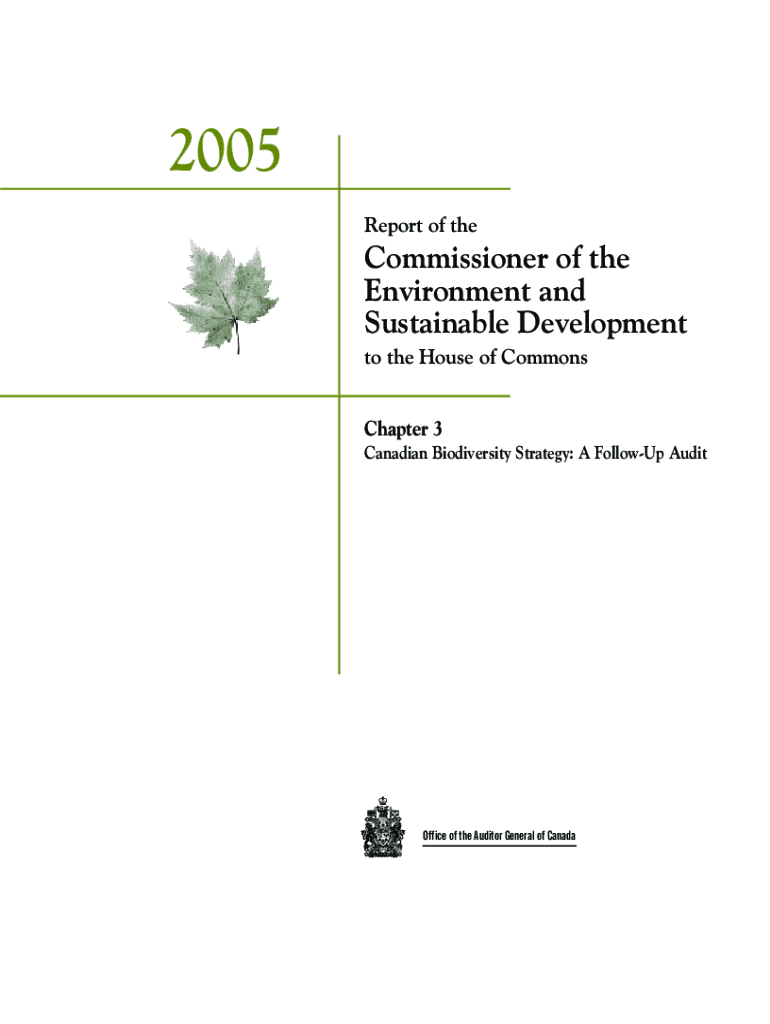
The "Report of the Commissioner of the Environment and Sustainable Development," often referred to as the Environment Commissioner's report, is a crucial document that evaluates Canada's environmental policies and their effectiveness. It primarily focuses on assessing governmental efforts in environmental conservation and sustainable development, offering an in-depth analysis of progress and areas needing improvement.
Purpose of the Report
- Assessment of Strategies: The report evaluates the implementation of environmental strategies, ensuring that governmental bodies adhere to sustainability goals.
- Policy Recommendations: It provides actionable recommendations to address policy gaps and promote environmental stewardship.
- Public Accountability: Acts as a transparency tool, holding the government accountable for its environmental commitments.
Historical Context
The existence of such reports dates back decades, providing a historical perspective on Canada's ecological initiatives. It often revisits previous audits to measure ongoing progress or address recurrent issues.
How to Use the Report
For Policymakers
- Data-Driven Decisions: Utilize findings to draft or revise environmental policies.
- Monitoring Progress: Track and compare strategy implementation over time.
For Educational Purposes
- Research Material: Serve as a credible source for academic research related to environmental policies.
- Case Studies: Offer tangible examples of environmental management and policy enforcement.
For Environmental Advocates
- Advocacy Tools: Use insights to lobby for stronger policies.
- Awareness Initiatives: Share findings to raise public consciousness about environmental issues.
Steps to Obtain the Report
- Visit Official Government Websites: Access the report via government portals focused on environmental policies.
- Library Access: Utilize public or university libraries, many of which hold archives of these reports.
- Freedom of Information Request: As a last resort, file a Freedom of Information request if reports are not publicly accessible.
Online Accessibility
- Digital Archives: Many older reports have been digitized for convenient online access.
- Direct Downloads: Select reports are available in PDF format for direct download.
Key Elements of the Report
Critical Components
- Executive Summary: Offers a brief overview of findings and key recommendations.
- Sector-Specific Analysis: Breakdown of initiatives across various environmental sectors, such as biodiversity and resource management.
- Progress Metrics: Quantitative and qualitative evaluations of policy implementations.
Stakeholder Feedback
- Public Consultation: Reports often incorporate feedback from public consultations or expert panels.
- Interdepartmental Collaboration: Highlights cooperation or lack thereof among governmental departments.
Who Typically Uses the Report


Government Officials
- Ministers and Cabinet Members: To align departmental policies with environmental objectives.
- Environmental Agencies: For implementation strategies and action plans.
Researchers and Academics
- Research Scholars: To analyze policy effectiveness and propose future strategies.
- Instructors: As teaching material for courses on environmental science and policy.
Non-Governmental Organizations (NGOs)
- Program Development: To guide the creation of community programs addressing environmental concerns.
- Funding Proposals: Use data to support applications for grants and funding.
Legal Use of the Report
Compliance and Regulations
- Legal Frameworks: Ensure environmental laws are in alignment with recommended strategies.
- Monitor Compliance: Track adherence to national and international environmental commitments.
Evidentiary Uses
- Court Cases: Serve as evidence in litigation concerning environmental damage or policy failure.
- Regulatory Audits: Aid in regulatory assessments and compliance checks.
Important Terms Related to the Report
Environmental Audits
- Definition: Independent evaluations of environmental strategies, focusing on efficiency and effectiveness.
- Types: Performance audit, compliance audit, and management audit.
Sustainable Development
- Concept: Balancing resource consumption with ecological preservation to meet present and future needs.
- Implementation: Integrating economic, social, and environmental goals.
Biodiversity Conservation
- Objectives: Preserve biological diversity through habitat protection and species management.
- Challenges: Address threats like habitat loss and climate change.
Examples of Using the Report
Case Studies
- Biodiversity Strategy Implementation: Details have been used in revising Canada's approach to biodiversity conservation.
- Policy Revisions: Areas identified in the report as weak influenced substantial policy changes and new legislation.
Success Stories
- Program Effectiveness: Demonstrated successes in certain government programs leading to enhanced funding and resources.
- Public Awareness Campaigns: The data has been utilized in campaigns to educate the public on environmental issues.
State-Specific Rules for the Report
While the report is national in scope, its recommendations may influence state-level policies within Canada. Each province can adapt strategies to regional contexts, resulting in differing implementations.
Provincial Integration
- Customized Initiatives: Provinces might tailor federal suggestions to fit local environmental needs.
- Benchmark Comparisons: States use the report's data to benchmark their performance against national standards.
By following these structured sections and providing comprehensive information about the "Report of the Commissioner of the Environment and Sustainable Development," readers can gain an understanding of its historical context, practical applications, and relevance across different sectors.