CoursesINDA, Association of the Nonwoven Fabrics Industry 2026

Get Form
CoursesINDA, Association of the Nonwoven Fabrics Industry Preview on Page 1

Here's how it works

01. Edit your form online
Type text, add images, blackout confidential details, add comments, highlights and more.

02. Sign it in a few clicks
Draw your signature, type it, upload its image, or use your mobile device as a signature pad.

03. Share your form with others
Send it via email, link, or fax. You can also download it, export it or print it out.

Definition & Importance of CoursesINDA, Association of the Nonwoven Fabrics Industry

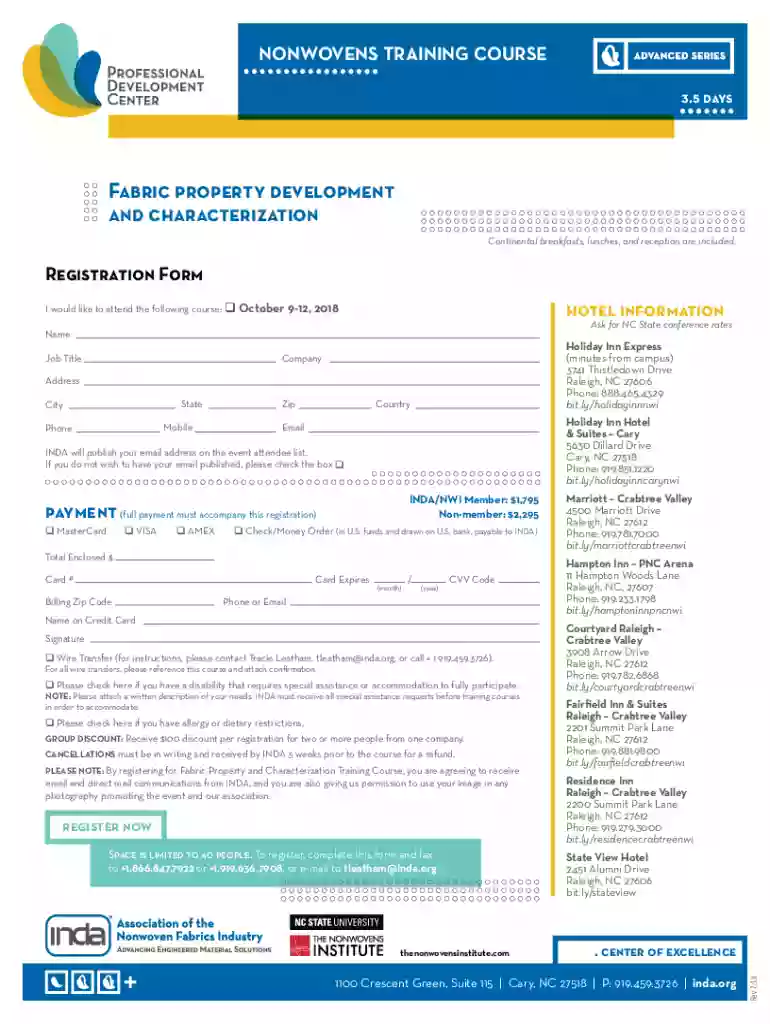
The CoursesINDA, Association of the Nonwoven Fabrics Industry is a specially designed program aimed at enhancing the knowledge and skills of professionals working with nonwoven fabrics. The curriculum focuses on fabric property development and characterization, providing vital education for those in industries ranging from textiles to medical products. Participants gain insights into the latest developments and techniques used in the production and analysis of nonwoven materials. This course serves as a cornerstone for those looking to advance in the field and ensures that attendees are well-versed in cutting-edge industry practices.

Key Elements Covered in the Course

The course covers the following critical components:

  • Fabric property development: Techniques to understand and manipulate the properties of nonwoven materials.
  • Characterization methods: Tools and methods used to analyze fabrics for quality assurance.
  • Industry standards: Familiarization with international standards pertinent to nonwoven fabrics.
  • Innovative technologies: Exploration of cutting-edge technologies currently shaping the nonwoven fabrics market.

Steps to Complete the CoursesINDA, Association of the Nonwoven Fabrics Industry

To successfully complete the course, participants need to follow several critical steps:

  1. Registration: Interested individuals must register for the course by providing necessary personal and professional details.
  2. Payment: Course fees vary for INDA members and non-members. Payment must be settled prior to course commencement.
  3. Attendance: Full attendance over the 3.5-day period is mandatory to glean all the educational benefits offered.
  4. Participation in Activities: Engaging in group discussions and hands-on sessions is required to grasp practical insights.
  5. Assessment: Completion of any course assessments or case studies is required for certification.

Application Process Specifics

  • Sign-Up Timeline: Registration typically opens months in advance of the start date, ensuring ample preparation time for attendees.
  • Discounts & Offers: Discounts are available for multiple registrations from a single company, promoting team-based learning.

Eligibility Criteria for Participation

The course is specifically structured for professionals within the nonwoven fabrics space. Typical participants include:


  • Industry Professionals: Individuals actively working with nonwoven materials.
  • Quality Assurance Specialists: Those involved in fabric testing and standards compliance.
  • Research and Development Teams: Innovators looking to explore new applications of nonwoven technologies.
decoration image ratings of Dochub

Additional Criteria

  • INDA Membership: Being a member of the Association of the Nonwoven Fabrics Industry offers discounted course rates.

Practical Use Cases and Scenarios

Real-world applications of the knowledge gained from the course demonstrate its practical utility. Some examples include:

  • Medical Fabrics: Optimizing nonwoven fabric characteristics for surgical masks and gowns.
  • Automotive Industry: Applying novel designs in automotive interiors to improve comfort and durability.
  • Consumer Products: Enhancing diaper absorption properties through better material characterization.

Important Terms Related to CoursesINDA, Association of the Nonwoven Fabrics Industry

Understanding common terminologies encountered during the course can enhance learning:

  • Nonwoven Fabrics: Textiles bonded together by chemical, mechanical, heat, or solvent processes.
  • Fabric Characterization: Analyzing material properties to evaluate quality and suitability for specific uses.
  • Property Development: Efforts to enhance the performance of fabrics through material and process adjustments.

Legal Use and Professional Benefits

Engagement in the CoursesINDA does not only enhance professional competence but also provides a competitive edge in the legal and commercial aspects of the nonwoven fabric industry. Professionals adept in characterization and development stand out in roles where precision and innovation are paramount.

Certification and Recognition

Upon successful completion, participants receive certification confirming their expertise. This credential can lead to new career opportunities and advancements.

Digital Integration & Software Compatibility

For those managing their workflow through digital channels and software, understanding software compatibility is crucial. Integration with platforms such as DocHub can facilitate:

  • Document Handling: Use DocHub for handling course materials and assignments online efficiently.
  • Collaboration: Leverage cloud-based tools for team projects during the course.

Filing Deadlines and Important Dates

For the October 9-12, 2018 session, the following deadlines were emphasized:

  • Early Registration: Typically closes months prior to facilitate materials preparation and participant allocation.
  • Payment Finalization: Required before the course date to confirm the seat.

This deadline management ensures all logistics are effectively organized, allowing participants to focus fully on learning and development during the course period.

be ready to get more

Complete this form in 5 minutes or less

Get form

Got questions?

We have answers to the most popular questions from our customers. If you can't find an answer to your question, please contact us.
Contact us
The global nonwoven fabrics market size was valued at $58.4 billion in 2023, and is projected to docHub $104.1 billion by 2033, growing at a CAGR of 6% from 2024 to 2033. Nonwoven fabric refers to cohesive fabric-like textile manufactured by arranging fibers together using heat, chemicals, or pressure.
The three types of fabric classes We can sort clothing fabrics into three broad classes. Of these, woven and knitted fabrics are the main contenders, made directly from yarns. However, occasionally, we see nonwoven fabrics.
The advantages of using nonwovens in medical and healthcare procedure-specific design. optimum wearer comfort. strong yet light in weight. optimal fluid absorbency. exchange of air, body heat and moisture.
The three main types of non woven fabric are spunbond, meltblown, and thermal bonded. Each type has its unique properties and uses. Spunbond non-woven fabrics are made from Polypropylene (PP) and are used in a wide range of applications, including medical disposables, filters, and more.
The warp and weft can be woven together in different variations of the three basic weaves; plain, twill and satin. These varieties can be shaped into dresses, tops, coats, etc.

Security and compliance

At DocHub, your data security is our priority. We follow HIPAA, SOC2, GDPR, and other standards, so you can work on your documents with confidence.

Learn more
ccpa2
pci-dss
gdpr-compliance
hipaa
soc-compliance

People also ask

Nonwoven fabric or non-woven fabric is a fabric-like material made from staple fibre (short) and long fibres (continuous long), bonded together by chemical, mechanical, heat or solvent treatment. The term is used in the textile manufacturing industry to denote fabrics, such as felt, which are neither woven nor knitted.
Disadvantages: 1) Compared with woven cloth, the strength and durability are poor. 2) It cannot be washed like other fabrics. 3) The fibers are arranged in a certain direction, so it is easy to split from the right angle and so on.