






Definition & Meaning
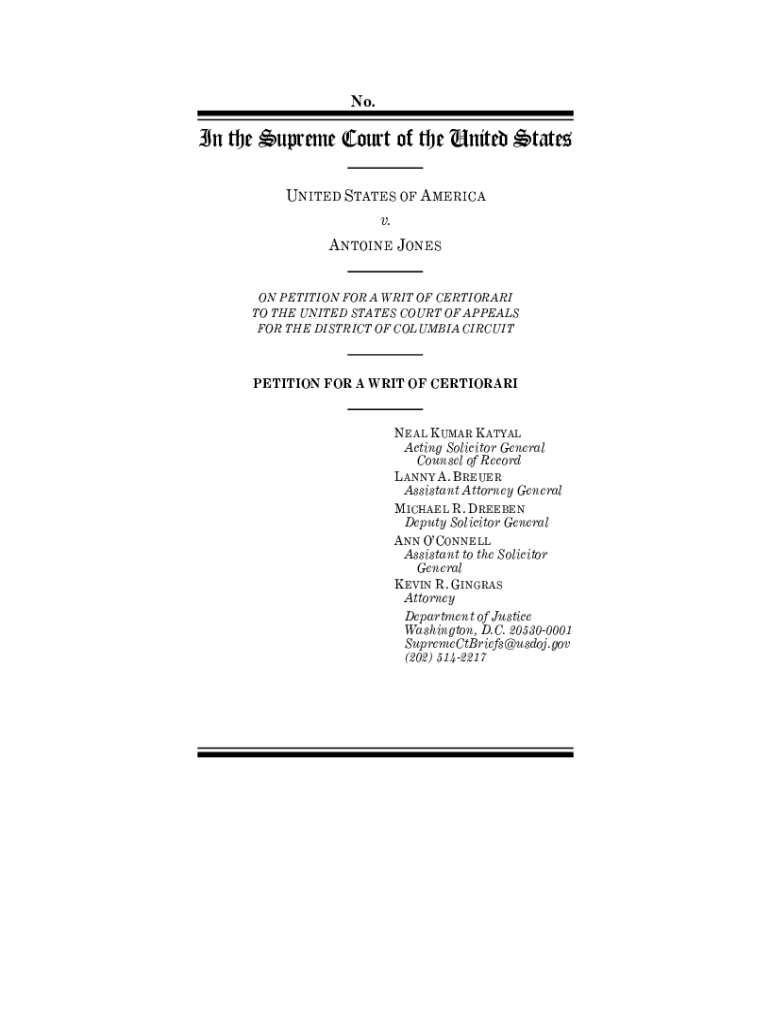
The case of United States v. Jones involves the legal question of whether the warrantless use of a GPS tracking device on a suspect's vehicle violates the Fourth Amendment, which protects against unreasonable searches and seizures. The Supreme Court is tasked with reviewing this case due to conflicting decisions in lower circuit courts. The central issue is the balance between individual privacy rights and law enforcement practices in tracking movements on public roads.
Core Issues
- Fourth Amendment: The protection against unreasonable searches and seizures is at the heart of this case. The Court must determine if attaching a GPS device to a vehicle without a warrant constitutes a search.
- Privacy Expectations: The petition argues whether individuals can expect privacy concerning their public movements.
- Circuit Split: The case arises from a split in decisions among different circuits, necessitating Supreme Court intervention.
How to Use the United States v. Jones Case
Understanding the Supreme Court's decision in United States v. Jones is crucial for legal professionals, law enforcement, and individuals interested in privacy rights. Here’s how different stakeholders might engage with the case:
Legal Professionals
- Case Precedent: Attorneys can use this case to argue similar privacy cases, involving technology and the Fourth Amendment.
- Law Review: It provides insights for scholarly articles focused on privacy rights and technological advances in surveillance.
Law Enforcement
- Operational Guidelines: Law enforcement agencies can refine their practices regarding surveillance techniques that could infringe on constitutional rights.
- Training Material: Develop training programs on surveillance methods that comply with Constitutional safeguards.
Steps to Complete a Legal Analysis of United States v. Jones
- Understand Case Background: Familiarize yourself with the factual and procedural history. This involves examining the original cause that brought the case to the Court.
- Analyze Lower Court Rulings: Explore how the D.C. Circuit and other circuit courts decided on similar issues.
- Review Supreme Court Arguments: Study the petitions and briefs submitted by both parties for key arguments.
- Evaluate the Decision: Examine the Supreme Court's decision and its reasoning.
- Consider Impact and Implications: Look into how the ruling affects future cases and ongoing practices in surveillance.
Detailed Steps
- Initial Case Survey: Research the timeline of Jones's case from arrest through appeals to the Supreme Court.
- Document Examination: Review related documents, including circuit decisions and amicus briefs.
- Oral Arguments: Listen to or read transcripts of oral arguments presented before the Court.
- Ruling Analysis: Break down the majority opinion and dissenting opinions if any.
Key Elements of the United States v. Jones Case
Legal Principles
- Attachment of Devices: The act of physically attaching a GPS device involves physical intrusion, traditionally considered a search.
- Public vs. Private Surveillance: Analyzes the public character of roads versus private autonomy in choices of movement.
Stakeholders
- Defendant's Rights: Focuses on Antoine Jones's arguments regarding privacy expectations on public roads.
- Government Interests: Discusses the government's angle on crime prevention through technology.
Why the United States v. Jones Case Matters
Privacy Engaged
This case is fundamentally about the boundaries of individual privacy in an age of advancing surveillance technology. It defines the balance between privacy rights and government surveillance capabilities.
Legal Precedents
United States v. Jones sets a precedent influencing future judicial decisions on similar technological privacy concerns, impacting cases involving phone tracking, data privacy, and more.
Important Terms Related to United States v. Jones
Glossary of Terms
- GPS Tracking: A method of using satellites to determine the location of a particular GPS receiver.
- Warrantless Search: A search conducted by law enforcement without a court-issued warrant.
- Fourth Amendment: Part of the U.S. Constitution that protects against unjustified searches and seizures.
Examples of Using United States v. Jones in Legal Context
- Training Materials: Law enforcement academies can use this case to develop training on legal search limits.
- Corporate Privacy Policies: Tech firms may refer to this ruling when drafting privacy protocols for consumer data.
Legal Use of the Case
The judgment serves as a cornerstone in various legal scenarios, advising law practices and organizations on surveillance legality. Legal advocacy and consumer rights groups also draw upon this case to bolster arguments for enhanced privacy protections and revisiting outdated statutes in consideration of technological advancements.
Application in Court
- Legal Precedent: Often cited in privacy-related cases as guidance for courts when making determinations on the expectations of privacy and the use of technology in surveillance.
Understanding the depth, debates, and decisions in the United States v. Jones highlights the intricacies of modern law and the age-old protection of privacy against the exigencies of law enforcement and surveillance.